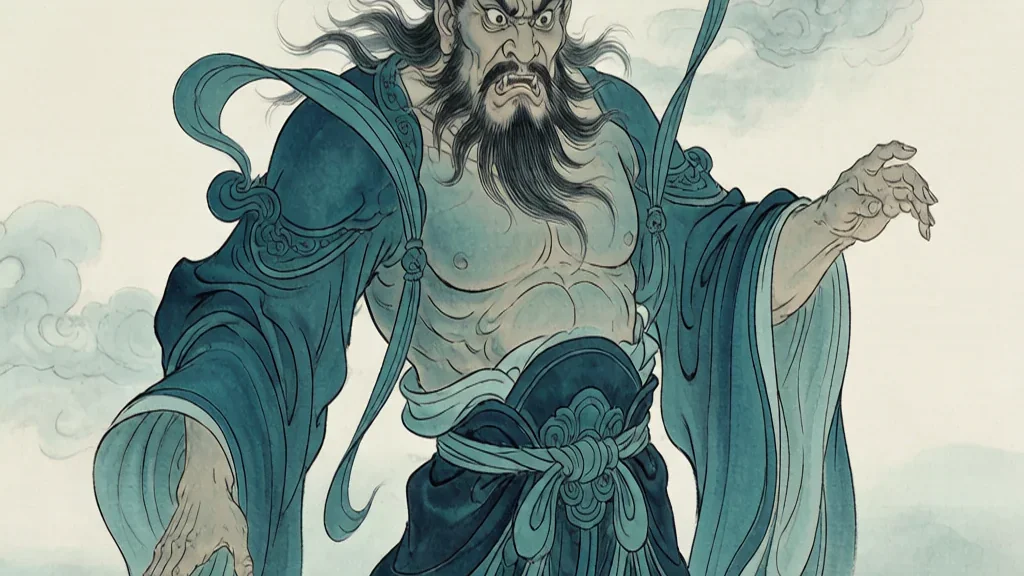
Gonggong (共工) is the Chinese god of water, floods, and the restless power of the deep, best remembered for his catastrophic clash with Zhurong, the god of fire. In myth he is a turbulent, proud deity whose defeat turned to cosmic vandalism: in a fit of rage he butted his head against Mount Buzhou, one of the pillars holding up the sky, and toppled it. That act tilted the heavens and bent the rivers eastward, explaining features of the Chinese landscape. Gonggong thus embodies both the necessity and the danger of water—the force that nourishes yet can drown the world.
Identity as the Water God
Gonggong is consistently cast as the lord of water and floods, a counterpart to the fire god Zhurong. In the five-phase scheme his element is water, associated with the north, the color black, and the winter season.
He is sometimes described as having a human face and a serpent or dragon body, marking him as a creature of rivers and seas. His monstrous form signals the untamed, chthonic side of water.
Unlike orderly rain gods who nourish crops, Gonggong represents water's capacity for chaos—the flood that ignores human boundaries and must be contained by heroes like Yu the Great.
The War with Zhurong
The central episode of Gonggong's myth is his war against Zhurong. The two elemental powers—water and fire—contended for supremacy, and Gonggong was defeated in the struggle.
This conflict dramatizes the elemental contest at the heart of Chinese cosmology, where phases overcome and generate one another. Water's loss to fire is a momentary imbalance later corrected by the natural cycle.
The defeat is crucial because it triggers Gonggong's desperate act against the cosmic pillar, linking his personal humiliation to a worldwide change in geography.
Toppling Mount Buzhou
After losing to Zhurong, the enraged Gonggong smashed his head into Mount Buzhou, a northwestern pillar that propped up the sky. The pillar broke, and the northwestern heavens collapsed while the earth's southeast sank.
As a result, the sky tilted toward the northwest and the earth dipped to the southeast; the rivers of China, obeying this new slope, have flowed eastward to the sea ever since. The myth thus explains the nation's river system.
This act of cosmic damage also set the stage for Nüwa's repair of the sky with melted five-colored stones, making Gonggong the unwitting cause of one of mythology's great restoration tales.
Connection to Flood Myths
Gonggong's association with devastating water ties him to the broader Chinese flood tradition centered on the hero Yu, who tamed the deluge by dredging channels rather than blocking it. The two figures—one causing, one curing—form a single narrative arc.
In some versions Gonggong's descendant or follower, Xiang Yao, is named as the source of a great flood that Yu must control, weaving the water god's lineage into the civilizing conquest of chaos.
These stories reflect a real cultural memory of living with the Yellow River's unpredictable floods, projecting the recurring disaster onto a willful divine antagonist.
Elemental Role in the Cosmos
As the water phase, Gonggong belongs to the cycling system of five elements, where water conquers fire's producer (metal) and is itself conquered by earth. His defeat by fire is therefore one turn of a perpetual wheel.
His northern, black, wintry domain complements Zhurong's southern, red, summer one, together covering opposite poles of the year and the compass. The pairing keeps the cosmos dynamically balanced.
Although a "villain" in his famous tale, Gonggong is necessary: without water's challenge, there would be no occasion for the heroism of Yu or the inventiveness of dike and canal.
Gonggong in Later Tradition
Across later folklore Gonggong sometimes appears as a demonic or rebellious figure punished by the heavens, and his name became a byword for obstinate, destructive pride. Yet he also retained a worshipful aspect as a river spirit.
Local cults along rivers and lakes offered him appeasement so that his waters would stay within their banks, a pragmatic devotion born of fear rather than affection.
In scholarly retellings he is understood as a personification of flood forces, useful for teaching why water management has always been central to Chinese statecraft and survival.
Cultural Echoes
The image of a single defiant act reshaping the world—Gonggong's headbutt—has proved durable in Chinese literature as a metaphor for the consequences of unchecked wrath and for humanity's exposure to natural catastrophe.
Modern adaptations in fiction and games often recast him as a tragic, misunderstood titan, emphasizing the sympathy owed to a power that is destructive only because it is unconstrained.
Whether villain or victim, Gonggong remains the mythic face of water's double nature: the same element that gives life can, when it overflows its limits, remake the earth.
Gonggong and the Art of Flood Control
Gonggong's destructive floods set the stage for China's enduring mastery of water engineering. The hero Yu the Great, called to tame the deluge, learned to dredge channels and guide the water seaward rather than dam it, a principle later celebrated as the foundation of successful and humane rule.
Canals, levees, and the great water-control works of successive dynasties can all be read as humanity's answer to the chaos Gonggong represents. To control water was, in this worldview, to complete the civilizing task the gods began, turning a lethal force into the servant of farms and cities.
Thus the water god is not merely a villain but the necessary opponent against whom Chinese statecraft defined itself; the constant threat of flood kept hydraulic management at the center of government and made engineers among the most honored of officials. Even today, the memory of catastrophic water shapes attitudes toward the great rivers, and rituals of thanksgiving after a safe flood season echo the ancient appeasement of Gonggong's restless power.
❓ Frequently Asked Questions
Who is Gonggong?
Gonggong is the Chinese water god associated with floods, the north, and the color black, best known for his war with the fire god Zhurong and the cosmic damage he caused in defeat.
What happened when Gonggong hit Mount Buzhou?
He broke the northwestern pillar holding up the sky, causing the heavens to tilt northwest and the land to sink southeast, which made China's rivers flow east to the sea.
Why did Gonggong fight Zhurong?
The two represented contending elemental powers—water and fire—struggling for dominance, a mythic expression of the five-phase interplay of nature.
How is Gonggong connected to Nüwa?
His destruction of the sky's pillar forced Nüwa to repair the heavens with melted five-colored stones, making him the indirect cause of her famous act.
Is Gonggong purely evil?
No; he personifies water's necessary yet dangerous power. While his wrath caused catastrophe, water itself is essential, and his role balances the cosmic cycle.
What does Gonggong symbolize?
He symbolizes the unbounded force of flood and the peril of unchecked anger, as well as the recurring reality of water management in Chinese civilization.