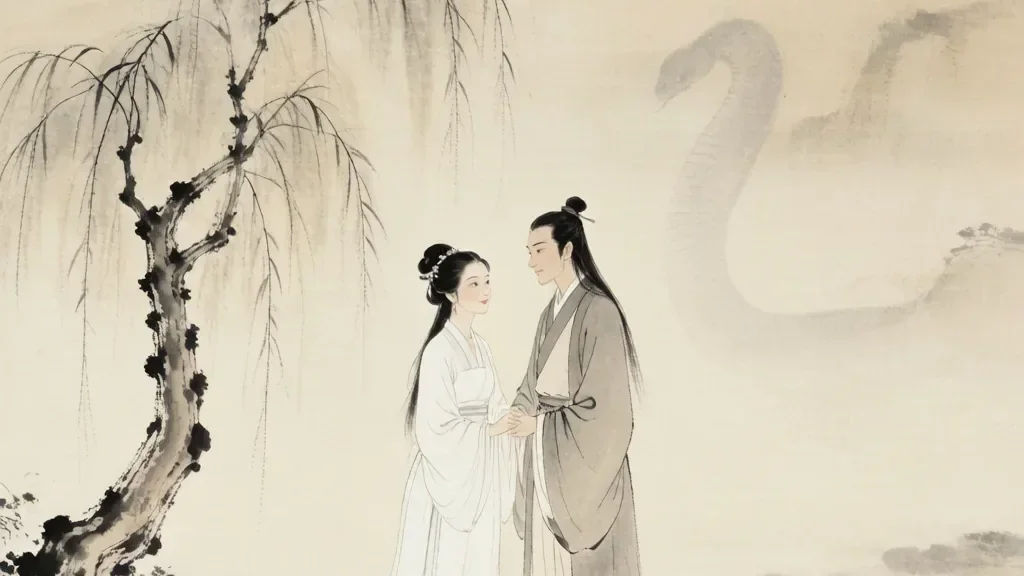
The Legend of the White Snake, known in Chinese as 白蛇传 (bái shé zhuàn), is among the most beloved romantic tales in Chinese folklore and one of the four great folktales of the tradition. It tells the story of Lady White, a thousand-year-old white snake spirit who takes human form, falls in love with a mortal pharmacist named Xu Xian, and marries him, only to be opposed by the monk Fahai, who imprisons her beneath the Leifeng Pagoda. Blending themes of love, transformation, devotion, and the tension between the human and spirit worlds, the legend has been retold for centuries in oral storytelling, opera, fiction, film, and television, and remains a living part of Chinese cultural imagination.
Origins in the Tang and Song Dynasties
The earliest roots of the White Snake story appear in the supernatural anecdotes of the Tang dynasty, when short tales of snake spirits and shape-shifting women circulated among literate audiences who enjoyed stories of the strange and uncanny. These early versions were far darker than the romance known today, often warning of the danger posed by animal spirits who preyed upon men. A snake woman might appear beautiful but ultimately bring ruin, reflecting a long-standing anxiety in Chinese folklore about the boundary between the familiar and the monstrous.
During the Song dynasty the narrative began to soften and took on the shape of a love story rather than a cautionary horror. The setting shifted toward the city of Hangzhou and its celebrated West Lake, a landscape that would become inseparable from the legend. By the time of the Ming and Qing dynasties, the tale had been expanded into a full romantic tragedy in which the snake spirit is sympathetic, loyal, and unjustly punished, a transformation that reflects changing tastes and a growing sympathy for the outsider figure.
The Scholar Xu Xian and the Pharmacy
At the center of the human world stands Xu Xian, a young man who runs a small medicine shop and who is gentle, kind, and somewhat naive. In most versions he first meets Lady White on the Broken Bridge over the West Lake during the Qingming Festival, when the spring rain has drawn crowds to the water. She appears as a beautiful and refined woman accompanied by her maid, and Xu Xian is charmed by her grace and warmth.
The two are brought together through a borrowed umbrella, a detail that became one of the most famous motifs of the story, symbolizing the beginning of intimacy and the sheltering of one stranger by another. After their marriage, Xu Xian and Lady White open a pharmacy together, where her deep knowledge of herbs and compassion for the poor earn the couple respect in their neighborhood. This domestic happiness is what makes the later intervention of Fahai so disruptive, because it threatens a genuinely loving household rather than a deceptive one.
Lady White and the Transformation
Lady White, whose given name is usually given as Bai Suzhen, is no ordinary woman but a white snake who has cultivated spiritual power for a thousand years and learned to assume human shape. Unlike the malicious snake spirits of older tales, she longs for ordinary human love and a family, and she approaches her marriage with sincerity rather than predation. Her character embodies the longing of the outsider to be accepted as fully human.
The tension of her condition emerges most sharply at the Duanwu Festival, when people traditionally drink realgar wine to ward off poisons and pests. Realgar is believed to reveal the true form of spirits, and when Lady White is persuaded to drink the wine she collapses and reverts to her serpent shape, terrifying the fragile Xu Xian and setting in motion the tragedy. This moment captures the central conflict of the legend, the impossibility of fully concealing a non-human nature in a human world that demands disclosure.
Xiao Qing the Green Snake
Beside Lady White stands Xiao Qing, the Green Snake, a younger snake spirit who serves as her loyal companion, maidservant, and sister-in-arms. Where Lady White is poised and maternal, Xiao Qing is fiery, impulsive, and quick to anger, and the contrast between the two women gives the story much of its dramatic energy. She is the one who most fiercely resents Fahai and who fights to defend her mistress.
In many retellings Xiao Qing begins as a lesser spirit, sometimes a green snake and sometimes a manifestations of a fish or lizard, who is subdued or befriended by Lady White and swears lifelong loyalty. After the imprisonment of her mistress she does not give up but trains in the mountains for years so that she can return, defeat Fahai, and topple the Leifeng Pagoda to free Lady White. Her persistence makes her a beloved figure of friendship and defiance in her own right.
The Flooding of the Temple and Fahai
The monk Fahai is the antagonist who believes that the union of a spirit and a mortal is an unnatural violation that must be ended. He warns Xu Xian of his wife's true nature and manipulates him into exposing her with realgar wine, then takes the terrified man into the monastery at Jinshan Temple to separate the couple. Fahai represents the rigid authority of religious law and the refusal to accept love that crosses the boundary between worlds.
When Lady White learns what has happened, she goes to the temple to demand her husband's return, and in her desperation she summons the waters of the Yangtze to flood the temple, an act that harms many innocent people and becomes the moral stain on her otherwise sympathetic character. The flood shows the danger of righteous love pushed to destructive extremes, and it provides Fahai with the justification he needs to imprison her. The confrontation at Jinshan Temple is the emotional climax of the legend.
The Leifeng Pagoda Imprisonment
Defeated and weakened, Lady White is sealed beneath the Leifeng Pagoda on the shore of the West Lake, a real structure in Hangzhou whose ruins became forever associated with the tale. The pagoda in the story is both a physical prison and a symbol of the forces that suppress love deemed improper by society and religion. For centuries visitors to Hangzhou would look upon the pagoda and recall the sorrow of Lady White.
The image of the pagoda crushing the snake woman became one of the most enduring icons of Chinese storytelling, and the phrase "the Leifeng Pagoda suppresses Lady White" entered everyday speech as a way of describing an unjust confinement. In earlier, more pessimistic versions of the legend she remains trapped forever, a somber judgment on her transgression, while later and more hopeful versions promise her eventual release through the loyalty of her companions and the growth of her son.
The Son and the Reunion
One of the most humane additions to the later legend is the birth of a son to Lady White and Xu Xian before her imprisonment. The child, named Xu Shilin, is raised by his father and grows up unaware of his mother's fate until he excels in the imperial examinations and learns the truth of her sacrifice. His success as a scholar becomes the means by which her suffering is acknowledged by the world.
In the most popular concluding versions, the grown son visits the Leifeng Pagoda and, through filial devotion and the intervention of sympathetic immortals, secures his mother's release, allowing the family to reunite. This ending reframes the legend as a story about filial piety as much as romantic love, aligning it with core Confucian values while still preserving the romance at its heart. The reunion ending is the one most often staged in opera and adapted on screen.
Symbolism of Love and Transgression
The White Snake legend works on several symbolic levels at once. On the surface it is a love story, but beneath that it is an argument about who counts as fully human and whether love that crosses boundaries of kind, class, or species can be legitimate. Lady White's desire for a mortal marriage reads as a desire for ordinary dignity rather than supernatural power, which makes her sympathetic to audiences across the centuries.
The figure of Fahai has been reinterpreted over time from a righteous monk into a stubborn and even tyrannical enforcer of rules, a shift that mirrors changing attitudes toward authority and individual feeling. The broken bridge, the umbrella, the realgar wine, and the pagoda have each become compact symbols in Chinese visual and literary culture, evoked whenever a writer wishes to summon themes of fragile love, exposure, and separation.
Regional and Operatic Traditions
The legend found its most durable home on the stage, especially in the regional operas of southeast China. The Yue opera version, developed in Zhejiang province near Hangzhou, became particularly famous in the twentieth century and is credited with standardizing the romantic, sympathetic interpretation of Lady White that dominates today. Peking opera and various local traditions also performed their own adaptations, each emphasizing different scenes such as the encounter on the bridge or the flood at Jinshan.
Because the story is built from a small set of vivid set pieces, it adapted well to the conventions of Chinese theater, where stylized movement and music could convey the supernatural without elaborate scenery. Troupes could perform a single famous scene, such as the drinking of the realgar wine, and audiences would recognize the whole arc of the tragedy. This modular quality helped the legend survive and spread across dialect and regional boundaries.
Modern Adaptations in Film and Television
In the twentieth and twenty-first centuries the White Snake story became a favorite subject of cinema, television, animation, and even video games, each generation reshaping it for new audiences. Early film versions in Shanghai and Hong Kong treated it as lavish period spectacle, while later television serials expanded the supporting cast and gave Xiao Qing and Fahai their own backstories and motivations, complicating the simple hero and villain roles of older tellings.
Animation studios produced family-friendly versions that softened the tragedy, and contemporary writers have experimented with reversing perspectives, retelling the events from the viewpoint of Fahai or Xiao Qing, or imagining a world in which the snake spirits live openly. The persistence of these adaptations shows that the core situation, a loving relationship threatened by an unyielding rule, continues to speak to modern concerns about identity, acceptance, and the right to choose one's own bonds.
The Legend in Popular Devotion
Beyond entertainment, the White Snake legend became woven into the local identity of Hangzhou, where the West Lake, the Broken Bridge, and the site of the Leifeng Pagoda are promoted as pilgrimage and tourist destinations tied directly to the story. Visitors are told the tale as they walk the very landscapes where its events are said to have unfolded, and vendors sell umbrellas and souvenirs referencing the characters.
The story also fed a broader folk sympathy for snake spirits as potentially benevolent rather than purely malevolent, contributing to a Chinese supernatural imagination in which animals who cultivate virtue can earn a place among humans. In this way the legend helped soften the older fear of the shapeshifting beast and offered a more generous vision of the spirit world, one in which love and loyalty, not merely species, determine who deserves a happy ending.
❓ Frequently Asked Questions
What is the Legend of the White Snake about?
It is a romantic tragedy in which a thousand-year white snake spirit named Lady White marries a mortal pharmacist, Xu Xian, but is separated from him and imprisoned beneath the Leifeng Pagoda by the monk Fahai, who opposes their union.
Who is Xiao Qing?
Xiao Qing is the Green Snake, a younger snake spirit who serves as Lady White's loyal companion and maid, and who later fights to free her mistress from the pagoda.
Why does Fahai imprison Lady White?
Fahai believes a marriage between a spirit and a mortal is unnatural and must be ended, so he exposes her true form and seals her beneath the pagoda to break the bond.
What is the meaning of the realgar wine?
Realgar wine is traditionally drunk at the Duanwu Festival to repel pests, but in the legend it reveals a spirit's true shape, forcing Lady White to revert to a serpent and terrifying Xu Xian.
Does the story have a happy ending?
Later versions give a hopeful ending in which the son born to the couple, Xu Shilin, grows up and secures his mother's release, allowing the family to reunite.
Where is the legend set?
The story is set around the West Lake in Hangzhou, especially the Broken Bridge and the Leifeng Pagoda, which remain tourist sites associated with the tale.