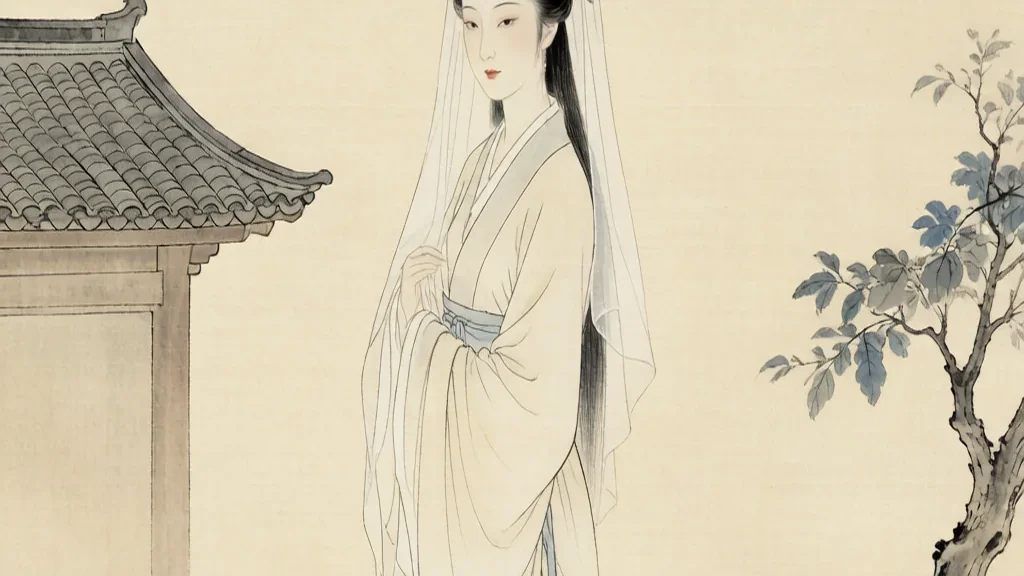
Nie Xiaoqian is one of the most famous ghost heroines of Chinese literature, a young woman murdered and enslaved by a tree demon in the Qing dynasty collection Liaozhai Zhiyi, or Strange Tales from a Chinese Studio, by Pu Songling. Forced by the demon to lure travelling men to their deaths so that it may feed on their vital energy, she meets the upright scholar Ning Caichen, falls in love, warns him of the trap, and is rescued through the help of the Taoist Yan Chixia, eventually winning the chance of a human life and marriage. Her story, later immortalised in film as A Chinese Ghost Story, is a tender tale of captivity and liberation in which the ghost proves more humane than the living, and love becomes the means of escaping the grasp of the demon. In the gallery of Chinese spectres she is the one who refuses her assigned wickedness and chooses the scholar over the grave.
Source in Liaozhai Zhiyi
Nie Xiaoqian first appears as a character in Liaozhai Zhiyi, the vast compilation of supernatural tales written by Pu Songling during the Qing dynasty, a book that gathered ghost, fox, and demon stories into a literati framework of irony and tenderness. The collection treated the fantastic as a lens on human feeling rather than mere horror, and Nie Xiaoqian is among its most beloved creations.
The tale belongs to a large family of Chinese ghost stories in which the dead interact with the living, sometimes to harm and sometimes to help. What sets Nie Xiaoqian apart is her moral agency: she is not a free ghost but a coerced one, and her struggle against her handler gives the story its spine.
Because Liaozhai was read by the educated class, Nie Xiaoqian entered the literary canon as well as the popular one. Scholars quoted her tale for its sentiment, while storytellers and players carried it into the mouths of the common people, so that her name became shorthand for the loyal ghost bride.
The Tree Demon's Captive
In the tale Nie Xiaoqian is dead, her remains buried near an old temple, and her spirit is held in thrall by a powerful demon, often described as an ancient tree spirit or a skeletal old monster, who uses beautiful female ghosts as bait. The demon compels her to enchant travelling scholars and steal the vital essence on which it feeds, a parasitic arrangement in which the ghost is both weapon and victim.
The coercion is the emotional core of her character. She is not wicked by nature but made to act wickedly, and her compliance is born of fear for her own continued existence in the afterlife. The demon threatens to punish or destroy those ghosts who refuse, so resistance carries a cost she can barely imagine paying.
This situation turns the usual ghost story inside out. The spectre is not the danger; the demon behind her is, and the ghost is the one in need of rescue. The reader's sympathy is recruited from the first, because Nie Xiaoqian is clearly a prisoner in her own death.
Ning Caichen the Scholar
The hero of the tale is Ning Caichen, a young scholar travelling to sit an examination or to conduct family business, who lodges near the haunted temple and behaves with unusual rectitude. Unlike the other men lured to their deaths, Ning resists the ghost's seduction, not from coldness but from a principled chastity and a devotion to his family.
His virtue is the hinge of the plot. Because he will not be tempted, Nie Xiaoqian is forced to deal with him honestly, and in their honest exchange a different feeling arises, one not manufactured by the demon. The scholar's steadiness becomes the ground on which the ghost can stand as a person rather than a tool.
Ning Caichen thus embodies the Confucian ideal of the self possessed gentleman, the man whose discipline protects him and, indirectly, saves another. His restraint is not prudery but generosity, since it creates the space in which Nie Xiaoqian can choose to be good.
The Temptation and the Warning
The famous scene of the tale has Nie Xiaoqian visiting Ning by night in the guise of a seductress, offering him a token meant to steal his life. When he refuses, she drops the pretence and confesses the demon's scheme, warning him plainly of the danger and telling him how to protect himself. The temptation becomes a confession, and the confession becomes a bond.
This reversal is the heart of her appeal. The ghost who comes to kill instead comes to warn, and in warning reveals a conscience the demon could not extinguish. Her choice to betray her master for a stranger marks the moment her personhood reasserts itself against possession.
The intimacy that follows is built on truth rather than desire. Ning and Xiaoqian are joined first by candour, and only later by love, a sequence that the tale presents as the proper order of things: trust before passion, character before courtship.
Yan Chixia the Taoist
The rescue is accomplished with the help of Yan Chixia, a Taoist adept sharing the scholar's lodging, who perceives the demonic presence and arms Ning with the means to survive and to free the ghost. Yan is the professional power in the story, the trained exorcist whose skill complements the scholar's virtue.
Yan Chixia represents the active spiritual authority that the genteel Ning lacks. Where the scholar wins the ghost by character, the Taoist defeats the demon by art, and the two modes together are needed. The tale thus honours both moral and magical means of confronting evil.
The figure of Yan Chixia became popular in his own right, spun off into further adventures in opera and film, a swashbuckling demon queller whose friendship with the scholar and the ghost forms a small fellowship of the rescued and the rescuer across the boundary of the living and the dead.
Escape and Rebirth
With the Taoist's help, Ning thwarts the demon and liberates Nie Xiaoqian from its control. In many versions he removes her remains to a proper grave beside his own family's land, an act of ritual care that gives the restless ghost a settled rest and a claim on the human world. The relocation of her bones is the concrete step that makes her rebirth possible.
The theme of reburial is deeply Chinese, resting on the conviction that the dead must be honoured with correct placement or their spirits will wander. Ning's piety toward a ghost not his kin is the measure of his goodness, and it is what finally breaks the demon's hold.
Once freed, Nie Xiaoqian is no longer a tool of predation but a protected spirit with a future. The escape is total: from demon to lover, from bait to bride, from the roadside grave to the ancestral soil, a movement the tale presents as a kind of resurrection.
Marriage and Household Life
The later portion of the legend follows Nie Xiaoqian into Ning's household as a wife or concubine, where she proves an ideal partner: devoted, capable, and strangely wise from her experience of death. Far from the morbid bride of horror, she becomes the competent manager of a happy home, a ghost who outdoes the living at domestic virtue.
These domestic scenes deepen the fantasy. The woman who was forced to destroy men now builds a life with one, and her otherworldly knowledge makes her a better wife than any ordinary candidate. The tale rewards the scholar's virtue with a union that is both romantic and practical.
The household resolution also satisfies the Confucian frame, for the ghost is finally incorporated into the family and the lineage, her strange origin dissolved into the ordinary blessings of marriage and progeny. The fantastic is domesticated, and the demon's victim becomes the ancestor's comfort.
Nie Xiaoqian on Stage and Screen
The story's enduring fame owes much to its many adaptations. Traditional opera staged the ghost bride for centuries, and the twentieth century transformed her into a cinema icon, most famously in the film known in English as A Chinese Ghost Story, which fused the old tale with romantic fantasy and acrobatic spectacle.
Each era reshaped Nie Xiaoqian to its taste: the Qing reader met a sentimental heroine, the opera audience a singing phantom, the filmgoer a luminous lover caught between worlds. Yet the constant was her moral courage, the refusal to remain the demon's instrument, which survived every translation.
The character's portability testifies to a durable wish in Chinese culture: that even the dead, even the coerced, may choose goodness and be rewarded with love. Nie Xiaoqian is the face of that wish, reprised whenever a new medium needs a ghost worth saving.
Symbolism of the Captive Ghost
At its deepest, the tale of Nie Xiaoqian is an allegory of coercion and conscience. The demon stands for any power that uses people as instruments, and the ghost stands for the spark that refuses, at cost, to be wholly used. Her liberation is the liberation of the self from the roles imposed on it.
The story also quietly exalts the powerless. A young dead woman, with no status and no strength, defeats a mighty demon simply by telling the truth to a good man. The victory belongs to honesty and love, not to force, and the demon is undone by the one weapon it cannot counter.
In the end Nie Xiaoqian remains the Chinese ghost who chose humanity over the grave, the captive who warned her prey and won a life. Her legend assures every reader that even in bondage the will may turn, and that love, once spoken truly, can carry the dead back into the light.
❓ Frequently Asked Questions
Who is Nie Xiaoqian?
Nie Xiaoqian is a ghost heroine in Pu Songling's Liaozhai Zhiyi, a young woman murdered and enslaved by a tree demon who lures men to feed its vital energy.
How is she freed?
She warns the scholar Ning Caichen of the trap, and the Taoist Yan Chixia helps defeat the demon; Ning then reburies her bones to give her rest.
Who is Ning Caichen?
Ning Caichen is the upright scholar who resists her seduction, earns her trust through virtue, and eventually marries her as a loyal ghost bride.
What role does Yan Chixia play?
Yan Chixia is the Taoist adept who perceives the demonic presence and supplies the spiritual means to survive it and liberate the ghost.
Is the story based on a real text?
Yes, it derives from Liaozhai Zhiyi, the Qing dynasty collection of supernatural tales, and was later adapted into film as A Chinese Ghost Story.
What does Nie Xiaoqian symbolise?
She symbolises the captive conscience that refuses coercion, showing that even the powerless can choose goodness and be redeemed by truthful love.