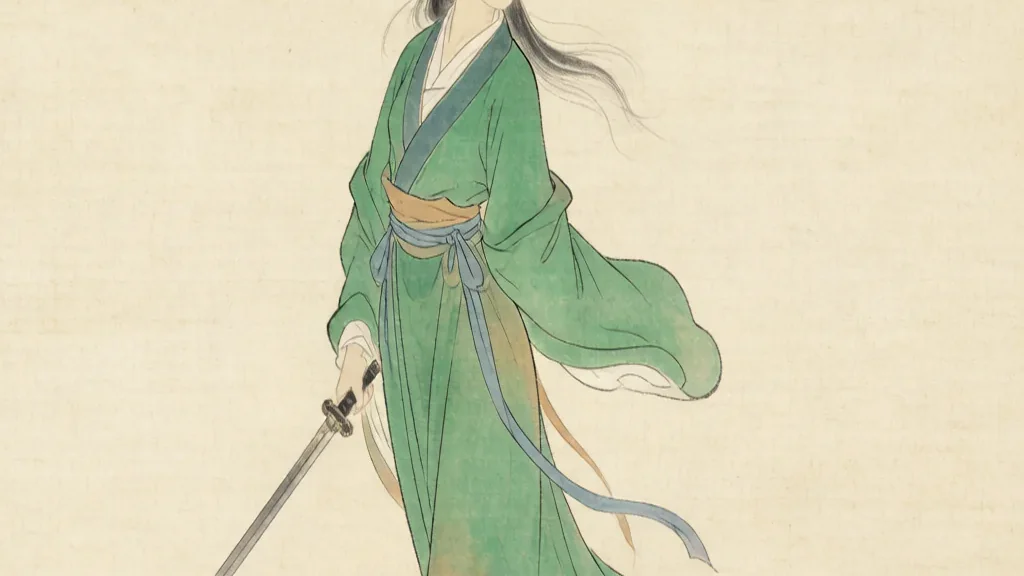
Xiaoqing, often called Qingqing, is the Green Snake spirit of Chinese legend, the fierce and loyal companion of the White Snake heroine Bai Suzhen in the enduring romance of the White Snake. Transformed from a green serpent that had cultivated spiritual power for centuries, she serves as the White Snake's sister, maid, and warrior, a hot tempered sword wielder whose devotion is tested when the monk Fahai imprisons her mistress beneath the Leifeng Pagoda. In most versions Xiaoqing flees, trains for centuries, returns, defeats Fahai, and shatters the pagoda to free Bai Suzhen, embodying the loyalty and righteous rage that complement the White Snake's gentler love. Where Bai Suzhen is the romance, Xiaoqing is the rebellion, the green flame that refuses to let injustice stand, and her name has become a byword for steadfast friendship.
Origins as a Green Serpent
Xiaoqing begins her mythical life as a green snake who, like her white counterpart, has spent centuries in the mountains practising the arts of transformation and gathering spiritual power. The motif of the serpent who cultivates into human form is ancient in Chinese folk belief, where reptiles, foxes, and plants alike were thought capable of becoming persons through long discipline.
Her green colour sets her apart from the white Bai Suzhen and signals a different temperament: where white suggests purity and yielding, green suggests growth, vigour, and a quick temper. The two serpents are complementary poles, the calm and the storm, the patient and the impulsive, joined in a single destiny.
In some tellings Xiaoqing is the junior spirit, weaker in power and younger in cultivation, who attaches herself to the White Snake out of admiration and affection. The hierarchy of the pair is thus earned by spiritual seniority, not by birth, a detail that shapes their sisterly dynamics throughout the tale.
Companion to the White Snake
The central relationship of the legend is the bond between Xiaoqing and Bai Suzhen. When the White Snake resolves to descend to the human world and marry the mortal Xu Xian, Xiaoqing goes with her, serving as confidante, helper, and guard. She is the wing on which the White Snake's love depends, the one who handles the rough work of the world.
Her role is practical as well as emotional. It is often Xiaoqing who manages the household, who fights the enemies, and who speaks the hard truths Bai Suzhen hesitates to utter. The romance could not survive without her, for she supplies the force that the lover's gentleness lacks.
In this partnership the legend models a complete friendship, the union of tenderness and courage in two beings who chose each other freely. Their serpent origin only sharpens the point: even creatures of the wild can teach human beings what loyalty means.
The Bond of Sisterhood
Xiaoqing and Bai Suzhen are usually described not as mistress and servant alone but as sworn sisters, a bond of equality sealed by affection rather than by rank. This sisterhood is the emotional anchor of the story, the relationship that endures when the human marriage is threatened by the monk's interference.
The sisterly tie also carries a quiet social meaning. In a culture that prized female bonds within the household, the two serpent sisters offered a magnified image of loyal companionship, a friendship strong enough to defy heaven and monastery alike. Their unity is the miracle beside which the magical transformation pales.
When Bai Suzhen is taken, it is the sister bond that motivates the rescue. Xiaoqing's century of training is fuelled not by duty but by love, the plain refusal to abandon the one who descended to the world with her. The legend makes sisterhood the engine of its climax.
Conflict with the Monk Fahai
The antagonist of the White Snake romance is Fahai, a Buddhist monk who perceives the serpent nature of Bai Suzhen and resolves to separate her from her mortal husband in the name of spiritual order. Xiaoqing is his natural opponent, the martial spirit who fights to protect her sister and who refuses the monk's claim that the marriage is an abomination.
The clash between Xiaoqing and Fahai is the clash of two kinds of purity: the monk's celibate, rule bound holiness, and the serpent's devoted, embodied love. The story famously declines to award the monk an easy victory, and Xiaoqing's resistance is the voice of that refusal.
In the early confrontations Xiaoqing is outmatched, and her failure to protect Bai Suzhen is the wound that drives the rest of her arc. The monk's triumph is temporary precisely because it leaves the loyal sister alive and unrepentant, a debt the tale means to collect.
The Leifeng Pagoda
Fahai's eventual victory is the imprisonment of Bai Suzhen beneath the Leifeng Pagoda, a real structure on the shore of West Lake in Hangzhou that became the literal stage of the myth. The pagoda stands in the story as the monument of separation, the cold architecture that buries love under stone in the name of doctrine.
The image of the buried wife is one of the most poignant in Chinese legend, and Xiaoqing's grief before the pagoda is its emotional centre. The tower is not merely a prison but a symbol of the weight that rigid orthodoxy can lay upon the living heart, the stone that silence sings against.
Local memory kept the pagoda alive as a tourist site and a story place, so that the fictional imprisonment acquired a geographic address. To visit Leifeng was, for centuries, to stand at the scene of the crime and to hope, with Xiaoqing, for the breaking of the stone.
Xiaoqing's Training and Return
After the defeat, most versions send Xiaoqing into hiding, where she devotes centuries to the refinement of her magic and her sword craft, nursing the vow to return. This interval of training is the serpent's answer to grief: not despair but discipline, the patient accumulation of the power needed to right the wrong.
The long wait also gives the legend its sense of cosmic patience. A serpent who thinks in centuries can afford to wait, and the tale rewards that patience by letting the delayed justice arrive at last. The monastery's victory is shown to be only a delay, not a settlement.
When Xiaoqing returns, she is no longer the hot tempered girl but a seasoned warrior of green fire, and the contrast between the fleeing sister and the returning avenger is the measure of her love. The training was herself, remade for the rescue.
The Shattered Pagoda
The climax of the legend is Xiaoqing's defeat of Fahai and the shattering of the Leifeng Pagoda, freeing Bai Suzhen from the rubble. The broken tower is the story's satisfying reversal, the moment when the architecture of suppression falls and the buried love walks free into the light.
In some retellings Fahai is not killed but driven into the belly of a crab, a comic humiliation that lets the monk survive while losing all authority, a typical Chinese taste for punishment that stops short of death. The crab that hides the monk became a small folk motif in its own right.
The shattered pagoda resolves the tale's central tension in favour of loyalty. Love, defended by a sister's righteous rage, proves stronger than the doctrine that would bury it, and the green snake's century of waiting is vindicated in a single collapse of stone.
Xiaoqing in Opera and Drama
The White Snake story has been a staple of Chinese opera for centuries, and Xiaoqing is invariably the favourite of the audience, the energetic green clad fighter whose acrobatics punctuate the slower arias of the lovers. Her role lets the performer display both sword play and comic timing.
The 1992 television adaptation revived the legend for a modern mass audience and fixed the image of Xiaoqing as a spirited, modern feeling companion, loyal to a fault and refreshingly frank. Generations of viewers came to love her as much as the romantic leads.
Because she combines fight and feeling, Xiaoqing translates well across media, from stage to screen to comic, and her popularity shows no sign of fading. She is the character who lets the ancient serpent tale speak to contemporary ideas of friendship and independence.
Symbolism of Loyalty and Rage
At bottom Xiaoqing embodies loyal rage, the anger that arises not from selfishness but from love wronged, the just fury that refuses to accept the burial of the innocent. Her green fire is the flame of protest, necessary where gentleness alone would be crushed.
She also symbolises the friend who does not waver, the counterpart to the lover who is swept away. Where Bai Suzhen is the heart of the romance, Xiaoqing is its spine, the one who remembers and returns when memory is all that remains.
In the end Xiaoqing remains the Green Snake who would not let the pagoda stand, the emblem of a devotion fierce enough to move stone. Her legend assures the listener that loyalty, given centuries if need be, can outlast every prison that orthodoxy builds, and that the sister who stays is the sister who saves.
❓ Frequently Asked Questions
Who is Xiaoqing?
Xiaoqing is the Green Snake spirit of the White Snake legend, the loyal companion and sworn sister of Bai Suzhen, known for her hot temper and sword skill.
What is her relationship to the White Snake?
She is Bai Suzhen's sister, maid, and warrior, the fierce protector who stands by her through love, imprisonment, and the long wait for rescue.
Why does she fight Fahai?
The monk Fahai imprisons Bai Suzhen beneath the Leifeng Pagoda, and Xiaoqing fights to defend her sister and later returns to shatter the prison.
How does the legend end?
After centuries of training Xiaoqing defeats Fahai and breaks the pagoda, freeing Bai Suzhen and vindicating her loyal rage.
Where is the story set?
The legend is set around West Lake in Hangzhou, where the real Leifeng Pagoda became the mythical prison of the White Snake.
What does Xiaoqing symbolise?
She symbolises loyalty and righteous anger, the devotion fierce enough to outlast any prison and the friend who stays to save the one she loves.