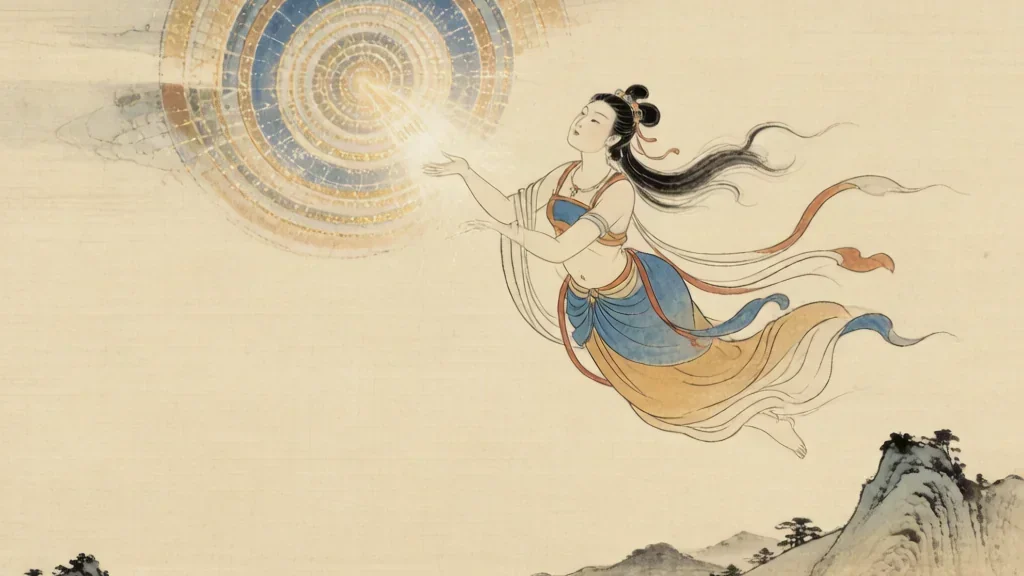
In the vast tapestry of world mythology, creation stories hold a special place — they tell us where we came from, what forces shaped our existence, and what values our ancestors held dear. Among these ancient narratives, few are as compelling and visually striking as the Chinese myth of Nüwa, the serpent-tailed goddess who not only crafted humanity from clay but also performed the extraordinary feat of mending the heavens themselves.
The story of Nüwa (女娲) is one of the oldest and most beloved tales in Chinese culture, appearing in texts dating back to the Warring States period over two thousand years ago. She is not merely a creator deity — she is a protector, a mother figure who refuses to abandon her children even when the cosmos itself falls apart. Her tale resonates across millennia because it speaks to something deeply human: the impulse to create, to nurture, and to repair what is broken.
The Birth of Humanity
After Pangu separated heaven and earth, the world was beautiful but empty. Mountains rose majestically, rivers flowed clear and bright, and forests teemed with life — yet there were no people. Nüwa, a goddess with the upper body of a woman and the lower body of a serpent, wandered this pristine world and felt a profound loneliness. The earth was full of wonders, but it lacked beings who could appreciate them, who could laugh and sing and build communities.
One day, as she gazed at her reflection in a still pond, an idea blossomed in her mind. She scooped up yellow clay from the riverbank and began to shape it with her divine hands. She molded tiny figures with legs instead of a tail — beings who could walk upright across the land. When she set them on the ground and breathed life into them, they immediately sprang to life, dancing and laughing around her feet. Nüwa was delighted. She had created humanity.
She worked tirelessly, shaping figure after figure from the yellow earth. But the world was enormous, and molding each person by hand was slow work. Realizing she needed a faster method, Nüwa dipped a vine rope into the mud and flicked it across the land. Wherever the droplets of mud fell, they transformed into people. According to the myth, those she shaped carefully by hand became the nobility — the scholars, rulers, and wise leaders. Those born from the splattered mud became the common people — farmers, artisans, and merchants. This is one of the earliest recorded explanations for social hierarchy in Chinese civilization.
Nüwa didn't simply create humans and abandon them. She taught them the arts of survival and society — how to cultivate crops, how to build shelters, and how to form families. She also established the institution of marriage, pairing men and women together so that humanity could continue to flourish on its own. For this reason, she was later worshipped as the goddess of marriage and matchmaking.
The Sky Splits Apart
For a time, the world prospered under Nüwa's watchful care. But peace is fragile, and catastrophe was brewing in the heavens. Two powerful gods — Gonggong, the god of water, and Zhurong, the god of fire — engaged in a terrible battle for supremacy. Their conflict shook the very foundations of existence. When Gonggong realized he was losing, he flew into a rage and smashed his head against Mount Buzhou, one of the four pillars that held up the sky.
The consequences were catastrophic. The pillar shattered, causing the northwestern sky to collapse. A gaping hole opened in the heavens, and through it poured cosmic chaos. Torrential rains flooded the earth, wildfires raged across the forests, and ferocious beasts emerged from the depths to prey upon the terrified humans. The earth itself cracked open, and rivers of molten fire surged up from below. It was nothing less than the apocalypse.
Nüwa looked upon the suffering of her children and was filled with grief and determination. She could not — would not — stand by while everything she had created was destroyed. Unlike the warring gods whose pride had caused the disaster, Nüwa's only concern was the welfare of humanity. She resolved to repair the heavens, no matter the cost.
The Five-Colored Stones
Nüwa gathered five-colored stones — blue, yellow, red, white, and black — from the banks of the great rivers and the slopes of sacred mountains. These were no ordinary rocks; they contained the elemental essence of creation itself, corresponding to the five elements of Chinese philosophy: wood, earth, fire, metal, and water. Each color represented a fundamental force of the universe.
She built a great furnace and melted the stones together, refining them into a molten amalgam of extraordinary power. For seven days and seven nights, she tended the fire, never resting, never wavering. When the stones had fused into a shimmering, iridescent substance, she flew up to the broken sky and began to patch the hole. Piece by piece, she sealed the cracks in the firmament, working with a precision and patience that only a mother's love could sustain.
But mending the sky was only part of the challenge. The heavens still sagged dangerously — without Mount Buzhou, there was nothing to hold them up. In a moment of extraordinary sacrifice, Nüwa sought out a giant celestial turtle that lived in the eastern sea. She cut off its four massive legs and used them as pillars to prop up the four corners of the sky. The turtle's sacrifice ensured that the heavens would never collapse again.
Even after these monumental tasks, Nüwa's work was not finished. She gathered reeds from the riverbanks, burned them to ash, and used the ashes to dam the floodwaters that still ravaged the land. She drove the wild beasts back into the forests and mountains, restoring balance to the natural order. Only when the world was safe once more did she finally rest.
According to the myth, the repairs Nüwa made were not perfect — and you can still see evidence of them today. The sky tilts slightly toward the northwest, which is why the sun, moon, and stars all drift in that direction. The rivers of China all flow toward the southeast because the earth was tilted during the great catastrophe. These geographical observations were woven into the myth, giving it a tangible connection to the physical world.
The Legacy of the Mother Goddess
Nüwa's story is more than just an entertaining myth — it is a cornerstone of Chinese cultural identity. She represents the ideal of benevolent power, using her divine abilities not for conquest or glory but for creation and protection. Unlike the warrior gods of many other mythologies, Nüwa's greatest strength lies in her compassion and her refusal to give up, even when faced with cosmic disaster.
Her tale also reflects important philosophical concepts in Chinese thought. The five-colored stones mirror the Wu Xing, or Five Elements theory, which underpins traditional Chinese medicine, martial arts, and cosmology. The idea that the universe can be repaired — that damage is not permanent — resonates with the Chinese cultural emphasis on harmony and balance. Nüwa doesn't destroy the chaos; she restores order.
To this day, Nüwa is honored in temples across China, particularly in Hebei Province where Mount Nüwa is said to be her dwelling place. Pilgrims visit to pray for fertility, protection, and harmony in their families. She remains a powerful symbol of motherhood, creation, and the enduring human spirit that refuses to surrender even when the sky itself is falling.
The next time you look up at the evening sky, remember that — according to one of humanity's oldest stories — it was once broken, and it was a mother's love that put it back together.
Nüwa and Fuxi: The First Couple
In many versions of the myth, Nüwa is paired with Fuxi, her brother and husband, who is credited with giving humans writing, fishing, and the eight trigrams. Together the two are shown as serpent-tailed figures with intertwined tails, an image found on tombs and ritual objects for over two thousand years. Some tales say that after a great flood destroyed humanity, Nüwa and Fuxi married and repopulated the earth, making them the joint ancestors of all people. Their union is also an early emblem of yin and yang, the complementary forces of male and female, dark and light. By linking creation, marriage, and cosmic balance in a single pair, the tradition presents human origins as rooted in both a mother's care and a harmonious partnership.
Nüwa as the Goddess of Marriage
Beyond creating people, Nüwa is honored as the one who invented marriage. According to the myth, after shaping humans she paired men and women so they could form families and continue the species on their own. For this reason she became a patron of matchmaking and marital harmony, and in some regions couples once prayed to her for a good union. Unlike later strict Confucian ideas that marriage was arranged by families, the Nüwa tradition emphasizes a natural, almost primordial bond between partners. Her role as marriage goddess connects directly to her role as mother goddess: she not only makes life but blesses the relationships that sustain it. Even today her name is invoked in blessings for weddings and family unity.
The Symbolism of the Broken Sky
The catastrophe Nüwa repairs is more than a storm; it is a picture of cosmic order collapsing. When the water god Gonggong smashed Mount Buzhou, the pillar holding up the sky, the clear and turbid forces of the world fell out of balance, and chaos returned. Nüwa's repair with five-colored stones maps neatly onto the Five Elements theory, suggesting that harmony must be rebuilt element by element. The detail that the sky now tilts toward the northwest, and rivers flow southeast, turns a moral story into an explanation of the physical world. The broken sky thus stands for any moment when order fails, and Nüwa's labor shows that such breaks can be mended through patient, selfless work rather than abandoned to ruin.
Nüwa in Temple and Ritual Today
Nüwa remains an active focus of worship in parts of northern China, especially in Hebei Province, where Mount Nüwa is honored as her dwelling place. Pilgrims visit her temples to pray for fertility, family protection, and harmony at home, treating her as a living guardian rather than a faded myth. Annual rituals and local festivals keep her story present in village life, and her image appears in folk art, paper cuts, and New Year prints. Scholars also study her as a rare example of a powerful female creator in world mythology, one who uses care rather than conquest. Through temples, art, and scholarly attention, Nüwa continues to connect modern Chinese families to an ancient idea of a mother who both makes and mends the world.
❓ Frequently Asked Questions
📝 Chinese Vocabulary
女娲 — : The mother goddess who created humanity and mended the sky; a central figure in Chinese creation mythology.
补天 — : "Mend the sky" — refers to Nüwa's heroic act of repairing the broken heavens.
五彩石 — : "Five-colored stones" — the magical stones Nüwa melted to patch the hole in the sky, representing the five elements.
不周山 — : Mount Buzhou, the cosmic pillar destroyed by Gonggong that caused the sky to collapse.
共工 — : The water god whose battle with Zhurong and subsequent rage caused the cosmic catastrophe.
伏羲 — : Fu Xi, the brother and husband of Nüwa and a culture hero who gave humans writing and fishing.
婚姻 — : Marriage, the institution Nüwa established by pairing the first men and women.
葫芦 — : Gourd or calabash, the vessel in some versions that shelters Nüwa and Fuxi through the great flood.
🎉 Fun Facts
- Nüwa and her brother-husband Fuxi are often depicted with intertwined serpent tails, symbolizing the union of yin and yang — one of the earliest representations of this foundational Chinese concept.
- Archaeologists have discovered Nüwa imagery on Han Dynasty tomb carvings dating back over 2,000 years, proving how ancient and enduring this myth truly is.
- The phrase "Nüwa mends the sky" (女娲补天) is still used in modern Chinese as a metaphor for someone who steps up to fix an impossibly difficult situation.
- Some versions of the myth say Nüwa and Fuxi survived a great flood by sheltering inside a giant gourd, linking her to flood-survival stories.
- Nüwa is worshipped as a goddess of marriage and matchmaking because she paired the first humans into couples.
- In Chinese art Nüwa is often shown holding a compass while Fuxi holds a ruler, symbols of her creative and ordering power.