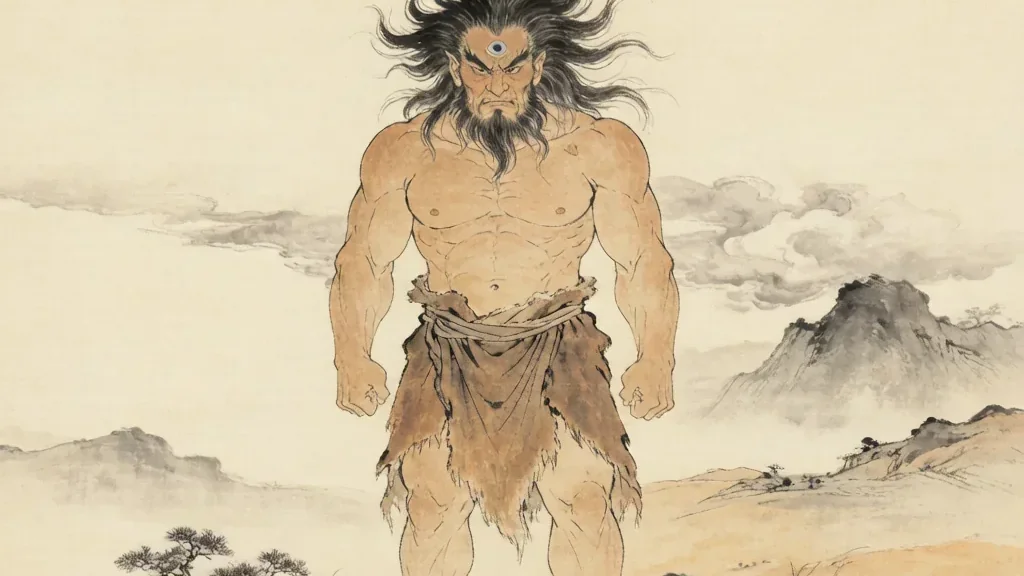
In the mythology of ancient China, the world was not a stable place. It was held together by pillars — great mountains that supported the sky and anchored the earth, keeping the two from collapsing back into the chaos from which they had been formed. The most important of these pillars was Mount Buzhou, the "Imperfect Mountain," located in the northwest. It was called imperfect because, unlike the other pillars, it was incomplete — a flaw in the cosmic architecture that would, one day, prove catastrophic. And the one who would exploit that flaw was Gonggong, the god of water, whose rage would tilt the heavens and bring the world to the brink of destruction.
The story of Gonggong (共工) is one of the most important in Chinese mythology, not for its own sake, but because it sets in motion the events that lead to one of the most famous myths of all: Nüwa mending the sky. Without Gonggong's destructive blow, there would be no broken heavens for Nüwa to repair. The two stories are two halves of a single cosmic drama, a cycle of destruction and creation that explains why the world is the way it is.
The God of Water
Gonggong was not a minor deity. He was one of the most powerful gods in the ancient Chinese pantheon, the personification of water in all its forms — the gentle rain that nourishes crops, the rivers that sustain civilizations, and the terrible floods that destroy them. He was usually depicted as a fearsome figure: a giant with the body of a human and the head of a serpent, or sometimes as a nine-headed serpent himself, his scales glistening with the dark waters of the primordial abyss.
Water, in Chinese cosmology, is one of the Five Elements — along with Wood, Fire, Earth, and Metal — and it is the most paradoxical. It is the source of life, without which nothing can grow. But it is also the most destructive, capable of wearing away stone, drowning cities, and reshaping the earth. Gonggong embodied both aspects. He could be benevolent, bringing rain in times of drought. But he could also be wrathful, unleashing floods that swept away everything in their path. He was, in many ways, the most unpredictable of the gods, and therefore the most feared.
In the cosmic order established by the Yellow Emperor and maintained by his successors, Gonggong had a place. He was responsible for the waters of the world, and his power was respected. But he was not content with his station. He chafed under the authority of the heavenly rulers, believing that water — the most powerful of the elements — should be supreme. And so, again and again, he rebelled.
The War for Supremacy
The most famous of Gonggong's rebellions took place during the reign of Zhuanxu, one of the Five Emperors, the mythical sage-kings who ruled in the early days of the world. According to some accounts, Gonggong had been appointed as an official under Zhuanxu, responsible for managing the waters. But he abused his power, causing floods to punish those who displeased him and withholding rain from those who defied him. When Zhuanxu confronted him, Gonggong revolted.
Other versions of the story describe a more straightforward power struggle. Gonggong, convinced of his own superiority, challenged Zhuanxu for the throne of heaven itself. He gathered an army of water spirits, river dragons, and flood demons, and marched against the heavenly court. The war that followed was terrible. Waters rose across the earth, drowning whole regions. The rivers changed their courses. The sea itself seemed to rise, threatening to swallow the land entirely.
But Zhuanxu was not without allies. He dispatched his greatest general, Zhurong — the god of fire — to face Gonggong in battle. The conflict between water and fire, the two most powerful and destructive elements, shook the cosmos. Zhurong rode a chariot of flame, wielding a spear of pure fire. Gonggong commanded waves that towered over mountains, leading his army of aquatic demons. For days they fought, each unable to overcome the other, their struggle leaving the earth scarred and the heavens trembling.
Finally, through a combination of heavenly favor and martial skill, Zhurong gained the upper hand. Gonggong's forces were scattered, his demons destroyed, his waters driven back. The water god himself was wounded and exhausted, his rebellion in ruins. He fled, pursued by Zhurong's fiery legions, until he reached the northwest — the region where Mount Buzhou stood, the imperfect pillar of heaven.
The Blow That Broke the World
It was there, at the foot of Mount Buzhou, that Gonggong made the decision that would change the world. Defeated, humiliated, his rebellion crushed, he could not bring himself to submit. The rage and shame that burned within him were too great. If he could not rule the heavens, he would destroy the order that kept him from them. If he could not win, he would make the world itself pay for his defeat.
With a roar that shook the mountains, Gonggong charged at Mount Buzhou and struck it with all his remaining strength. Some accounts say he butted it with his serpent head; others say he struck it with his hands or his weapons. Whatever the method, the effect was catastrophic. Mount Buzhou, that vital pillar of heaven, shattered. The top of the mountain broke away and soared into the sky, while the base crumbled into the earth. The cosmic axis trembled. The northwest corner of the sky, no longer supported, began to tilt. The southeast corner of the earth, no longer anchored, began to sink.
The consequences were immediate and devastating. The sky, tilted toward the northwest, caused the sun, moon, and stars to slide in that direction, which is why — the ancient Chinese believed — celestial bodies move from east to west across the sky. The earth, sinking in the southeast, caused the waters of the world to flow in that direction, which is why — they believed — China's great rivers run eastward to the sea. But these cosmological explanations were small comfort to the people living through the catastrophe.
The sky had torn open. Fires blazed from the cracks, consuming forests and fields. Waters poured from the breaches, flooding the lowlands and drowning entire communities. Monsters and demons crawled through the gaps in the cosmic order, ravaging the mortal world. The earth itself was unstable, prone to earthquakes and landslides. The order that had held the world together since the days of Pangu was collapsing, and humanity, Nüwa's precious creation, was on the brink of extinction.
A World Out of Balance
What makes Gonggong's story so compelling is not just the spectacle of destruction, but what it reveals about the Chinese understanding of the world. In this mythology, the cosmos is not the creation of a single, all-powerful god who decrees its laws from on high. It is a delicate balance, held together by structures and agreements, vulnerable to the ambitions and rages of the powerful beings who inhabit it. The world can be broken — not by accident, but by will. And when it is broken, it takes another act of will to repair it.
Gonggong's blow is the act of a being who would rather destroy the world than accept his place in it. It is the cosmic equivalent of a tantrum, a refusal to lose gracefully. And yet, there is something almost admirable in his defiance, even as we recoil from its consequences. He is the only figure in Chinese mythology who, upon losing a war against heaven, chooses to attack the structure of reality itself. He does not surrender. He does not flee into exile. He strikes at the very pillars of the world, knowing that he cannot win but determined that, if he must fall, the world will fall with him.
The ancient Chinese saw in this story a warning about the dangers of unchecked ambition and the fragile nature of cosmic order. But they also saw something else: an explanation for the way the world is. Why does the sky seem to lean? Why do the stars move as they do? Why do the rivers flow east? These questions, which might seem simple to us, were profound mysteries to the people of ancient China, and Gonggong's story provided an answer — mythological, perhaps, but satisfying in its way.
The Stage Is Set
Gonggong's story does not end with his blow against Mount Buzhou. In some versions, he dies in the act, consumed by his own rage. In others, he survives, only to be punished or imprisoned by the victorious gods. But his fate, in a sense, is beside the point. The damage is done. The sky is broken. The earth is flooded. The world is dying. And into this catastrophe steps the figure who will become, in many ways, the most beloved goddess in Chinese mythology: Nüwa.
Nüwa, the mother goddess who had created humanity from the yellow earth, could not bear to see her children destroyed. She would gather five-colored stones, melt them down, and use them to patch the broken sky. She would sever the legs of a great sea turtle and use them as new pillars to support the heavens. She would gather the ashes of reeds and use them to stop the floods. She would, in short, save the world that Gonggong had broken.
But that is her story, and it is told elsewhere. What matters here, in Gonggong's story, is the destruction. Without him, there is no broken sky. Without the broken sky, there is no need for Nüwa's heroism. The two stories are inseparable, two halves of a single mythological truth: that the world is both fragile and resilient, that it can be broken by the powerful and mended by the compassionate, and that destruction and creation are not opposites but partners in the endless cycle of cosmic renewal.
The Legacy of the Broken Pillar
Gonggong has not been forgotten. His name appears in classical literature, in historical chronicles, in poetry and painting. He is often invoked as a symbol of destructive ambition, the being whose refusal to accept defeat brought ruin upon the world. But he is also, in a strange way, a necessary figure — the one whose destruction made possible a greater act of creation. Without his rage, Nüwa would never have had the chance to show her love. Without the broken sky, the world would never have known the full extent of its own capacity for renewal.
In modern China, the story of Gonggong is sometimes invoked in discussions of environmental catastrophe — floods, dam failures, the consequences of humanity's own "war" against nature. The water god, who personified the destructive power of water, serves as a reminder that the forces we seek to control are more powerful than we are, and that when they break free of their constraints, the damage can be world-ending. The story of Gonggong is, in this sense, as relevant today as it was two thousand years ago.
And so the myth endures. The water god rages still. The pillar is broken still. The sky tilts, the rivers flow, the world bears the scars of a cosmic catastrophe that happened before history began. And somewhere, in the realm of myth, a mother goddess gathers her stones, ready to mend what has been broken, as she has done before and will, perhaps, do again.
Gonggong in Later Literature
Beyond the core myth, Gonggong appears throughout Chinese literature as a byword for destructive ambition. Classical poets invoked his name when describing floods and upheaval, while historians of the early empires retold his rebellion as a warning about overreaching power. In the Huainanzi and other Han dynasty texts, his clash with Zhuanxu is woven into cosmological explanations for the tilt of the world. Later Daoist and Buddhist writers occasionally recast him as a reformed or subordinate spirit, showing how a feared destroyer could be absorbed into newer religious systems. The persistence of his story across more than two thousand years shows how a single act of mythical defiance kept speaking to each generation's anxieties about order, nature, and the cost of pride.
The Flood After the Fall
When Mount Buzhou shattered, the cosmic balance broke and waters poured across the earth. According to later mythic chronology, this deluge was so vast that it required the hero Yu the Great to spend thirteen years taming it, digging channels and dredging rivers so people could live again. Gonggong's blow and Yu's labor are thus two halves of one catastrophe-and-repair cycle, much as Gonggong and Nüwa are paired as breaker and mender. Some regional tales name Gonggong's minister Xiangliu as the source of lingering poisons in the floodwaters. The connection helped ancient audiences explain why China's rivers behaved as they did, and why controlling water remained the supreme test of a worthy ruler. It also framed flood control as a sacred duty of rulers, linking cosmic myth directly to the practical engineering that defined Chinese statecraft for millennia.
❓ Frequently Asked Questions
📝 Chinese Vocabulary
共工 — : The god of water in Chinese mythology; the rebel who broke the pillar of heaven.
不周山 — : "Mount Buzhou" — the "Imperfect Mountain," the pillar of heaven that Gonggong broke; bù zhōu means "not complete."
怒触 — : "Angrily struck" — refers to Gonggong's attack on Mount Buzhou; part of the title 共工怒触不周山.
水神 — : "Water god" — Gonggong's title and domain in the Chinese pantheon.
祝融 — : Zhurong, the god of fire who battled Gonggong and embodied the opposing element in the war for the heavenly throne.
颛顼 — : Zhuanxu, a sage-king of the Five Emperors whose throne Gonggong challenged, triggering the war that ended at Mount Buzhou.
天柱 — : Pillar of heaven, the cosmic columns such as Mount Buzhou that held up the sky and anchored the earth below.
相柳 — : Xiangliu, the nine-headed serpent minister of Gonggong, said in some accounts to have spread poison after the great flood.
🎉 Fun Facts
- The ancient Chinese believed Gonggong's blow explained the movements of the heavens: the sky tilts northwest, so stars and planets slide from east to west, and the earth sinks southeast, so China's rivers flow eastward to the sea.
- Gonggong appears in multiple Chinese myths with different opponents — in some he fights the fire god Zhurong, in others the Yellow Emperor, and in still others the sage-king Yao.
- Some scholars connect Gonggong to actual prehistoric floods in Chinese history, suggesting his myth may encode memories of real catastrophic deluges that shaped early Chinese civilization.
- In Daoist cosmology, Gonggong represents the destructive aspect of the Water element — a reminder that even the most life-giving force can become devastating when it is out of balance.
- In some later mythic chronologies, the deluge released by Gonggong's blow is the very flood that the hero Yu the Great spent thirteen years learning to control.
- Ancient historians such as Sima Qian blur the line between the water god and a leader of a real tribal confederation, suggesting a historical chief behind the myth.
☯️ Explore the Five Elements
Gonggong embodied the Water element — one of the Five Elements that shape Chinese philosophy and astrology. Discover your elemental balance.
Check My Five Elements →