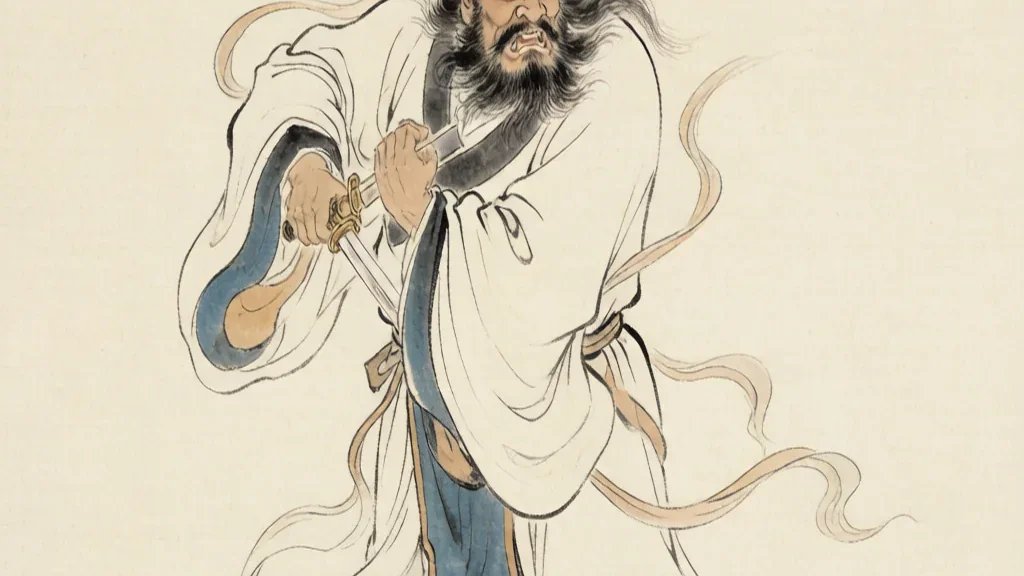
Zhong Kui, the Demon Queller, is among the most striking and visually arresting figures in Chinese folklore, a fierce bearded exorcist who guards homes, banishes evil spirits, and presides over the ghostly population of the dead. Unlike the gentle forgetful lady of the underworld or the merciful sea goddess, Zhong Kui is righteous anger made visible: a scholar wronged by the mortal world who, through death and imperial appointment, became the celestial policeman of the spiritual realm. His legend explains how a man who failed to gain office in life rose to command the armies of the afterlife, and his image, brush in one hand and sword in the other, has been hung on doors and in halls for over a thousand years to drive away misfortune. The story of Zhong Kui weaves together the agony of the imperial examination system, a emperor's healing dream, the artistry of famous painters, and the enduring Chinese need for a defender against the uncanny, making him a unique bridge between bureaucratic history and supernatural protection.
Origins in the Tang Dynasty Dream of an Emperor
The most famous origin narrative places Zhong Kui in the court of the Tang dynasty, when an ailing emperor is said to have dreamed of a small demon stealing his possessions and a larger, terrifying man who seized the thief, tore it apart, and introduced himself as one who had vowed to rid the world of evil spirits. Upon waking cured, the emperor is said to have summoned his court painter to record the vision so that others might benefit from the protective image.
This dream frame is significant because it links Zhong Kui directly to imperial authority and to the power of art. The painted likeness, commissioned at the highest level, became a template copied for centuries, so that the earliest visual standard of the Demon Queller came from a royal recovery story rather than from a village ghost tale. The throne thus authenticated the figure.
The healing dimension of the legend also matters: Zhong Kui arrives not merely as a warrior but as a cure, banishing the sickness bearing demon and restoring the ruler's health. From the start his function is therapeutic, the removal of a malign influence so that order and vitality can return, a role that made him welcome in bedrooms and sickrooms as much as at gates.
The Scholar Who Was Denied Office
Beneath the imperial dream lies a darker biographical legend that gives Zhong Kui his pathos. In this version he was a talented candidate of the imperial examination system who traveled to the capital and placed first in the palace exam, only to be denied the expected high post because of his grotesque appearance, a humiliation so bitter that he dashed his own head against the palace steps and died.
The examination system was the great channel of social advancement in imperial China, and its cruel rejection of a meritorious man on grounds of looks supplied the emotional fuel of the tale. Zhong Kui's tragedy is the tragedy of merit betrayed by superficial judgment, and his later power reads as a cosmic correction: the court that scorned him must now depend on him for protection.
After his death the underworld ruler, moved by his loyalty and wronged virtue, is said to have appointed him king of the ghosts, charging him with maintaining order among the dead and suppressing the malicious ones. The rejected scholar thus becomes the chief magistrate of the spirit world, a bitter irony the folklore clearly savors, since the bureaucracy that failed him in life employs him in death.
Zhong Kui as King of the Ghosts
In his underworld office Zhong Kui commands the legions of the dead and specializes in disciplining the restless or harmful among them, a role that earns him the title of ghost king in popular speech. He is depicted leading bands of lesser demons who serve as his troops, turning the very forces of chaos into an army of order under his command.
This command structure reflects the Chinese habit of organizing the supernatural along bureaucratic lines, mirroring the earthly administration with its ranks, seals, and jurisdictions. Zhong Kui fits neatly into that imagined civil service as the enforcer, the official whose portfolio is spiritual public safety, and whose badge of office is not a seal alone but a blade.
His authority is doubly grounded: in the underworld appointment by the ruler of the dead, and in the recognition of the living through imperial art and household worship. Between those two endorsements he stands as a figure legitimate on both sides of the grave, which is exactly what makes him effective as a guardian whom neither ghost nor demon can legitimately defy.
Iconography: Sword, Beard, and Bat
Zhong Kui is almost always portrayed as a large, glowering man with a wild beard, bulging eyes, and a robe of office, sometimes ragged, sometimes splendid, wielding a sword or a writing brush, and often accompanied by a bat. The bat is a punning symbol, because its name sounds like the word for fortune, so the creature circling his head signals that his fierce presence also attracts luck.
The sword is his instrument of execution and expulsion, the literal means by which he cuts down demons, while the brush or scroll recalls his identity as a scholar and suggests that his power is also literate, backed by documents and commands. The union of weapon and writing tool captures his nature as both warrior and official, a scholar who enforces.
Artists throughout history treated his portrait as a serious commission, and the standard composition, a striding, scowling exorcist with sleeves flying, became so fixed that deviations read as intentional commentary. The face is meant to terrify the wicked while reassuring the righteous, a dual expression that is the whole point of his image: he looks like a demon so that demons will flee from him.
The Painters Who Made Him Famous
The tradition that a Tang court painter first set Zhong Kui's likeness established a long line of distinguished artists who returned to the subject, especially around the fifth lunar month when pictures of him were displayed to ward off pestilence and evil. Master painters used the theme to show their command of movement, rage, and the grotesque, turning exorcism into high art.
Because the figure was associated with a founder of figure painting renowned for vigorous, wind blown lines, Zhong Kui pictures became a showcase for brushwork as much as for piety. Collectors valued them not only as protective charms but as demonstrations of skill, so the Demon Queller migrated into the connoisseur's studio while remaining on the peasant's door.
This double life, folk talisman and fine art subject, helps explain his durability. He was never confined to one class or context; the same image could sanctify a gate or ornament a screen, and the prestige of famous renditions kept his likeness current long after many comparable spirits had faded from fashion.
Role as a Door Guardian and Seasonal Protector
Households traditionally hung Zhong Kui's image on doors or in the main hall to block the entry of malevolent influences, a practice especially common at the New Year and during the hot, disease prone fifth month of the lunar calendar. His glaring portrait served as a spiritual lock, warning troublemaking spirits that this threshold was under protection.
He is sometimes paired with or substituted for the door gods of popular religion, the martial generals who stand watch at gates, but his specialization in ghosts sets him apart as the guardian against the dead rather than merely against intruders. Where the door gods police the living world, Zhong Kui polices the boundary with the otherworld.
In seasonal custom his picture might be burned or replaced annually, the old effigy discharged and a fresh one installed to renew the ward, a rhythm that kept the protection active and gave families a regular ritual of spiritual housekeeping. The calendar thus embedded him in domestic time as firmly as in domestic space.
Zhong Kui in Opera and Popular Performance
Regional theater adopted Zhong Kui as a commanding role, with performers using bold makeup and a heavy, stamping gait to convey his awful authority. Plots often show him hunting a specific demon that threatens a household or a virtuous person, combining exorcism with comic byplay among his ghostly subordinates, who provide comic relief against his grimness.
The staged Zhong Kui allowed audiences to witness evil visibly subdued, a satisfying spectacle in eras when disease and misfortune were readily personified as spirits. The drama externalized anxiety and resolved it on stage, leaving the spectators with the relief of having seen order restored by a recognizable champion.
Because the role required both martial and vocal strength, it became a vehicle for star performers, and famous interpreters passed down stylized routines that taught audiences exactly how to read each gesture. The living actor thus became, like the painted image, a vessel of the same protective presence, blurring ritual and entertainment once more.
Theme of Justice for the Wronged
At its ethical core the Zhong Kui legend is a story about the redemption of the humiliated. A man denied his rightful place because of appearance is, after death, given a higher office than any he was refused, and the world that scorned him must appeal to him for safety. The folklore thereby satisfies a deep appetite for poetic justice.
This theme resonates with the many tales in Chinese tradition where the wrongly dead return clothed in power, suggesting a belief that the cosmos eventually compensates the unjustly treated. Zhong Kui is the benign face of that belief, the avenger who chose service over vengeance and who protects rather than destroys the living order that failed him.
His example also quietly criticizes the examination and official system that judged by surface, a criticism safe to voice only through a ghost story. By making the rejected candidate the master of the spirit bureaucracy, the legend delivers a gentle rebuke to the worldly bureaucracy, wrapped in the costume of a protective myth.
Comparison with Other Demon Quellers
Zhong Kui belongs to a worldwide category of threshold guardians and monster slayers, resembling in function the door gods and martial deities found across Asian religions, yet his backstory as a failed scholar is unusually specific and humanizing. He quells demons not because he was born a god but because he was wronged and then elevated, a very Chinese path to divinity.
Unlike the gentle underworld figures who comfort the dead, Zhong Kui confronts them, and unlike the remote high gods he works at the messy level of households and sickness, which gives him a practical, approachable authority. He is the troubleshooter of the pantheon, called in when something has gone wrong rather than worshipped for general blessing.
His visual kin include the glaring temple guardians and the hell wardens of Buddhist art, but his popularity in the private home rather than the public temple is distinctive. The Demon Queller came to live with ordinary families, a domestic deity of defense whose image was as common as a lock on the door.
Modern Legacy and Enduring Image
In the modern period Zhong Kui survives in New Year prints, animated shorts, and costume dramas that retell his origin with varying sympathy, sometimes emphasizing his tragedy and sometimes his glory. His face still appears on festive charms and on the packaging of products meant to convey protection or good fortune through the bat pun.
Contemporary artists have reinterpreted him as a symbol of integrity unrecognized by corrupt systems, a rebel bureaucrat who exposes the folly of judging by appearance, which keeps his story relevant to audiences concerned with fairness and merit. The ancient exorcist thus acquires modern political resonance without losing his old protective function.
He also endures simply because people like having a fierce friend at the threshold. In a culture that values harmony but acknowledges the reality of malign influence, Zhong Kui offers the comfort of a guardian who is scarier than whatever he guards against, and that comfort is why his glaring portrait still hangs where families need to feel safe.
Why the Legend of the Demon Queller Lasts
The legend lasts because it resolves several needs at once: the need to personify and therefore control fear, the need to believe that wrongs will be rectified, and the need for a defender who is both legitimate and terrifying to the enemy. Zhong Kui satisfies all three, which is rare for a single figure, and his image does the work of a prayer and a alarm at once.
His humanity, the scholar who suffered and was denied, keeps him relatable even in his monstrous glory, so that worshippers see not an alien god but a fellow victim promoted to protector. That empathy is the emotional glue of the cult, distinguishing him from colder, more distant exorcists of other traditions.
Finally, the legend persists because it is useful. As long as households fear the unknown at the door, they will want a glare fiercer than the dark, a sword quicker than the curse, and a bat that brings luck even as it signals his coming. Zhong Kui delivers all of these in one unforgettable face, and that is why, a thousand years after a emperor's dream, the Demon Queller still stands watch.
❓ Frequently Asked Questions
Who is Zhong Kui?
Zhong Kui is the Demon Queller, a ferocious bearded figure who guards households and subdues evil spirits. Legend says he was a wronged scholar who died and was appointed king of the ghosts, giving him authority over the dead and the power to banish demons.
Why does he look so frightening?
His glaring, wild appearance is intentional: he is meant to terrify malicious spirits so they flee, while reassuring the righteous. By looking like a demon he drives demons away, which is the whole logic of his protective image.
What is the Tang emperor dream story?
A Tang emperor reportedly dreamed of a small demon and a larger man who caught it and vowed to rid the world of evil. Cured on waking, the emperor had the vision painted, and that painting became the template for Zhong Kui's likeness for centuries.
Why is there a bat in his pictures?
The bat is a pun, because its name sounds like the word for fortune, so the creature near him signals that his fierce protection also attracts luck. It turns a fearsome exorcist into a bearer of good destiny.
How is Zhong Kui used in the home?
Families hang his image on doors or in halls, especially at New Year and in the fifth lunar month, to block evil influences and pestilence. The picture acts as a spiritual lock renewing the household's safety each year.
What is the moral of his legend?
The core lesson is poetic justice for the wronged: a man denied office for his looks is later made ruler of the ghostly bureaucracy. The tale quietly criticizes judging by appearance while affirming that true merit is eventually honored.