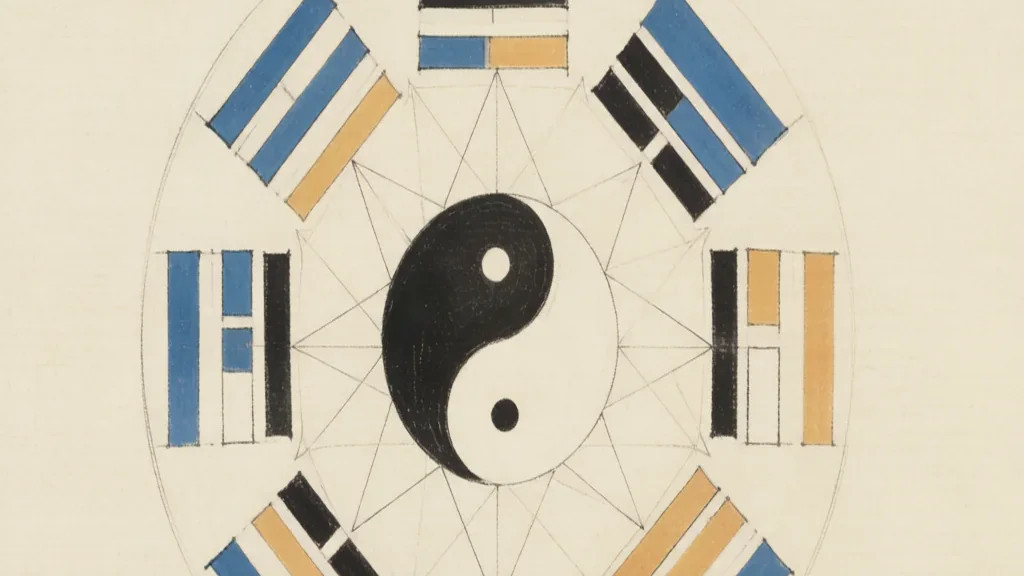
The Eight Trigrams — the bagua (八卦) — are the eight three-line figures at the root of Chinese thought about change. Each trigram is a stack of three lines, either unbroken (yang) or broken in the middle (yin), and each stands for a power of nature: heaven, earth, thunder, water, mountain, wind, fire, lake. Alone they are simple; combined they generate the sixty-four hexagrams of the Yijing, the Book of Changes, and from there flow into cosmology, medicine, martial arts, architecture, and art. To know the bagua is to hold a key to how China has imagined the living, shifting order of the world.
Origins of the Trigrams
Legend credits the mythical sage Fuxi (伏羲) with inventing the bagua after contemplating the patterns of the heavens and the markings on a dragon-horse that emerged from the River Luo. Observing that all things pair into opposites, he drew the unbroken line for yang (active, bright, male) and the broken line for yin (receptive, dark, female), and combined them into eight figures. Whether or not Fuxi was historical, the trigrams crystallized in the early Zhou period as a system for classifying the fundamental forces of existence, long before they were folded into the Yijing.
The Eight Figures and Their Meanings
The eight trigrams are: Qian (☰, three unbroken lines) for Heaven and pure creative force; Kun (☷) for Earth and receptive support; Zhen (☳) for Thunder and awakening; Kan (☵) for Water and the perilous depths; Gen (☶) for Mountain and stillness; Xun (☴) for Wind and penetration; Li (☲) for Fire and clarity; and Dui (☱) for Lake and joy. Each is linked to a direction, a season, a family member, an animal, and a part of the body in later correlative systems, so that a single trigram opens onto a whole web of correspondences.
The Former Heaven Sequence
The "Former Heaven" (xiantian) arrangement, attributed to Fuxi, places the trigrams in a balanced, mirrored circle: Qian (Heaven) at the top opposite Kun (Earth) at the bottom, with Fire and Water, Thunder and Wind, Mountain and Lake arranged in opposing pairs. This sequence represents the cosmos in its ideal, unmanifest state — the blueprint before the world unfolds. It is the diagram most often shown as the circular bagua, and it expresses perfect symmetry between yin and yang.
The Later Heaven Sequence
The "Later Heaven" (houtian) arrangement, attributed to King Wen of Zhou, rearranges the trigrams to map the actual, changing world of human experience: the four cardinal directions, the seasons of the year, and the flux of fortune. This is the sequence used in most practical divination and in fengshui, because it describes how energies actually move through time and space rather than how they rest in ideal balance. The shift from Former to Later Heaven is itself a lesson: the world we live in is process, not stasis.
The Yijing Connection
The bagua are the building blocks of the Yijing (I Ching), the Book of Changes. By stacking two trigrams one above the other, the tradition produces sixty-four hexagrams, each a six-line figure with its own name, judgment, and line-by-line commentary. The Yijing's earliest layers date to the Western Zhou period, and over centuries it gathered commentaries (the "Ten Wings") that turned a divination manual into a profound philosophical text. To consult the Yijing is to read the interplay of two trigrams and so to read a situation's hidden dynamics.
Bagua in Divination
In traditional practice, a questioner casts yarrow stalks or coins to generate a hexagram, then reads its judgment and changing lines. The answer is never a simple prediction; it describes the present configuration of forces and hints at how they will develop if things follow their natural course. The bagua thus teach not fatalism but timing — knowing when to advance (like Thunder) and when to be still (like Mountain). This is why the Yijing has been consulted for three thousand years by generals, farmers, and poets alike.
Bagua in Martial Arts
The bagua gave rise to Baguazhang (八卦掌, "Eight Trigrams Palm"), one of the three great internal martial arts of China alongside Taijiquan and Xingyiquan. Its signature is circular walking: the practitioner steps in a circle around a central point, palms turning, evoking the endless revolution of the trigrams. Each palm change is linked to a trigram and its nature, so that the body rehearses the cosmology. The art values evasion over force, spiral movement over straight lines, and the cultivation of internal energy over brute strength.
The Bagua as Cosmic Symbol
Beyond divination and combat, the bagua is a universal emblem of cosmic order. It appears on temple ceilings, on the robes of Daoist priests, on the compass-rose of the geomancer, and on protective mirrors hung above doorways to deflect malicious energy. The trigrams remind the viewer that the ten thousand things arise from the interplay of yin and yang, and that harmony comes from keeping the eight powers in their proper relation. In this sense the bagua is less a belief than a lens.
Bagua in Daily and Popular Culture
The eight trigrams have seeped into everyday Chinese life. The bagua diagram ornaments coins, jade pendants, and wedding gifts; it names streets, restaurants, and exercises; and it underlies the logic of fengshui consultations in homes and offices. Even the familiar yin-yang circle is often framed by the eight trigrams. To grow up Chinese is to absorb the bagua's grammar almost without noticing — the intuition that the world moves in paired, reversible, cyclical forces.
❓ Frequently Asked Questions
What are the eight trigrams?
They are Qian, Kun, Zhen, Kan, Gen, Xun, Li, and Dui — each a three-line figure of broken and unbroken lines.
What do the trigrams mean?
They stand for Heaven, Earth, Thunder, Water, Mountain, Wind, Fire, and Lake — the basic powers of nature.
How are the bagua used?
They are combined into the sixty-four hexagrams of the Yijing for cosmology, divination, and art.
What is the difference between the two sequences?
The Former Heaven arrangement shows the ideal cosmos; the Later Heaven shows the actual, changing world and is used for divination.
Are the bagua only for fortune-telling?
No. They also inform martial arts, fengshui, medicine, and the layout of temples and homes.
Who created the bagua?
Legend credits the sage Fuxi, while King Wen of Zhou is credited with the Later Heaven sequence used in the Yijing.