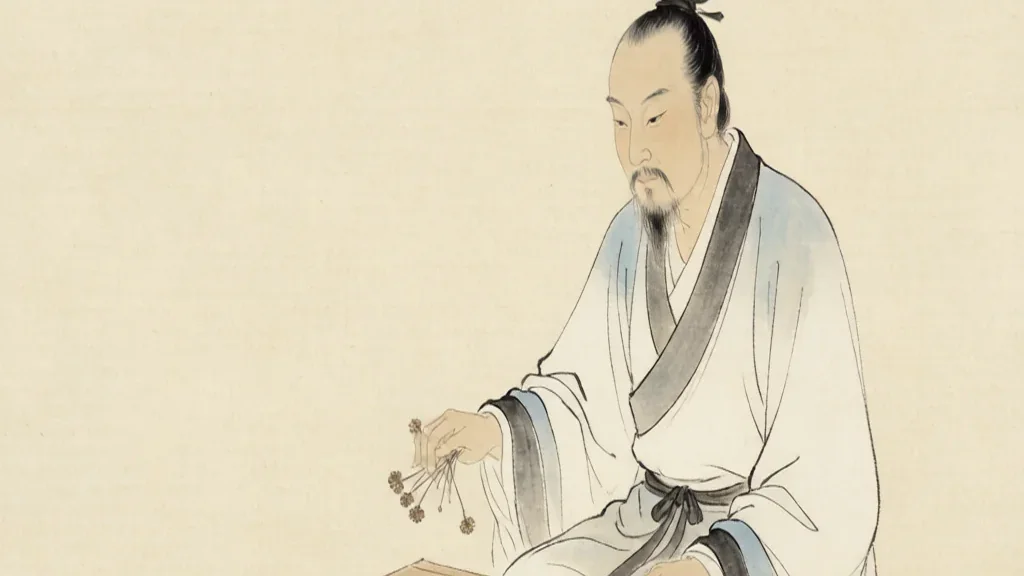
The Yijing, or "Classic of Changes" (often called the I Ching in the West), is the oldest of China's five Confucian classics and the most influential book of divination ever written in the Chinese world. At its core is a system of sixty-four hexagrams built from stacks of broken and unbroken lines, each hexagram a small symbolic image — "The Creative," "The Receptive," "Difficulty at the Beginning" — accompanied by cryptic judgments and commentaries. For three thousand years Chinese have cast the Yijing to read the shifting pattern of a situation and to choose a course of action, treating it less as fortune-telling than as a manual for decision-making in a world of constant change. Its philosophy that everything moves in cyclical transformation lies beneath much of later Chinese thought, from Daoism to statecraft.
The Structure: Trigrams and Hexagrams
The Yijing is built from the yao, or line. A line is either yang — a solid unbroken bar (—) — or yin — a broken bar (- -). Three lines stacked make a gua, or trigram; there are eight of these, the bagua, each with a name and a cluster of associations: heaven, earth, thunder, water, mountain, wind, fire, lake. Stack two trigrams and you get a six-line hexagram, and because each of the eight can sit above or below each of the eight, there are exactly sixty-four hexagrams. Each hexagram carries a name, a short "judgment" (tuan), and a line-by-line commentary, forming a compact dictionary of life's typical situations.
The genius of the system is that each hexagram implies its neighbors. Changing a single line can turn one hexagram into another, so the book is inherently about transition: the situation you are in is never fixed but always becoming its opposite. This is why the Yijing is the "Classic of Changes" — not a static almanac but a map of motion.
The Eight Trigrams
The eight trigrams are the alphabet of the system. Qian (heaven, pure yang) and Kun (earth, pure yin) are the parents; the other six are their "children," each mixing yin and yang in a different pattern. Zhen is thunder, Kan is water, Gen is mountain, Xun is wind, Li is fire, and Dui is lake. Each is linked to a direction, a family member, a body part, an animal, and a season, so that a trigram is a condensed symbol standing for a whole field of related things. In later Daoist and cosmological usage the bagua became a universal index, printed on amulets, compass dials, and the floors of temples.
When you "read" a hexagram you are really reading the interaction of two trigrams: what happens when water sits over fire, or mountain rests above lake. The image generates the advice. A good diviner holds the trigram associations in mind the way a musician holds scales, improvising meaning from their combination.
How to Cast: Yarrow Stalks
The classical method uses fifty yarrow stalks. One is set aside as the "unused" stalk representing the mystery, leaving forty-nine. These are divided, counted off in fours, and the remainders manipulated through three rounds to yield a line: a remainder of one or two gives a yin or yang line, and a special "old" yin or "old" yang line signals a changing line that will mutate into its opposite. Repeat six times, once for each position from bottom to top, and you have built a hexagram, possibly with moving lines that generate a second, future hexagram. The whole procedure is slow, ritualized, and meant to quiet the mind into a receptive state.
The yarrow ritual is itself a meditation. By forcing the querent to count and wait, it detaches him from anxiety and opens attention to the pattern of the moment. The randomness is not mere chance; it is a way of sampling the present configuration of yin and yang in the cosmos, which the hexagram then names.
How to Cast: The Coin Method
A faster, hugely popular method uses three coins. Each toss assigns value: heads (often the inscribed side) counts as a yin value of two, tails as a yang value of three; the three coins summed give a line, and a total of six or nine marks a changing line. Six tosses build the hexagram. Because coins are cheap and quick, the coin method democratized the Yijing, letting any merchant or farmer consult it without a specialist's training. The two methods yield the same sixty-four hexagrams; only the feel differs — the coins are brisk, the stalks solemn.
Critics note the coin method slightly shifts the probability of changing lines compared with yarrow stalks, but in practice both produce the full range of readings. What matters is the question asked and the attention brought to the answer, not the hardware of the cast.
Reading a Hexagram
Once the hexagram is cast, the consultation turns to the text. The diviner reads the hexagram's name and judgment for the overall situation, then the "image" (xiang) — a one-line poetic description of what the two trigrams together suggest — and finally the six line texts, focusing especially on any changing lines, which speak directly to the querent's action. If moving lines are present, the book also points to the "future" hexagram they produce, showing where the situation is headed. The reader then interprets all this against the specific question.
The language is deliberately ambiguous and image-rich: "The dragon lies hidden in the deep; it is not the time to act," or "Crossing the great river brings good fortune." Such lines are not predictions but advisories, inviting reflection. The Yijing is famous for answering the question you should have asked, not the one you did, which is part of its enduring authority.
Changing Lines and the Future Hexagram
The concept of the changing line is the Yijing's deepest idea. A hexagram is not a fixed verdict but a snapshot; the moving lines show which parts of the situation are in flux and therefore which advice is live. When a yin line is "old" it flips to yang, and when a yang line is "old" it flips to yin, transforming the whole figure into a second hexagram. The pair — present and future — frames the consultation as a movement through time. A skilled reader treats the first hexagram as "where you are" and the second as "where this leads if the present tendency continues."
This is why the book resists being a simple oracle. It teaches that outcomes depend on response: the same situation, met with wise action on the moving lines, can turn toward fortune; met with folly, toward the named danger. The changes are instructions for participation in change.
History and the Ten Wings
The Yijing began as a divination manual in the Shang and early Zhou periods (the core hexagram texts may date to around 1000 BCE). Over centuries it acquired the "Ten Wings" (Shiyi), a set of commentaries traditionally attributed to Confucius, which reinterpreted the book as moral and cosmological philosophy rather than mere fortune-telling. These commentaries — on the images, the judgments, the trigrams, and the sequence of hexagrams — turned the Yijing into a wisdom text studied by scholars. By the Han dynasty it was the first of the Confucian classics, and its yin-yang logic fed directly into the formation of mainstream Chinese cosmology.
The book's authority grew precisely because it could be read on two levels at once: as a technique for casting and as a school of statesmanship and self-cultivation. Emperors consulted it; generals used it before battle; poets quoted it; and Neo-Confucian thinkers of the Song era built their metaphysics on its bipolar vision of reality.
The Yijing and Chinese Thought
The Yijing's central claim — that reality is process, that opposites interdepend and succeed one another — became a foundational idea of Chinese science, medicine, and art. The yin-yang and five-phases (wuxing) systems, the logic of acupuncture, the theory of musical tones, and the principles of fengshui all echo its relational thinking. In the arts, the ideal of capturing a situation's "rising and falling" rather than a fixed likeness owes something to the hexagram mindset. Even Chinese historiography, with its cycles of order and disorder, reads like a commentary on the Changes.
Abroad, the Yijing reached Europe via Jesuit translators in the seventeenth century and fascinated Leibniz, who saw in its binary lines a prefiguration of his mathematics. In the twentieth century it shaped Carl Jung's idea of synchronicity. Its prestige in the West as a book of wisdom rather than mere augury is largely a modern, post-translation phenomenon.
Yijing in Daily Life and Modern Use
Historically the Yijing was consulted for everything from the founding of a capital to a missing ox. Today in China and the Chinese diaspora it remains a living practice: businessmen cast before signing deals, students before exams, families before moving house. Apps and printed coin-set kits have modernized the cast without changing the text. At the same time, many readers approach it as literature or philosophy, opening it at random for a daily reflection rather than a prediction — a "bibliomancy" of self-examination.
The book's survival across dynasties, revolutions, and translations is itself a kind of proof of its thesis: that what endures is what can change. The Yijing keeps being reread because it is built to be reread, its ambiguity a feature that lets each age find its own image in the sixty-four figures.
Common Misunderstandings
A frequent error in the West is to treat the Yijing as predictive fortune-telling — a machine that outputs "yes" or "no." In its own tradition it is closer to a decision aid and a mirror: it structures attention and surfaces the hidden logic of a situation. Another misunderstanding is that the hexagrams are arranged randomly; in fact their sequence (the "King Wen" order) follows a deliberate pattern of oppositions and unfoldings meant to be studied. A third is to confuse the Yijing with astrology or numerology; it shares the yin-yang worldview but is a self-contained symbolic system with its own rules of casting and reading.
Finally, the Yijing is not uniquely Chinese in function — every culture has oracles — but it is unusual in the literary and philosophical weight it accumulated, so that the same object serves the peasant, the philosopher, and the psychologist.
❓ Frequently Asked Questions
What is the Yijing?
It is the ancient Chinese Classic of Changes, a book of 64 hexagrams used for divination and as a manual of decision-making.
How do you consult it?
By casting a hexagram with yarrow stalks or three coins, then reading the judgment and line texts for your situation.
What is a changing line?
It is a line that flips into its opposite, turning the hexagram into a second "future" hexagram that shows where things lead.
Is the Yijing just fortune-telling?
No. In its tradition it is a decision aid and mirror of a situation, later read also as moral and cosmological philosophy.
What are the Eight Trigrams?
They are the bagua — heaven, earth, thunder, water, mountain, wind, fire, lake — the building blocks of all 64 hexagrams.
Who wrote the commentaries?
The Ten Wings, traditionally credited to Confucius, reinterpreted the oracle as wisdom literature studied by scholars.