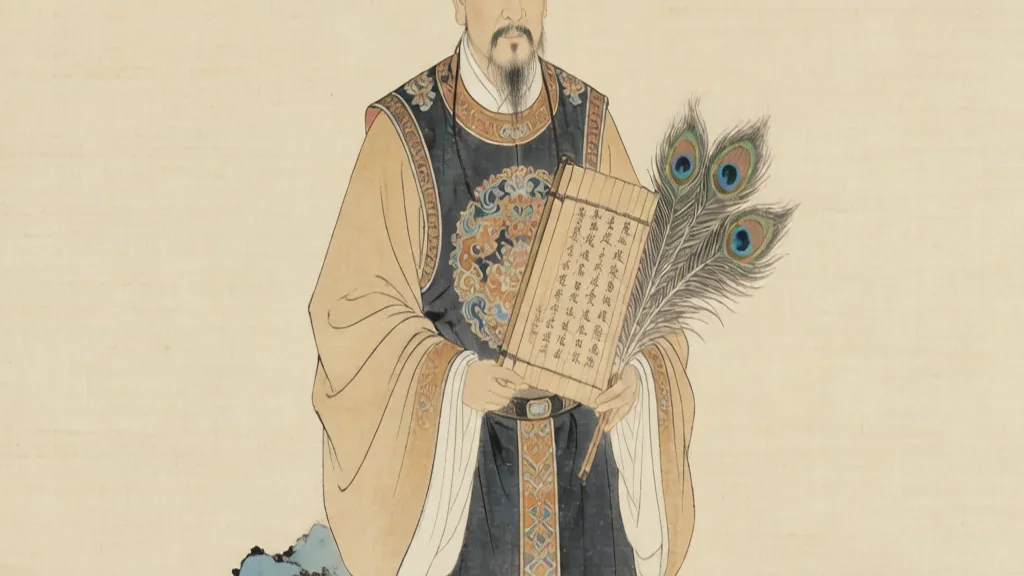
The Bimo are the ritual priests and scriptural specialists of the Yi people, one of China's largest ethnic minorities, spread across the mountainous highlands of Sichuan, Yunnan, Guizhou, and Liangshan. More than shamans, the Bimo are custodians of a written classical language — the ancient Yi script — through which they chant burial scriptures, exorcise misfortune, and guide the soul of the dead back to its ancestral homeland. For the Yi, the Bimo stands at the intersection of literacy, law, and the sacred: he is priest, judge, healer, and historian in one. This tradition, known as Bimoism, is among the most complete indigenous priestly systems still practiced in southwest China, and its vast corpus of handwritten manuscripts preserves a cosmology entirely independent of Chinese Buddhism or Daoism.
Who the Bimo Are
The word bimo (also spelled pimo) literally pairs "bi," meaning "to recite from a book," with "mo," a learned man or master. A Bimo is therefore a man who reads the holy books aloud. He is distinguished from the sunyi, a separate class of non-literate spirit-mediums who fall into trance and speak with deities directly. The Bimo works through text; the sunyi works through possession. A family usually belongs to a Bimo lineage, and the role is hereditary in many regions, passed from father to son along with the family's library of manuscripts and the secrets of how to read them.
Becoming a Bimo requires years of study. A novice must memorize hundreds of scriptures in the archaic Yi liturgical language, learn the complex ceremonial calendar, master divination by chicken bones or bamboo sticks, and train his voice for all-night chanting at funerals. Because the classical Yi language differs sharply from the everyday speech of villagers, the Bimo's knowledge is genuinely esoteric. He is the one person in the community who can read what the ancestors wrote, and therefore the one who can speak to the ancestors on behalf of the living.
The Yi Script and Its Scriptures
The Yi writing system is one of the world's few indigenous scripts to have been used continuously for over a thousand years. It is logographic: each character stands for a word or a syllable, and many signs are stylized pictures of the thing they name — a mountain, an eye, a road. The script was standardized in the Ming-era "script reform" attributed to the Yi scholar Aki, who fixed the shapes of tens of thousands of characters. Unlike Chinese, Yi is written top to bottom in vertical columns, or left to right in modern reform, and it was used for both sacred and secular records: treaties, land deeds, genealogies, and the great ritual canon.
The Bimo's library is enormous. Scholars estimate the surviving Yi manuscript corpus at tens of thousands of volumes, held in libraries from Beijing to Washington and, above all, in the hands of Yi families in Liangshan. The single most important category is the burial and funerary literature — the Hnewo cycle and the great "Scripture of Origin" — which narrates the creation of the world, the descent of humans, and the long road the soul must walk after death. These are not quiet texts; they are chanted at the deathbed for days, a marathon performance that can last a week.
Burial Scriptures and the Journey of the Soul
At the center of Bimo practice is the funeral. The Yi believe that death is a journey, not an end, and that the soul must be escorted home to the land of the ancestors, often imagined in the north or in a mythic place called "Zzyge" or the realm of the first clan mother. The Bimo's job is to read the soul its map. He chants the "road-opening" scriptures that name every river, mountain, and gate the dead must pass, reciting the passwords that let the soul proceed and warning it against the demons and false turnings that lead to oblivion.
The climax of the rite is often the "scripture of driving away the calamity" and the ritual sending-off of the soul, sometimes accompanied by the sacrifice of a goat or ox whose spirit becomes the dead person's mount. In Liangshan the funeral may end with the "bone-washing" rite, in which the bones of the deceased are recovered, cleaned, and reburied in the ancestral mountain. Without a Bimo to perform these texts, the Yi hold, the soul wanders forever as a hungry ghost, a catastrophe for both the dead and their descendants.
Cosmogony and the Creation Epic
The Yi creation tradition is vast and regionally varied, but a shared outline appears again and again. In the beginning there was only chaos and a primordial fog; from it emerged the first creatures and, eventually, the culture-heroes who shaped the earth. A central figure in many Liangshan accounts is the cosmic serpent or the "three sons of the sky," and an episode in which heaven and earth are separated and humans are taught fire, grain, and writing. The Bimo chants these stories not as myth but as foundational history — the charter that explains why the Yi sacrifice, marry, and bury as they do.
One of the most celebrated Yi epics is "Meige" (in Yunnan) and the "Creation Epic" of Liangshan, which tells how the world tree was planted, how the first humans were formed from blood or clay, and how death entered the world through a broken taboo. These narratives also encode practical knowledge: the seasons, the stars, the proper times to plant and to mourn. The Bimo is thus a living encyclopedia, and his chanting transmits science as well as salvation.
Divination and Ritual Diagnosis
When illness, crop failure, or bad luck strikes, the Yi turn to the Bimo to "read the cause." He does this through divination. The most famous method is ngepu, divination by the thigh-bone of a sacrificed chicken: the Bimo reads the blood vessels and cracks of the bone to learn which spirit is angry and what offering will pacify it. Other techniques use bamboo slips, the position of beans, or the patterns of burnt sheep shoulders. Each verdict comes with a prescribed scripture and a sacrifice.
Divination is also used to choose auspicious days for weddings, migrations, and burials, and to detect witchcraft. The Yi world is densely populated with spirits of the house, the field, the forest, and the ancestors, any of whom can be the hidden author of a misfortune. The Bimo's diagnostic reading translates unexplained suffering into a named cause and a repeatable cure.
The Bimo and Yi Law
In traditional Yi society, before the modern state reached the highlands, the Bimo was also a jurist. The Yi had a sophisticated oral and written legal code, the tzylly or "customary law," covering homicide, theft, marriage, and inheritance, and the Bimo was the one who knew it and could recite the precedents. Disputes between clans were settled by Bimo-led arbitration, with compensation rates fixed by scripture. To curse a false oath, the parties might swear before the Bimo over a sacrificed cock, the bird's death sealing the truth of the words.
This fused the sacred and the civil: an insult to the ancestors was also a legal wrong, and a broken contract could be punished by ritual as well as by fine.
The Sunyi: Spirit Mediums
Bimoism is a two-tier system. Alongside the literate Bimo stands the sunyi (also suni), a medium who does not read books but who, in trance, is mounted by gods and ancestors and speaks in their voice. The sunyi diagnoses by possession, performs spirit-catches, and treats the "soul-loss" illnesses that the Bimo addresses through scripture. Where the Bimo is bookish, hereditary, and tied to the great funeral liturgy, the sunyi is ecstatic, often self-called through illness or vision, and works with drums, bells, and dance.
The two are complementary and sometimes rivalrous. A family might call a Bimo to chant the burial scripture and a sunyi to drive out a haunting in the same week. Anthropologists note that the sunyi's practice shows clear shamanic traits — ascent to the sky, recovery of a lost soul, battles with demons — while the Bimo represents a "clerical" priesthood built on writing.
Chicken-Bone Divination in Detail
The chicken-bone rite deserves a closer look because it is the signature Bimo technique. A healthy rooster is sacrificed, and its right thigh-bone is cleaned and split, exposing the network of fine holes and channels inside. The Bimo holds the bone to the light and interprets the pattern: a clear, open channel may mean the offering is accepted; a blocked or discolored vessel signals that a particular ancestor or spirit remains unsatisfied and names which scripture must be read next. The reading is public, performed before the family, so the diagnosis is witnessed and binding.
Decline, Survival, and Revival
The twentieth century was brutal to Bimoism. Like Dongba and other indigenous traditions, it was attacked as "feudal superstition," its manuscripts burned and its practitioners punished, especially during the campaigns of the mid-century and the Cultural Revolution. Many aged Bimo died without successors, and the classical liturgical language faded from daily use. By the 1980s observers feared the tradition might survive only in museums.
Since then the turn has been remarkable. Chinese scholarship has embraced Yi manuscripts as priceless cultural heritage, and Liangshan Yi Autonomous Prefecture has funded the collection, photocopying, and translation of the canon. A new generation of Yi intellectuals, proud of their script, has revived Bimo training, and the Yi writing system has even been computerized. Funerals in Liangshan today still feature Bimo chanting the old road-opening scriptures, now sometimes amplified by microphone — an ancient voice carried on modern watts.
Bimoism in Comparative Perspective
Bimoism is best understood not as "primitive religion" but as a full priestly civilization with its own script, canon, law, and cosmology. It invites comparison with the Dongba priests of the Naxi, the Tibetan Buddhist lamas who also work in a classical liturgical language, and the ritual specialists of other Siberian and Himalayan peoples. What makes the Bimo unusual is the combination of a true writing system with a funerary liturgy so elaborate that it can take a week to perform, all preserved in a minority language largely outside the Chinese cultural mainstream.
For the Yi, the Bimo is the spine of ethnic identity. To lose the Bimo would be to lose the ability to send the dead home and to read the ancestors. Revival is therefore survival — a people keeping the book open so the road to the ancestors stays lit.
❓ Frequently Asked Questions
What is a Bimo?
A Bimo is the ritual priest of the Yi people, a literate specialist who chants the classical burial scriptures and performs divination and law.
How is a Bimo different from a sunyi?
The Bimo works through written texts and recitation; the sunyi is a spirit-medium who enters trance and speaks with deities directly.
What language does the Bimo use?
He chants in the archaic classical Yi language, written in the Yi logographic script, which differs greatly from spoken Yi dialects.
Why are Bimo funerals so long?
Because the soul must be guided home through a long named journey, requiring days of chanting the road-opening and calamity-driving scriptures.
What is chicken-bone divination?
It is the Bimo's signature diagnostic rite, reading the channels of a sacrificed chicken's thigh-bone to learn which spirit is angry.
Is Bimoism still practiced?
Yes. Liangshan funds manuscript preservation and Bimo training, and funerals there still feature traditional chanting today.