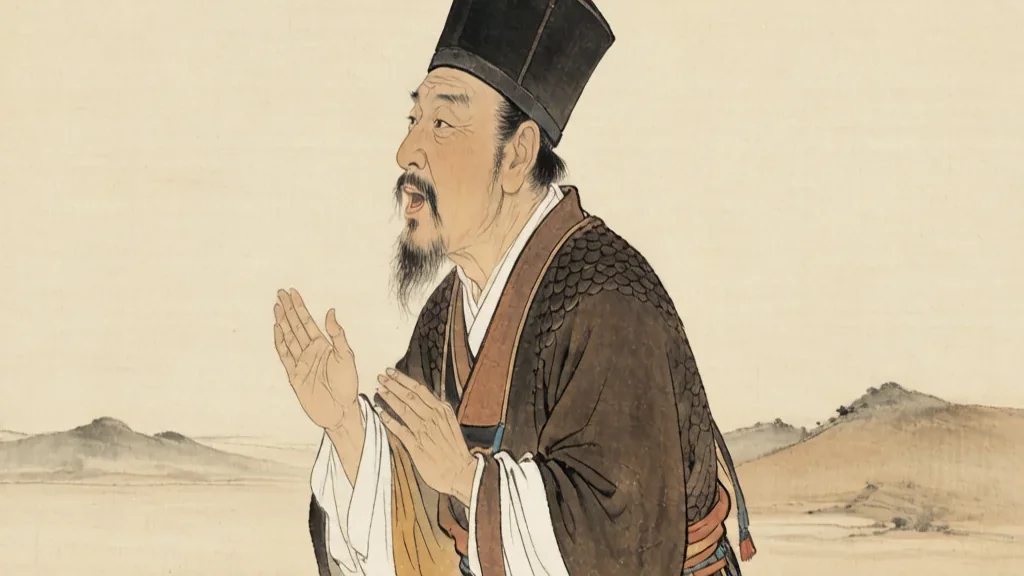
The Dongba religion of the Naxi people of southwest China is unique in the world: it is a living faith whose scriptures are written in pictographs — small painted pictures of the sun, the moon, a man, a mountain — that are still read aloud by priests today. Centered on the town of Lijiang in Yunnan, Dongba is the only indigenous hieroglyphic writing system still in active use anywhere on earth. More than a script, it carries an entire cosmology, a body of ritual, and a vanishing way of seeing the world in which humans, nature spirits, and ancestors are bound together.
The Dongba Script
The Dongba script uses well over a thousand pictographs. Unlike Chinese characters, which are logographic and largely divorced from their original pictures, Dongba signs still look like what they mean: a crescent for the moon, a wavy line for water, a stick figure for a person. The system is partly phonetic — some signs stand for sounds as well as meanings — but its genius is visual. Crucially, the script was never used for everyday correspondence; it exists almost entirely to record ritual texts. This is why scholars call it a "hieroglyphic" rather than a fully developed writing system, and why its survival is so precious.
The Dongba Priests
A Dongba is both priest and scribe. He (the role has traditionally been male) undergoes years of apprenticeship to memorize the vast corpus of sacred texts, learn the choreography of ceremonies, master the pictographic script, and train his memory for all-night chanting. A senior Dongba may know dozens of rituals by heart and be able to paint the spirit-banners used in them. He leads the community through birth, marriage, illness, and death, and acts as its bridge to the unseen world. The training is oral and practical; the books are aids to a performance that lives in the body and the voice.
The Naxi Cosmology
Naxi religion is a layered blend of indigenous belief, Tibetan Buddhism, and Daoism. At the top sits the creator and culture-hero Mibao (also called Mee-ba), who taught humans their rituals and their writing. Beneath him are the shu — nature spirits who own the mountains, rivers, trees, and animals. The shu are not gentle; if humans take too much from nature without making offering, the shu send illness and misfortune. This gives Dongba a strong ecological ethic: the land is inhabited and must be respected. Ancestors, too, remain active, and the dead must be properly sent home lest they linger and harm the living.
The Creation Epic
The centerpiece of Dongba literature is the creation myth, told in a long epic chanted at festivals. It narrates how the world began in chaos, how the first humans were shaped, how death and separation entered the world, and how the Naxi received their customs from the gods. The best-known episode is the "Battle of the Gods and the shu," in which order is won from rivalry, and the "Origin of the Dongba Scriptures," in which the god Mibao descends to teach humankind how to read, heal, and sacrifice. These stories are not merely literature; they are the charter for how the Naxi should live.
Major Ceremonies
The most important Dongba rite is the "Sacrifice to Heaven" (jitian), performed annually by each lineage to secure prosperity and harmony with the high gods. Equally vital is the "Road-Opening" funeral ritual, in which the priest chants a map of the soul's journey back to the ancestral homeland in the north, painting a "spirit road" banner to guide the dead. There are also great communal rites to appease the shu, and exorcisms to drive out disease-spirits. Ceremonies combine chanting, drumming, dancing, and the burning of paper effigies, often lasting days.
Dongba Art and Dance
Dongba is famous for its visual art. Priests paint ritual scrolls, masks, and "spirit road" banners in a bold, almost childlike pictographic style, and they perform a formalized "Dongba dance" in which each movement depicts a deity, animal, or spirit. A remarkable set of paintings, the "Dongba Dance Scripture," catalogs hundreds of postures with written captions — an illustrated choreography manual unique in China. The art is functional, not decorative: every figure is a being to be summoned, honored, or driven away.
Dongba Paper and Craft
Dongba texts are written on handmade paper produced from the bark of the wаx tree (a local evergreen), a craft perfected over centuries. The resulting paper is thick, durable, and naturally resistant to insects — essential in the damp climate of Lijiang, where ordinary paper would rot. Pigments are made from minerals and plants, and brushes from bamboo and animal hair. The making of paper, ink, and banner is itself a sacred skill passed within Dongba families, binding the written tradition to a material craft.
Decline and Political Turmoil
The Dongba tradition suffered badly in the twentieth century. The suppression of "feudal superstition" in the mid-century campaigns, and especially the upheavals of the Cultural Revolution, destroyed countless manuscripts and discouraged practice. Many elders who held the knowledge died before passing it on, and the Naxi language itself narrowed as Mandarin became the language of school and work. By the late 1970s, observers feared the tradition might disappear within a generation.
Contemporary Revival
Since the 1980s the Chinese state has reversed course, recognizing Dongba as an precious intangible cultural heritage and supporting its study. The Dongba Culture Research Institute in Lijiang trains new priests, catalogs surviving manuscripts, and publishes editions of the scriptures. Lijiang's status as a UNESCO World Heritage site has brought tourism that both funds and threatens the tradition — visitors love the pictographs, but commercialization can hollow out their meaning. The challenge now is to keep Dongba a living ritual rather than a museum piece, and a handful of young Naxi are again learning to read the pictures of their ancestors.
❓ Frequently Asked Questions
What is Dongba?
It is the indigenous shamanic faith of the Naxi of Yunnan, led by Dongba priests and recorded in a pictographic script.
Why does Dongba use pictographs?
Its picture-characters record rituals, the creation epic, and healing texts in a script still read aloud today.
Where is Dongba practiced?
Around Lijiang in Yunnan, a UNESCO heritage region, though the tradition has spread with the Naxi diaspora.
Is Dongba a written language for daily use?
No. The script exists almost entirely for religious texts, not for ordinary letters or accounts.
Who are the shu?
They are nature spirits who own the mountains, rivers, and animals, and who must be appeased with offerings.
Is Dongba still alive today?
Yes. Institutes in Lijiang train new priests and publish texts, though tourism and assimilation remain challenges.