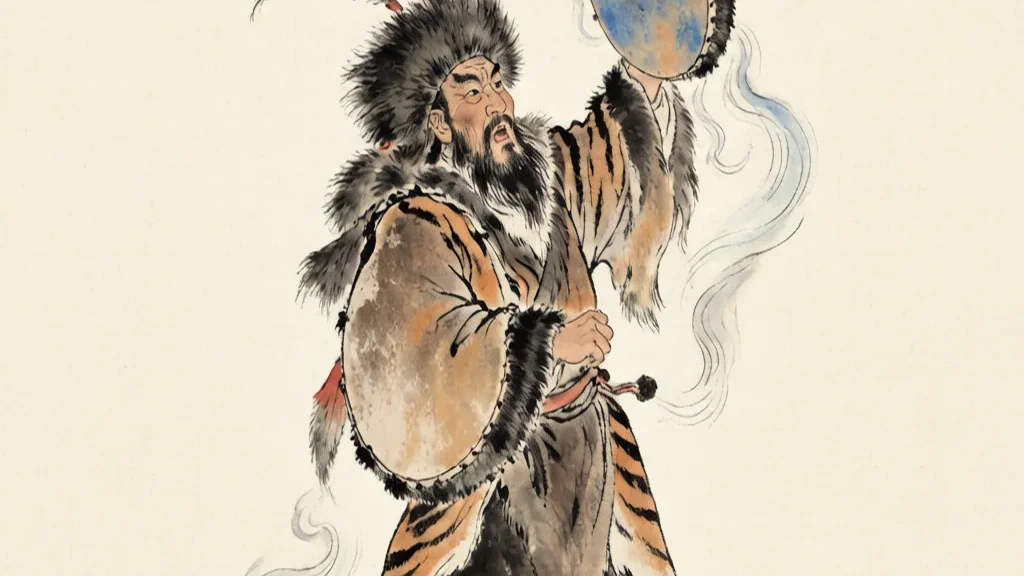
Shamanism in China lives among the northern peoples — the Tungusic and Mongol spirit-workers of the forests, steppes, and taiga, who journey in trance to heal the sick, find lost souls, and ensure the success of the hunt. Far from the imperial Confucian court and the stone temples of the south, this is a religion of breath, drumbeat, and freezing rivers, in which the boundary between the human world and the spirit world is thin enough to cross. Among the Manchu, Ewenki, Nanai, Oroqen, and Mongol peoples, the shaman remains a figure of awe: part priest, part doctor, part traveler between worlds.
What Is a Shaman?
A shaman is a ritual specialist who can enter an altered state of consciousness to communicate with spirits, heal illness, guide the dead, and negotiate with the powers of nature. The shaman's authority does not come from book learning or ordination but from a personal calling — often a sickness, a vision, or a brush with death that marks the person as one the spirits have chosen. Once initiated, the shaman is said to possess spirit helpers, ancestors, and animal allies who lend their strength during journeys. In Tungusic understanding, the shaman is not merely a performer of rites but a living bridge: the only human who can travel where ordinary souls cannot go and return to tell of it.
The Roots of the Word "Shaman"
The word "shaman" itself comes from the Tungusic language of the Evenki people, where saman means "one who knows" or "one who is excited." Russian explorers encountered the term in Siberia and carried it into European languages in the seventeenth and eighteenth centuries, and from there it entered English. Today the word describes similar spirit-medium traditions across the Arctic, Central Asia, and the Americas, but its linguistic birthplace lies precisely in the Tungusic north that this article concerns. In Chinese the practice is called saman jiao (萨满教), "the teaching of the shaman," though among the peoples themselves it is less a codified religion than a way of life.
The Tungusic Three-World Cosmos
Tungusic cosmology imagines the universe in three layers. The Upper World is the home of benevolent and ancestral spirits, often associated with the sky and the sun. The Middle World is the human realm of villages, rivers, and animals. The Lower World is a darker region of powerful, sometimes dangerous spirits that must be approached with caution. These worlds are connected by a cosmic tree, mountain, or river — a vertical axis the shaman climbs or descends during trance. This three-world model is shared, with local variations, across Siberian and Central Asian shamanic cultures, and it explains why so much of shamanic equipment (poles, ladders, notched staffs) is built to symbolize a route upward or downward.
The Shaman's Drum and Costume
The shaman's most important instrument is the frame drum, often called the "spirit drum." Its round skin is the shaman's horse, boat, or wing — the vehicle that carries the soul on its journey. The drum's back is frequently painted with a map of the cosmos or the shaman's helping spirits. Equally important is the costume: a fringed coat whose hanging strips represent feathers or the rays of the world tree; a headdress of metal antlers or birds that marks the shaman as part-animal; and belts hung with bells and iron mirrors that clang to drive off hostile spirits. Every element of the regalia is a tool of transformation, announcing to the spirits that a journey is beginning.
Initiation and the Calling
Among the Tungusic peoples, no one simply decides to become a shaman. The calling usually arrives as an ordeal: a prolonged illness, seizures, wandering in the woods, or a dream in which spirits demand service. Elders recognize these signs and put the candidate through a long apprenticeship under an established shaman. The initiate must learn the names of hundreds of spirits, memorize long chants, master the drum, and survive symbolic "dismemberment" — a mythic death in which the body is cut apart and rebuilt by the spirits, stronger than before. Only after this painful rebirth is the new shaman considered able to travel safely.
Rituals of Healing and the Hunt
The two great tasks of the northern shaman are healing and the hunt. For healing, the shaman journeys to retrieve a lost soul — the belief being that sickness comes when a person's soul wanders or is stolen by a spirit. The shaman finds it, coaxes it back, and seals it in the body. For the hunt, the shaman asks the animal masters — the spirits who guard the herds of elk, bear, and reindeer — for permission and luck, promising that the bones and gratitude will be returned to the forest. These are not abstract ceremonies but practical negotiations for survival in a harsh land, and the shaman's failure could mean a village went hungry or a sick child died.
Shamanism Among the Manchu
The Manchu, who founded the Qing dynasty (1644–1912), practiced a distinctive shamanism centered on the worship of heaven (abka), ancestors, and a pantheon of hunting and clan spirits. Manchu shamans served their lineages in rituals of purification, sacrifice, and thanksgiving, often performed around a sacred wooden pole set in the courtyard. The "sacred pole" (suolun gan) was understood as a conduit between heaven and earth, up which offerings of pork and millet could ascend to the spirits. Manchu shamanism was intensely domestic and clan-based, tied to the hearth rather than to public temples.
The Qing Imperial Cult
When the Manchu rose to rule all of China, they brought their shamanism into the palace. The Qing court maintained shamanic shrines inside the Forbidden City and at the imperial ancestral temple, conducting regular rites of heaven-worship and ancestor-offering according to Manchu custom. For a time, this northern cult stood beside — and sometimes above — the Confucian state rituals of the conquered Han majority. Yet over the long span of the dynasty, Buddhist and Confucian forms gradually absorbed or displaced many shamanic practices at court, and by the nineteenth century the imperial shamanism was a conservative relic rather than a living faith.
Shamanism Among the Ewenki, Nanai, and Oroqen
Beyond the Manchu, the Tungusic tradition survives among smaller peoples of the northeast. The Ewenki reindeer herders of Inner Mongolia and the Russian borderlands keep shamans who work with the spirits of the taiga. The Nanai (Hezhen) of the Amur River region are famous for richly carved shamanic robes and for female shamans whose power was especially linked to water and fish spirits. The Oroqen, a hunting people of the Greater Khingan range, preserved bear-ceremonies in which the slain animal was honored as a returning ancestor. In each group the details differ, but the core — a chosen person who travels for the community — remains the same.
Survival, Pressure, and Revival
Tungusic shamanism has endured centuries of pressure: the advance of Tibetan Buddhism and Daoism, the anti-superstition campaigns of the twentieth century, the disruption of the Cultural Revolution, and the slow erasure of indigenous languages through assimilation. Yet it has not vanished. Among the Ewenki, Nanai, and Oroqen, elders still remember the chants, and a few practicing shamans remain. Since the 1980s the Chinese state has listed elements of northern shamanism as intangible cultural heritage, and anthropologists and filmmakers have recorded what they can. The tradition now faces a new threat and a new hope at once: tourism and identity politics that can commodify it, even as younger people rediscover it as a badge of ethnic pride.
❓ Frequently Asked Questions
Who are the shamans?
Among the Manchu, Ewenki, Nanai, Oroqen, and Mongols, they are ritual specialists who enter trance to work with spirits on behalf of the community.
What do shamans actually do?
They ascend the spirit world to heal the sick, retrieve lost souls, ensure hunting success, and guide the dead to the afterlife.
Where does the word "shaman" come from?
It comes from the Evenki Tungusic word saman, meaning "one who knows," passed into Russian and then into English.
What marks Tungusic shamanism?
Its defining marks are the drum, the symbolic costume, the three-world cosmos, and the journey of the soul in trance.
Did the Qing court practice shamanism?
Yes. The Manchu founders maintained shamanic shrines in the Forbidden City, though Buddhist and Confucian rites later displaced much of it.
Does Tungusic shamanism still survive?
It does, among the Ewenki, Nanai, and Oroqen, though it faces pressure from modernization, assimilation, and the loss of indigenous languages.