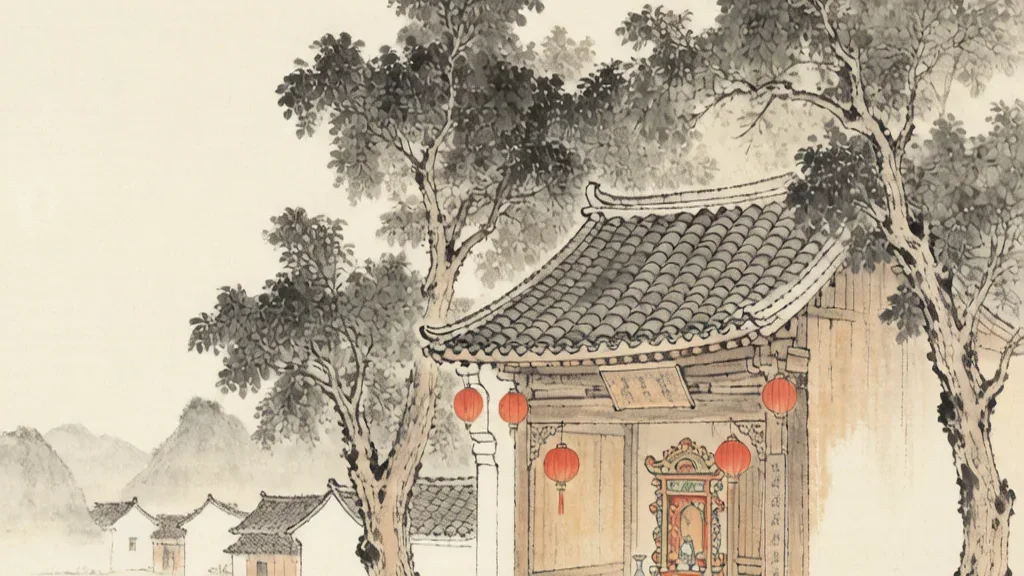
Across the Chinese countryside and in the lanes of old towns, small temples devoted to local gods dot the landscape: the earth god's shrine at the village edge, the neighborhood temple to a protective deity, the wayside altar to a figured hero. These are the minjian miao — folk temples — the grassroots layer of Chinese religion, distinct from the great Buddhist monasteries and Daoist abbeys. Their gods are not universal buddhas but intimate local powers: the Tudigong, or "Lord of the Earth," who guards a single street or field; the Cheng Huang, city god of a walled town; the Mazu of a fishing coast. Folk temples are where most Chinese, historically, actually met the divine — through festivals, vows, and the everyday business of asking a neighbor-god for rain, heirs, and safety.
What a Folk Temple Is
A folk temple is any shrine managed by a local community rather than by a celibate monastic order. It may be grand or a single niche in a wall, but its defining feature is that it belongs to the people of a place: a village, a guild, a surname group, a ward of the city. The priesthood, if any, is often part-time and locally hired; the real authority lies with lay trustees and the worshippers themselves. Folk temples are practical institutions. People come to make a yuan (vow) — "if my son recovers, I will repaint your statue" — and to repay it with a plaque, a curtain, or a opera performed in the god's honor.
This is religion as contract and reciprocity. The god protects; the community feeds, honors, and repairs his house. The boundary between "Buddhist," "Daoist," and "folk" is blurry at the local level: a folk temple might shelter a Buddhist Guanyin beside a Daoist Zhenwu beside an unclassified local serpent-spirit, because what matters is efficacy, not doctrine. Scholars call this blending "Chinese popular religion," and the folk temple is its headquarters.
The Earth God: Tudigong and Tudi Miao
The most ubiquitous folk deity is the Tudigong, often called the "God of the Soil" or "Local Earth God," paired with his wife Tudipo. His shrine, the Tudi miao or "earth temple," can be found at almost every village entrance, crossroads, bridge, and graveyard in the Chinese countryside. He is a humble, grandfatherly figure in a square hat, far below the great celestial gods in rank, but he is the one who knows every household and every field. Farmers offer him incense at planting and harvest; travelers bow to him for safe passage; builders placate him before breaking ground.
The earth god's job is local administration of the invisible. He reports births and deaths in his jurisdiction to the heavenly bureaucracy, guards the boundary stones, and settles quarrels among lesser spirits. Because his power is small and intimate, he is approachable — the deity you complain to about a noisy ghost or a stolen chicken. In cities his role was taken by the Cheng Huang (city god) and the men shen (gate gods) who guarded the wards.
The City God: Chenghuang Miao
Above the village earth god stood the Chenghuang, the City God who protected a walled town and its people. Every county seat of imperial China had a Chenghuang miao, usually near the yamen (government office), because the City God was imagined as the spiritual magistrate mirroring the earthly one. He judged the dead, presided over the underworld court of his city, and could be invoked to end droughts, plagues, and riots. Notably, many City Gods were real historical officials later deified — virtuous magistrates who, after death, were believed to continue serving the public as gods.
The City God's temple was a civic center. Annual inspections paraded his image through the streets; major lawsuits were sometimes sworn before him; and at the ghost festival he received the hungry dead. The Chenghuang miao of Shanghai and of Xi'an remain famous, the former now surrounded by a bustling bazaar that shows how folk temples doubled as markets and meeting places.
Community Temples and the Temple Fair
Many folk temples are dedicated to a patron of a trade, a clan, or a locality — Guangong for merchants, Mazu for sailors, a loyal minister or a filial daughter for a hometown. Their great moment is the miao hui, the temple fair, held on the god's birthday. The fair combines procession, opera on a temporary stage facing the god, food stalls, and gambling, drawing thousands. The procession carries the god's sedan through the neighborhood so he can "inspect" his territory and absorb its praise; the opera repays his protection with entertainment.
Temple fairs are also economic and social hubs. They set dates for trade, matchmaking, and the settling of accounts. In imperial and republican times the fair was often the largest regular gathering in a peasant's year. The temple committee that runs the fair is a real local government of sorts, raising funds, arbitrating, and representing the community to the state — which is why folk temples were sometimes treated by authorities as centers of subversion as much as of piety.
Household and Wayside Shrines
Folk religion does not stop at the temple door. Most homes keep a small altar with ancestral tablets and prints of Caishen (the wealth god) or Zao Jun, the Kitchen God, who reports each family's conduct to heaven on the twenty-third of the twelfth month. At the street level, tiny she shrines and lishè altars to the soil and grain once marked every hamlet; the word shehui ("altar and gathering") is the very root of the modern Chinese word for "society." A wayside niche to a local chenghuang subordinate or a wangye plague god might receive a stick of incense from any passerby seeking luck.
These miniature shrines show that folk religion is distributed and granular: the sacred is woven into the geography of daily life. You do not have to climb a holy mountain to meet a god; one stands at the end of the lane. The intimacy is the point — a god who knows your name and your field.
Ritual Specialists: The Liturgical Side
Folk temples employ a range of part-time ritual experts. The shenzhu or "incense master" keeps the altar and leads lay worship. For funerals, exorcisms, and the great communal rites, communities hire Daoist priests (daoshi) or Buddhist monks (heshang), or local mediums (jitong) who fall into trance to write "spirit letters." A fashi (ritual master) may perform the jiao thanksgiving festival that renews the covenant between a community and its gods, complete with a "pardon" petition carried to heaven on a paper boat.
The liturgy is syncretic. A single village rite might blend Daoist cosmic diagrams, Buddhist sutra-chanting, and older shamanic possession, stitched together by lay organizers who care about results. This pragmatic mixing is the hallmark of folk religion and the reason it resists neat classification by the great traditions.
Gods of Wealth, Kitchen, and Gate
Beyond the earth and city gods, the folk pantheon teems with functional deities. Caishen, the God of Wealth, is welcomed at the New Year with opening-the-gate-of-wealth ceremonies and images pasted on doors. Zao Jun, the Kitchen God, lives by the stove and is the family's internal spy for heaven; on his ascent he is plied with sticky sweet malt so he will "speak sweetly" and not report faults. The men shen, two brusque door-gods, paste on gates to block evil from entering. Each governs a slice of domestic life, and each gets his small offering.
This分工 (division of labor) among minor gods is strikingly bureaucratic: the supernatural world is organized like a government, with clerks, judges, and patrols. The folk temple is the local office of that government, and worship is a kind of civic administration of fortune.
Persecution and Revival
Folk temples have always lived precariously under states suspicious of unauthorized collective power. The Republican-era "Down with the Gods" campaigns, the mid-century suppression of "feudal superstition," and the Cultural Revolution's Red Guards destroyed or converted innumerable shrines — into schools, granaries, and offices. Statues were smashed, incense banned, and festivals forbidden. By the late 1970s many villages had no standing temple and no one who remembered the chants.
Since the 1980s the rebound has been astonishing. Communities have rebuilt earth-god shrines, refloated temple fairs, and re-established procession routes, often with funds from overseas relatives and local entrepreneurs who credit the gods with their success. The state now tolerates and even promotes "intangible cultural heritage" folk events, so long as they read as culture rather than "superstition." The result is a living, contested, vigorously local religious life.
Folk Religion and Chinese Identity
Folk temples are more than piety; they are the architecture of community. They house the memory of a place — its founding clan, its rescued saint, its annual rhythm. Anthropologists from J. J. M. de Groot to modern fieldworkers have argued that this popular layer is the true "civil religion" of China, more durable than any dynasty. To understand Chinese spirituality one must stand, therefore, not only in the famous monastery but in the small tudi miao at the village gate, where a farmer lights a stick of incense to the old man who watches over his field.
❓ Frequently Asked Questions
What is a folk temple?
It is a community shrine to local gods, run by lay trustees rather than monks, where people make vows and seek practical help.
Who is the earth god Tudigong?
He is the humble Local Earth God who guards a single village or ward and knows every household and field within it.
What happens at a temple fair?
On a god's birthday the community parades his image, stages operas in his honor, and holds a great market and feast.
Are folk temples Buddhist or Daoist?
Usually both and neither; they blend gods and rites from many sources, valuing results over strict doctrinal belonging.
What is the Kitchen God's job?
He lives by the stove and reports each family's behavior to heaven once a year, so households placate him with sweets.
Are folk temples still active?
Yes. Since the 1980s villages have rebuilt shrines and revived fairs, now often promoted as cultural heritage.