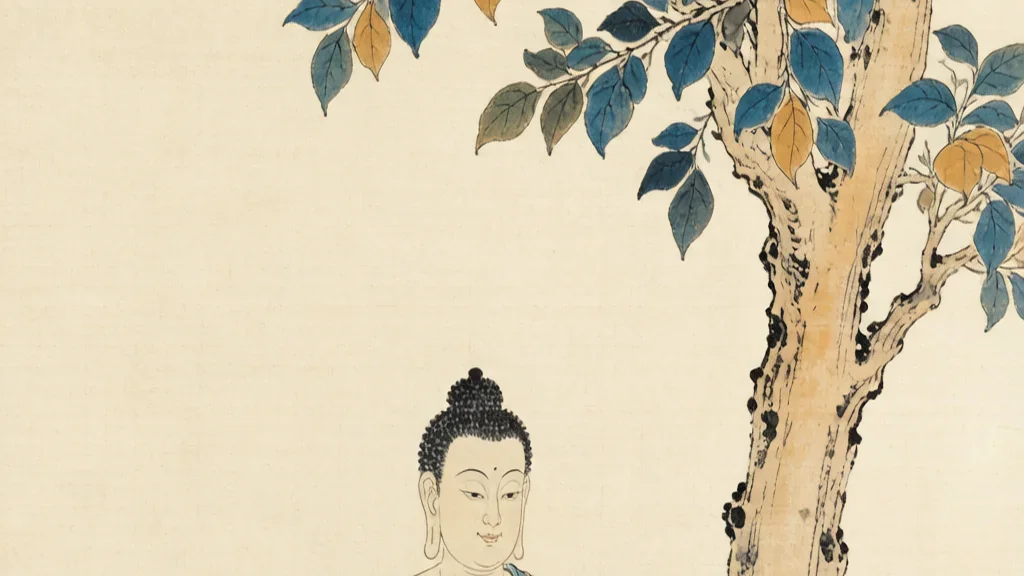
The life of Siddhartha Gautama — the Buddha, the "Awakened One" — is among the most influential stories ever told. Born a prince in what is now Nepal, he abandoned his palace to solve the riddle of suffering, and beneath a tree he woke to a vision of how the world works. Although his footsteps never fell on Chinese soil, his biography traveled the Silk Road and was retold in Chinese for nearly two thousand years, shaping caves, sutras, poems, and the daily devotion of millions. To understand the Buddha's life is to understand the seed from which Chinese Buddhism grew.
Birth and the Prophecy
Tradition places the birth of Prince Siddhartha around the fifth century BCE in the kingdom of Kapilavastu, at the foot of the Himalayas. His mother, Queen Maya, was said to have conceived him after a dream of a white elephant, and to have given birth standing beneath a sal tree in the Lumbini garden. Seers prophesied that the child would become either a universal monarch or a fully enlightened teacher who would renounce the world. His father, King Suddhodana, longing for a successor, resolved to shield the boy from every sight of pain, surrounding him with pleasure and walls.
Life Inside the Palace
For years the young prince knew only comfort. He was given three palaces for the three seasons, music, and a wife, Yasodhara, who bore him a son, Rahula. Yet the king's protection could not hold forever. Siddhartha was a thoughtful child who noticed the limitation of pleasure, and as he grew he began to wonder what lay beyond the gates. The court's efforts to hide aging, sickness, and death from him only made the eventual discovery more shattering — a classic Buddhist teaching that ignorance, not suffering itself, is the root of unease.
The Four Sights
On excursions beyond the walls, the prince met in turn an old man bent with age, a sick man in pain, a corpse being carried to the burning ground, and a calm wandering ascetic with no possessions. The first three revealed the inescapable truths of decay, illness, and death that await all living things; the fourth showed that one might meet them not with denial but with a free and searching spirit. These "four sights" overturned his world. Realizing that his own luxury could not exempt him or those he loved, he determined to find a cure for the human condition.
Renunciation
That night, legend says, Siddhartha looked once more on his sleeping wife and child, and quietly rode out of the palace with his servant and horse. Cutting his hair and exchanging royal robes for a beggar's cloth, he became a homeless seeker. This act — the "great going forth" — is the model for every Buddhist monk's ordination: the willing surrender of family, status, and comfort in exchange for the search for truth. He was twenty-nine, by the traditional count, and he would not return as a prince but as the Buddha.
The Years of Austerity
Siddhartha first studied with the great teachers of his day, mastering their meditations, then joined a band of extreme ascetics who ate almost nothing and tortured the body to break its cravings. For six years he pushed himself to the edge of death by starvation. Yet enlightenment did not come. He realized that neither indulgence nor self-torture was the path; the answer lay in a "middle way" between the two. Reviving himself with food offered by a village girl, he left his companions and seated himself beneath a fig tree to meditate without rising.
Enlightenment Under the Bodhi Tree
Beneath the bodhi tree at Bodhgaya, Siddhartha vowed to remain until he understood the cause of suffering and its end. Through the night Mara, the tempter, assailed him with armies, doubt, and desire, but the future Buddha summoned the earth to witness his past merits and defeated each attack. As the morning star rose, his mind cleared completely: he saw the chain of cause and effect by which beings are born and reborn, and he woke as the Buddha. He had become, at about thirty-five, the Awakened One who would spend forty-five years teaching what he had found.
The First Sermon and the Dharma
Soon after, the Buddha walked to the Deer Park at Sarnath and preached to his former companions, setting in motion the "Wheel of Dharma." His first teaching laid out the Four Noble Truths — that life is marked by unsatisfactoriness, that this comes from craving, that it can cease, and that the path to its cessation is the Noble Eightfold Path of right view, intention, speech, action, livelihood, effort, mindfulness, and concentration. These two formulations remain the skeleton of all Buddhist teaching, in China as everywhere else.
The Buddha's Teaching in China
The Buddha's biography reached China with the first Buddhist missionaries in the Han period, carried along the Silk Road and later the sea routes. Chinese monks translated the life-stories (the jataka tales of his former births, and the vanayana accounts of his last life) into flowing prose, and pilgrims like Xuanzang traveled to India to bring back fuller versions. Artists carved his birth, enlightenment, and death into the caves of Dunhuang, Yungang, and Longmen. For Chinese devotees the Buddha's life was not remote history but a mirror of their own capacity to wake up.
Festivals and Devotion
Chinese Buddhists still mark the Buddha's life in the calendar. His birth is celebrated on the eighth day of the fourth lunar month as the "Bathing the Buddha Festival" (Buddha's Birthday), when statues are lavished with sweet tea. His enlightenment and death (parinirvana) are honored in other observances, and his image presides over every altar. To recite his name, to light incense before his form, or to trace his story in a temple mural is, for the faithful, to keep the awakened example close — a daily reminder that awakening is possible for anyone.
The Buddha's Death and Legacy
According to tradition, the Buddha died at about eighty, in the town of Kushinagar, having eaten a final meal and laid himself down between two sal trees. He told his disciples that the Dharma, not a person, was now their refuge, and that all compounded things are subject to fading. His parinirvana — the final "blowing out" of the fires of craving — became a major subject of Chinese art and a consoling image of peace. From that death flowed the schools of China: Chan, Pure Land, Tiantai, Huayan, and the rest, each a different way of living the life he began.
❓ Frequently Asked Questions
What is the core story of the Buddha's life?
Birth as a prince, the four sights of suffering, renunciation, years of austerity, enlightenment under the bodhi tree, and forty-five years of teaching.
How did China receive the Buddha's story?
Via the Silk Road and sea routes from the Han period on, inspiring cave art, translated sutras, and new schools.
Why is the Buddha important in China?
His teaching became one of the three great traditions alongside Confucianism and Daoism, shaping art, ethics, and daily life.
What are the Four Noble Truths?
That life involves unsatisfactoriness, that this comes from craving, that it can cease, and that the Eightfold Path leads to its cessation.
What is the bodhi tree?
The fig tree at Bodhgaya under which Siddhartha meditated and awoke as the Buddha; a major pilgrimage site.
How do Chinese Buddhists honor the Buddha's life?
Through the Bathing-the-Buddha festival, temple murals of his life, chanting his name, and lighting incense before his image.