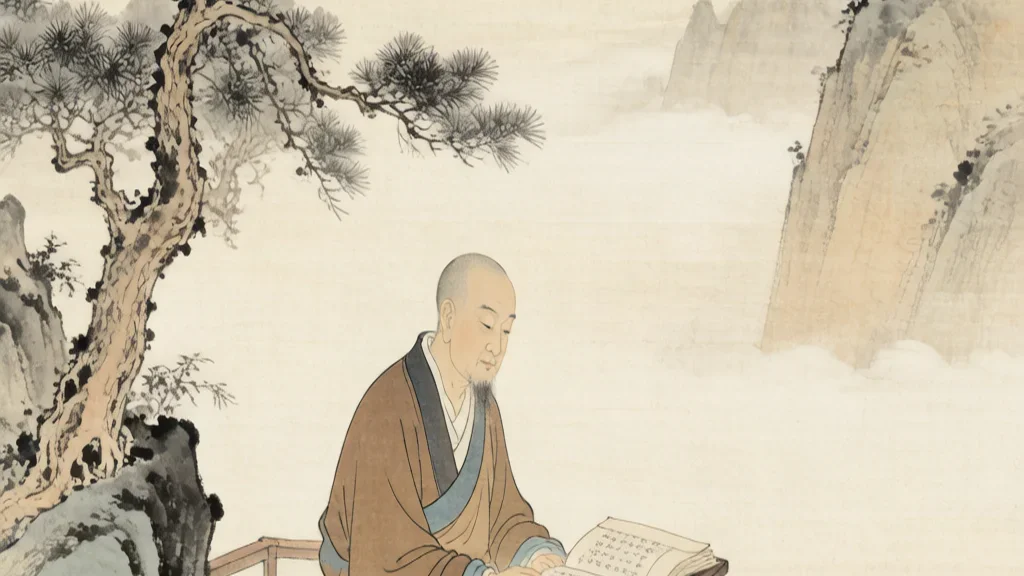
Tiantai Buddhism (天台宗, Tiāntái Zōng) was the first major school of Chinese Buddhism to construct a comprehensive philosophical and contemplative system entirely from a Chinese standpoint. Founded by the great synthesizer Zhiyi (智顗, 538–597) on Mount Tiantai in present-day Zhejiang province, the school took its name from that mountain rather than from a scripture or a person. Its central conviction is that all Buddhist teachings, however apparently contradictory, are skillful expressions of a single truth, and that the Lotus Sutra reveals the ultimate message that every sentient being—without exception—possesses the potential for Buddhahood. Blending rigorous scriptural classification, subtle metaphysics, and a concrete method of meditation, Tiantai offered later Chinese Buddhism a grand, inclusive framework that shaped Huayan, Chan, Pure Land, and the Japanese Tendai and Nichiren traditions for more than a millennium.
Zhiyi and the Founding of Tiantai
Zhiyi was born in the turbulent waning years of the Liang dynasty and became a monk in his youth, drawn to both meditation and the study of sutras. After training under the master Huisi, he settled on Mount Tiantai, where he gathered disciples, built monasteries, and produced the lectures that his students later compiled into canonical texts. Though he never claims the title of founder himself, later generations recognized him as the de facto creator of the school. What set Zhiyi apart was his refusal to favor one scripture over another; instead, he arranged the entire Buddhist canon into a logical progression, showing how each teaching prepared the mind for the next. His two monumental works, the Mohe Zhiguan (Great Calming and Contemplation) and the Fahua Xuanyi (Profound Meaning of the Lotus), remain the intellectual backbone of East Asian Buddhism. Through him, Indian doctrine was no longer merely translated but reorganized as a living Chinese path.
The Lotus Sutra as the Supreme Teaching
At the heart of Tiantai lies unshakeable devotion to the Lotus Sutra (法华经, Fǎhuá Jīng), which the school honors as the Buddha’s final and fullest revelation. In the Lotus narrative, the Buddha compares his earlier teachings to expedient medicines given to sick children, while the Lotus itself declares the One Vehicle—the single path that quietly unifies the sometimes separate vehicles of the hearers, the solitary buddhas, and the bodhisattvas. For Zhiyi this meant that the differences among Buddhist schools were not real contradictions but pedagogical stages suited to different capacities. The famous parable of the burning house, in which a father lures his children out with promises of three carts but gives them one magnificent white ox-cart, became for Tiantai the perfect image of skillful means culminating in unity. This inclusive reading made the school attractive to both ordained monks and lay devotees who longed for assurance of their own eventual awakening.
The Five Periods and Eight Teachings
To explain how the Buddha’s words could be both diverse and ultimately one, Zhiyi devised the classification known as the “Five Periods and Eight Teachings” (五时八教, Wǔshí Bājiào). The five periods trace the chronological arc of the Buddha’s career: the Flower Garland period immediately after enlightenment, the Agama period of basic doctrine, the Vaipulya period of expanded teachings, the Prajñaparamita period of wisdom, and finally the Lotus and Nirvana period. The eight teachings divide into the “four doctrines of doctrine,” distinguishing the content of the message, and the “four doctrines of method,” distinguishing how it was taught. This schema was not a dry table of contents but a spiritual map; it assured practitioners that apparent contradictions in the canon reflected the Buddha’s compassion in meeting people where they stood. The classification was so influential that nearly every later Chinese school measured itself against Tiantai’s arrangement of the scriptures.
The Three Truths
Tiantai metaphysics rests on the doctrine of the Three Truths (三谛, Sāndì): emptiness (空, kōng), conventional existence (假, jiǎ), and the middle way (中, zhōng). Emptiness affirms that no phenomenon possesses an independent, unchanging self-nature. Conventional existence affirms that, within dependent origination, things genuinely appear and function in the everyday world. The middle truth affirms that emptiness and conventional existence are not opposed but mutually pervading—each is the other, neither reducible to a mere negation. Zhiyi insisted that the three are not three separate truths to be grasped in sequence but one reality seen from three inseparable angles, a position called the “round and perfect” (圆融, yuánróng) perspective. This threefold logic allowed Tiantai to reconcile the negative dialectics of Madhyamaka emptiness with the affirmative cosmology of the Buddha-nature teachings, healing a split that had long troubled Buddhist thought in China.
The Threefold Contemplation in a Single Mind
From the Three Truths flows the meditative method of the “threefold contemplation in a single mind” (一心三观, Yīxīn Sānguān). Rather than rotating through three separate insights one after another, the practitioner realizes, within a single moment of awareness, emptiness, conventional existence, and the middle all at once. This is a cornerstone of Tiantai practice because it refuses the illusion that liberation is reached by discarding the world for some abstract void. The ordinary, deluded mind, observed calmly, is revealed to be identical with the enlightened mind; there is nowhere else to go. Zhiyi taught that this contemplation could be practiced while walking, sitting, or performing any daily activity, provided the attention was gathered and settled. The brilliance of the method lies in its economy: a single thought, thoroughly penetrated, opens onto the whole of reality.
Three Thousand Realms in a Single Thought
Tiantai’s most distinctive metaphysical formula is “three thousand realms in a single thought” (一念三千, Yīniàn Sānqiān). The number three thousand is derived by multiplying the ten realms of existence (hell, hungry ghosts, animals, asuras, humans, heavens, śrāvakas, pratyekabuddhas, bodhisattvas, and buddhas) by ten to show that each realm contains all the others, and then by the thirty realms of the five aggregates, the realms of sense, and the realms of dust. The startling conclusion is that one fleeting thought-moment of an ordinary person already encompasses the entirety of the cosmos, including all the buddha realms. This doctrine demolishes any sense of distance between samsara and nirvana; the world of suffering and the world of awakening interpenetrate in every instant. It gave Tiantai a profoundly this-worldly spirituality, in which enlightenment is not a far future achievement but the realization of what is already present.
Calming and Contemplation (Zhiguan)
The practical heart of Tiantai is zhiguan (止观), usually translated as “calming and contemplative insight.” Zhi, calming, stills the turbulence of discursive thought and stabilizes the mind in concentration; guan, contemplation, pierces phenomena with wise discernment. Zhiyi’s Mohe Zhiguan outlines a vast program of practice, from preliminary moral discipline and posture, through the gradual steps of concentration, to the sudden realization of the round and perfect truth. He enumerated the “four kinds of samadhi” practiced through sitting, walking, half-walking half-sitting, and non-moving conduct, as well as the “twenty-five assisting practices” for overcoming obstacles such as drowsiness, restlessness, and doubt. Crucially, Tiantai holds that calming and insight must be balanced; lopsided concentration dulls the mind, while lopsided analysis scatters it. This balanced, methodical approach made Tiantai a complete manual of mental cultivation that later Chan masters both borrowed from and reacted against.
Universal Buddhahood and the Buddhahood of Plants
Perhaps the most radical claim of Tiantai is the universal possibility of awakening. The Lotus Sutra’s promise that even the icchantika—the person of deepest delusion—can become a buddha is taken with full seriousness. Zhiyi and his heirs pushed this further with the teaching that insentient things, including plants and stones, also share in Buddha-nature (草木成佛, cǎomù chéngfó). Since reality is one and emptiness pervades all, there is no ground for excluding the non-sentient world from the scope of awakening. This idea scandalized more conservative schools, who reserved Buddhahood for beings with consciousness and moral capacity, but it expressed Tiantai’s consistent refusal to set up boundaries within the single truth. The ecological resonance of this view has made it newly attractive to modern interpreters, who see in it an ancient affirmation that human liberation is bound up with the liberation of the entire living cosmos.
Tiantai’s Influence on East Asia
Although Tiantai as an independent institution declined in China after the late Tang persecutions of Buddhism, its thought never disappeared. Its classification system became the common grammar of Chinese Buddhist exegesis, and its meditation manuals fed directly into the rising Chan school. In the eleventh century the Japanese monk Saichō carried Tiantai to Japan as Tendai, where it became the mother school of Japanese Buddhism and the matrix from which both the Pure Land faith of Honen and Shinran and the militant reform of Nichiren would emerge. Nichiren’s exclusive devotion to the Lotus Sutra and his chanting of its title are, in essence, a popularized Tiantai conviction carried to its logical extreme. In Korea and Vietnam, Tiantai lineages likewise persisted. Today the school’s emphasis on harmony, inclusivity, and the immediate availability of enlightenment continues to speak to anyone puzzled by the seeming contradictions among the world’s spiritual paths.
📝 Chinese Vocabulary
🎉 Fun Facts
❓ Frequently Asked Questions
What is the One Vehicle taught by Tiantai?
It is the Lotus Sutra’s teaching that all Buddhist paths are skillful means leading to one supreme awakening, so that every being can become a buddha.
Who founded the Tiantai school?
Zhiyi (538–597), who systematized its doctrines and meditation on Mount Tiantai in Zhejiang after training under the master Huisi.
What are the Three Truths?
Emptiness, conventional existence, and the middle way—three inseparable aspects of one reality, realized together rather than in sequence.
What does “three thousand realms in a single thought” mean?
It means one ordinary thought-moment already contains the entire cosmos, including all ten realms of existence, so samsara and nirvana interpenetrate.
How does Tiantai meditation work?
Through zhiguan, balancing calming (concentration) and contemplation (insight) so that a single observed thought reveals the whole of reality.
Why was Tiantai important for Chinese Buddhism?
It gave Chinese Buddhism a grand inclusive framework that classified the whole canon and shaped Huayan, Chan, Pure Land, and Japanese Tendai and Nichiren.