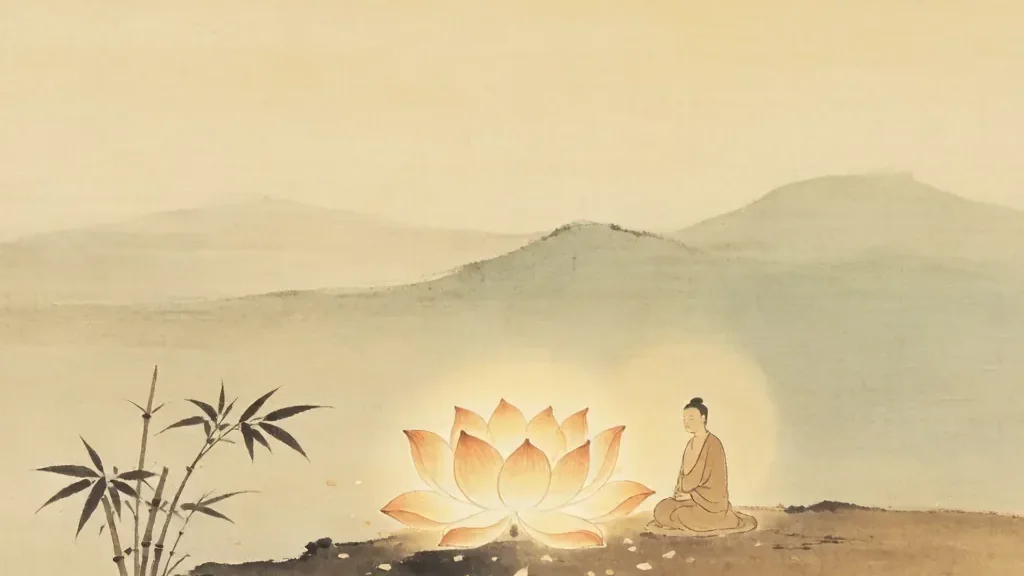
Pure Land Buddhism (净土宗, Jìngtǔ Zōng) is one of the most widely practiced forms of Buddhism in East Asia, embraced by hundreds of millions of followers across China, Japan, Korea, Vietnam, and the Chinese diaspora. At its heart lies a simple yet profound promise: by placing sincere faith in Amitabha Buddha and calling upon his name, an ordinary person can be reborn in his Pure Land, a realm of bliss where enlightenment is swift and certain. Unlike paths that demand decades of scholarly study or austere meditation, Pure Land opened the door of liberation to farmers, merchants, soldiers, the ill, and the elderly. This is the story of a faith built on grace rather than achievement, and of how a single vow reshaped the religious life of a continent.
Amitabha and His Vow
According to the foundational sutras of the tradition, Amitabha — whose name means "Infinite Light" and "Infinite Life" — was once a king who, moved by the suffering he witnessed, renounced his throne to become a monk named Dharmakara. Over countless eons of practice, he made forty-eight great vows (本愿, běnyuàn) describing the kind of Buddha-field he would create. The eighteenth vow is the most celebrated: he pledged that any being who, with sincere faith and aspiration, calls upon his name even ten times at the moment of death shall be reborn in his Pure Land.
This vow is the theological cornerstone of the school. Where other Buddhist paths emphasize the practitioner's own strenuous effort (self-power, 自力, zìlì), Pure Land teaches that Amitabha's vast merit, accumulated over ages, is offered freely to all who rely on it (other-power, 他力, tālì). The Buddha's compassion, in this view, meets the weakness of ordinary people who lack the time, temperament, or capacity for arduous training in a degenerate age.
Recitation of the Name
The core practice of Pure Land Buddhism is nianfo (念佛), the recitation of Amitabha's name. In China devotees most often chant "Namo Amituofo" (南无阿弥陀佛, "Homage to Amitabha Buddha"), using rosaries or prayer beads to count repetitions, or simply the rhythm of the breath to sustain a steady inner murmur. The practice can be voiced aloud, whispered, or held silently in the mind, making it portable and available at any moment — while walking, working, or facing death.
Because the method asks for no literacy, no temple, and no special status, it democratized Buddhism as never before. A grandmother in a village, a traveler on a road, a soldier before battle could all invoke the same saving name. The simplicity was deliberate: the masters taught that the very ordinariness of the practice is its profundity, for it turns the busy, distracted mind toward the Buddha with every repetition.
Faith and Practice
Pure Land teachers have long stressed that rebirth in the Pure Land is not an escape from responsibility but a stepping-stone. The realm is called "Pure" because every condition there supports spiritual progress: there is no war, hunger, or hatred, and one learns directly from Amitabha until full awakening is reached. From there the bodhisattva returns freely to this world to help others — the ideal of compassion fulfilled.
The great Tang master Shandao (善导, 613–681) clarified that single-minded faith, not the quantity of good deeds, is what secures rebirth, though virtuous living naturally follows from gratitude. Later teachers balanced this with the warning that mere lip-recitation without sincerity is hollow. The tradition thus wove together faith, aspiration, and conduct into a single continuous practice of remembrance.
The Pure Land Paradise
The Pure Land (Sukhavati, 极乐世界, Jílè Shìjiè, the "Land of Ultimate Bliss") is vividly described in scriptures such as the Amitabha Sutra and the Longer Sukhavati Sutra. It is a world of golden ground, jeweled trees whose leaves chime like music, and rivers of cool water in which the weary bathe. Strange and gentle birds recite the Dharma, and lotus flowers of miraculous size cradle the newborn souls who arise there.
Rebirth itself is imagined as a "lotus birth": the devotee appears seated within a lotus that gradually opens as his or her purity matures. There is no aging, sickness, or death, and no distinction of caste or sex — all are equal before the Buddha. This luminous imagery gave ordinary people a tangible, consoling picture of what awaits beyond the uncertainties of mortal life.
Huiyuan and the Lotus Society
The first organized Pure Land community in China is traditionally traced to the monk Huiyuan (慧远, 334–416), who gathered 123 disciples on Mount Lu in 402 CE and founded the White Lotus Society (白莲社, Báilián Shè). Facing the waters of Lake Poyang, they made a solemn vow to be reborn together in the Pure Land, sealing their pact with an offering to Amitabha.
Huiyuan is revered as a bridge figure: a scholar of Daoist and Confucian learning who turned wholeheartedly to Buddhism, and who insisted on the independence of the monastic order from court power. Though later lineages would name other figures as patriarchs, the White Lotus Society became the enduring model of a lay-monastic community bound by a shared vow — a template repeated in countless recitation societies down to the present day.
The Patriarchs of the School
Chinese Pure Land honors a lineage of patriarchs who systematized its teachings. After Huiyuan came Tanluan (昙鸾, 476–542), who turned from Daoist longevity techniques to Amitabha's vow; Daochuo (道绰, 562–645), who promoted nianfo with tireless energy; and Shandao, whose commentaries fixed the doctrine of exclusive reliance on the Buddha's power. The tradition eventually enumerated thirteen patriarchs, culminating in later figures who spread the faith among the people.
Two late masters deserve special mention. Zhuhong (莲池, 1535–1615) and, above all, Yinguang (印光, 1861–1940) revived Pure Land in the Ming and modern eras. Yinguang's plainspoken letters to lay followers — collected into volumes still read today — urged sincerity, filial piety, and constant recitation, making him the most influential Pure Land teacher of the last century.
Pure Land and Chan Synthesis
Despite their different emphases, Pure Land and Chan (Zen) meditation grew deeply intertwined in China. Chan stressed sudden awakening through disciplined sitting; Pure Land stressed salvation by faith. Rather than competing, they complemented each other, and many monasteries combined silent meditation with group nianfo recitation.
The tenth-century master Yongming Yanshou (永明延寿) famously taught that "Chan and the Pure Land are one" (禅净一致, chán jìng yīzhì). He argued that genuine insight and sincere devotion are two faces of the same path. By the late imperial period, the synthesis was so complete that most Chinese Buddhists identified simultaneously as Chan practitioners and Pure Land devotees, a dual identity that remains typical today.
Women and Lay Devotion
Pure Land's openness made it especially dear to women, the elderly, and the sick — those whom elite monastic Buddhism sometimes marginalized. Because rebirth depended on faith and the calling of the name rather than on ordination or learning, a laywoman could attain the same promise as a monk. Mothers taught nianfo to children; grandmothers kept small altars where they recited before domestic shrines.
The tradition also produced revered female exemplars and a vast literature of "transfer of merit," in which the living dedicated their recitation to departed parents and kin. In a society that prized filial duty, Pure Land offered a concrete spiritual technology for repaying one's parents and ensuring their safe passage — a powerful reason for its deep household roots.
Pure Land in Art and Architecture
The visual world of Pure Land is among the glories of East Asian art. Cave-temples at Dunhuang and Longmen preserve Tang murals showing Amitabha enthroned in his paradise, flanked by the bodhisattvas Guanyin (Avalokiteshvara) and Dashizhi (Mahasthamaprapta), the "Three Saints of the West" (西方三圣, Xīfāng Sānshèng). Below them, the faithful kneel in worship while music and light fill the scene.
Architecturally, Pure Land halls (弥陀殿, Mítuó diàn) became standard features of Chinese monasteries, housing colossal gilded statues of the Buddha before which congregations chanted. The imagery was not mere decoration but a devotional aid: gazing on the paradise was meant to plant its memory so deeply that the dying mind would naturally turn toward it at life's end.
Pure Land Today
Pure Land remains the devotional backbone of Buddhism across East Asia. In Japan it blossomed into the Jodo and Jodo Shinshu schools founded by Honen (1133–1212) and Shinran (1173–1263), the latter becoming the largest Buddhist denomination in the country. In Korea and Vietnam, nianfo societies thrive alongside meditation centers, while in China recitation groups meet daily in temples and homes.
Modern masters continue to teach that the practice speaks directly to contemporary anxiety: the simple repetition of a holy name becomes a refuge from noise and fragmentation. Whether understood as cosmic grace or as mindful concentration, Pure Land endures because it answers the oldest human question — how an ordinary, flawed person may still find release — with an answer as brief as a breath: call upon the Buddha, and trust.
📝 Chinese Vocabulary
🎉 Fun Facts
❓ Frequently Asked Questions
Q: What is the central practice of Pure Land Buddhism?
A: The central practice is nianfo — reciting "Namo Amituofo" with sincere faith to be reborn in Amitabha's Pure Land.
Q: Do Pure Land followers reject other Buddhist practices?
A: No. Most combine recitation with meditation, scripture study, and good deeds; in China Pure Land and Chan were long practiced together.
Q: What is the difference between Pure Land and Chan?
A: Chan emphasizes self-effort and meditation for sudden awakening; Pure Land emphasizes salvation by faith in Amitabha's grace.
Q: Is rebirth in the Pure Land permanent?
A: Yes. It is a temporary but secure stage where one trainings until reaching full Buddhahood, after which one may return to help others.
Q: Who was the most important Chinese Pure Land patriarch?
A: Shandao (613–681) of the Tang dynasty, who taught exclusive reliance on Amitabha's vow, is regarded as the school's great systematizer.
Q: How did Pure Land spread beyond China?
A: It traveled to Japan via monks such as Honen and Shinran, becoming Jodo and Jodo Shinshu, and also took root in Korea and Vietnam.