Huayan philosophy (华严, Huáyán) is among the most intellectually dazzling achievements of Chinese Buddhism. Grounded in the Avatamsaka Sutra—the Flower Garland—it presents a cosmos in which every phenomenon contains and reflects every other, like a vast net of jewels in which each gem mirrors all the rest. Flourishing in the Tang dynasty under a line of brilliant patriarchs, Huayan transformed an Indian scripture into a distinctively Chinese vision of totality, harmony, and mutual containment. Its influence reached far beyond the monastery, shaping Chan Buddhism, East Asian aesthetics, and even modern scientific and ecological thought. To read Huayan is to encounter a worldview in which separation is an illusion and every part, however small, is a doorway to the whole.
Indra’s Net: The Jeweled Cosmos
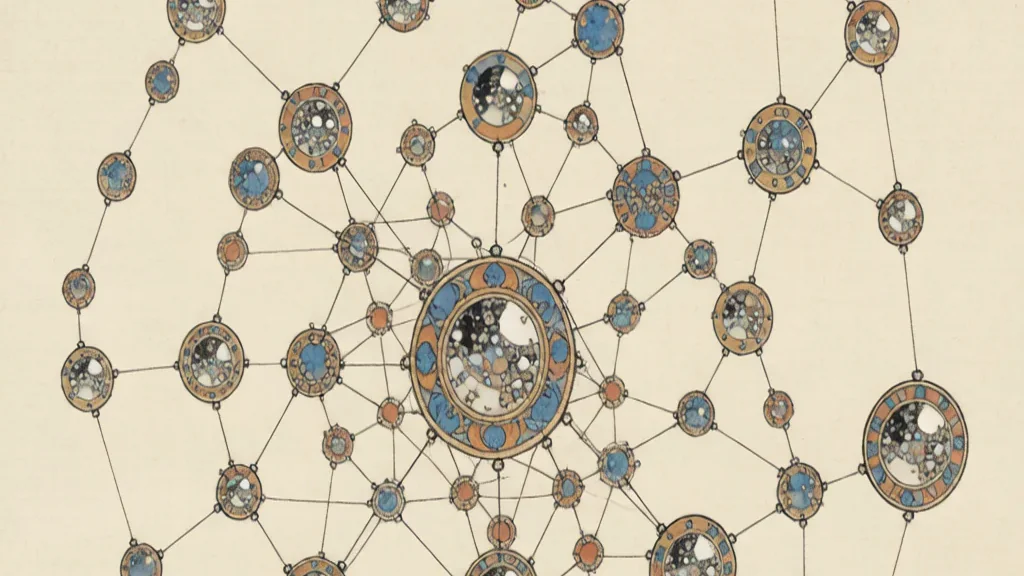
The school’s most famous image is Indra’s net, a cosmic lattice hanging in the palace of the god Indra. At each intersection sits a jewel, polished so perfectly that it reflects all the other jewels, and each of those reflections contains the reflections of all the others, to infinity. No jewel exists in isolation; each is at once itself and the entire net. Huayan takes this image as a literal description of reality: every atom, every moment of experience, every being is such a jewel, containing and reflecting the whole of existence. The metaphor became the cornerstone of Chinese Buddhist metaphysics and a poetic resource for centuries of art and literature. It expresses, in a single picture, the school’s central claim that the one and the many, the part and the whole, are perfectly interfused without confusion or loss of identity.
The Avatamsaka Sutra
Huayan takes its name from the Avatamsaka Sutra (华严经, Huáyán Jīng), a vast and visionary scripture probably assembled in stages in India and translated into Chinese in several recensions, the most celebrated being the七十卷 (seventy-fascicle) and the eighty-fascicle versions of the Tang. The sutra depicts the Buddha’s enlightenment as a cosmic event in which the entire universe is revealed as the radiant, ordered body of awakening. Its centerpiece, the “Ten Mysterious Gates” and the career of the bodhisattva Sudhana’s pilgrimage through fifty-three spiritual friends, illustrate the infinite interconnection of all things. For Huayan masters this text was not merely literature but the direct map of reality; their entire philosophy is an exegesis of its vision. The sutra’s scale and beauty made it, in the words of later admirers, the “crown” of the Buddhist canon in East Asia.
The Huayan Patriarchs
Huayan was systematized by a succession of Tang masters. Dushun (杜顺, 557–640) is honored as the first patriarch, who outlined the doctrine of the mutual containment of phenomena. His disciple Zhiyan (智俨) deepened the analysis, and the third patriarch, Fazang (法藏, 643–712), gave the school its mature form, writing the great commentaries that remain its foundation. Fazang served at the Tang court and famously explained the doctrine to Empress Wu Zetian by placing a golden statue of a lion in a hall of mirrors, showing how the one lion appears multiplied yet remains one—demonstrating the principle of “one in many, many in one.” Later patriarchs such as Chengguan (澄观) and Zongmi (宗密) defended and expanded the teaching, the latter bridging Huayan with Chan. Together these thinkers turned an Indian vision into a Chinese philosophical monument.
The Fourfold Dharmadhatu
To analyze reality, Huayan employs the scheme of the “fourfold dharmadhatu” (四法界, sì fǎjiè): the realm of phenomena (the world of distinct things), the realm of principle (the empty suchness that all things share), the realm of the non-obstruction of principle and phenomena (how emptiness and form coexist), and the highest realm of the non-obstruction of phenomena with one another. This last, “phenomena interfusing without obstruction” (事事无碍, shìshì wúài), is the school’s signature insight: not only do form and emptiness not conflict, but each individual phenomenon perfectly contains and penetrates every other. A single atom can hold the entire universe; a single thought can encompass all of time. The fourfold scheme is a ladder of understanding that culminates in the realization that the everyday multiplicity around us is already the perfect, unobstructed display of enlightenment.
The Ten Mysterious Gates
Within the highest realm, Huayan articulates the logic of interpenetration through the “Ten Mysterious Gates” (十玄门, shí xuán mén), a set of paired perspectives that show how the one and the many relate. For example, the gate of “all phenomena simultaneously present” affirms that the whole cosmos is contained in any single event; the gate of “the subtle and the vast freely penetrating” affirms that the infinitely small and the infinitely large interpenetrate. These are not abstract paradoxes but contemplative descriptions of how reality is actually structured, intended to dismantle the habit of thought that slices the world into separate, competing things. By rotating through the ten gates, the practitioner trains the mind to see every situation as both utterly unique and totally universal—a discipline that Huayan regarded as itself a form of awakening.
Enlightenment and the Interpenetration of All Things
Huayan insists that awakening is not the escape from the world but the clear seeing of the world as it already is: the perfect interfusion of all things in the suchness of the present moment. Because every phenomenon contains the whole, no experience is trivial and no being is outside the scope of enlightenment. Purity and defilement, delusion and wisdom, are not separate realms but interdependent aspects of one reality, like two sides of a single coin that cannot be pulled apart. This means that practice in any ordinary moment carries universal significance; to wash a bowl or to hear a bird is, potentially, to touch the entire Awakened Cosmos. The practical thrust of Huayan is therefore deeply this-worldly and affirming: the sacred is not elsewhere but radiant in the textures of daily life, available wherever attention is fully given.
Influence on Chan Buddhism
Although Huayan was an exegetical school, its vision fed directly into the rising Chan (Zen) tradition. The Chan emphasis on sudden enlightenment and on seeing one’s own nature owes much to Huayan’s claim that awakening is already present and needs only to be realized, not attained by stages. Patriarchs such as Zongmi explicitly sought to harmonize Huayan metaphysics with Chan practice, and later Chan monasteries routinely studied Huayan texts. The famous Chan phrase that “the mind is the buddha” and the koan literature’s playful dissolving of distinctions both echo Huayan’s logic of non-obstruction. In this sense Huayan provided Chan with its philosophical backbone, even as Chan supplied the lived, experiential realization that Huayan’s scholastic brilliance sometimes only described. The two schools are best understood as complementary expressions of one East Asian Buddhist genius.
Art, Aesthetics, and the Huayan Worldview
Huayan’s vision of totality left a deep imprint on East Asian art and aesthetics. The Chinese garden, with its carefully framed vistas in which a single rock or window opens onto an implied infinity, can be read as a built version of Indra’s net. Landscape painting that dissolves the boundary between near and far, and poetry that finds the cosmic in the particular, draw on the same sensibility. In Japan, Huayan-inspired temples such as Todaiji embody the ideal of the cosmic buddha Vairocana enfolding all things. Even ritual architecture—the concentric, symmetrical layout of monastic compounds—echoes the ordered yet interpenetrating cosmos of the sutra. Huayan thus shaped not only doctrine but the very forms through which East Asian cultures have trained themselves to perceive beauty as a glimpse of the whole.
Huayan in Modern Thought
In the modern era Huayan has enjoyed an unexpected second life as a point of dialogue between Buddhism and science. Thinkers such as D.T. Suzuki praised it as “the crown of Buddhist thought,” and the physicist David Bohm, in his notion of the “implicate order,” drew striking parallels with Huayan’s claim that each part enfolds the whole. Ecological philosophers have seized on the school’s denial of isolated selves as an ancient antidote to the fragmentation of modern life, arguing that if every being contains every other, then harming one is harming all. Whether or not these comparisons are scientifically exact, they testify to the enduring power of Huayan’s central intuition: that reality is a seamless, mutually reflecting whole, and that wisdom begins with seeing the connections we ordinarily overlook.
📝 Chinese Vocabulary
🎉 Fun Facts
❓ Frequently Asked Questions
What is Huayan’s core idea?
The “realm of Indra’s net,” in which every jewel reflects all the others endlessly, meaning every phenomenon contains and interpenetrates the whole.
Which text is central to Huayan?
The Avatamsaka (Flower Garland) Sutra, a vast visionary scripture regarded as a summit of East Asian Buddhism.
Who were the Huayan patriarchs?
A Tang line led by Dushun, Zhiyan, Fazang, Chengguan, and Zongmi, who systematized the school’s metaphysics.
What does “non-obstruction” mean?
The teaching that phenomena, and principle and phenomena, interpenetrate without conflicting—each contains the whole, yet remains itself.
Why was Huayan important?
It shaped the harmony and totality emphasized in Chinese Buddhism and fed directly into Chan practice and East Asian aesthetics.
How does Huayan relate to modern thought?
Its vision of mutual interconnection has been compared to quantum and systems physics and praised by ecologists as a basis for holistic ethics.