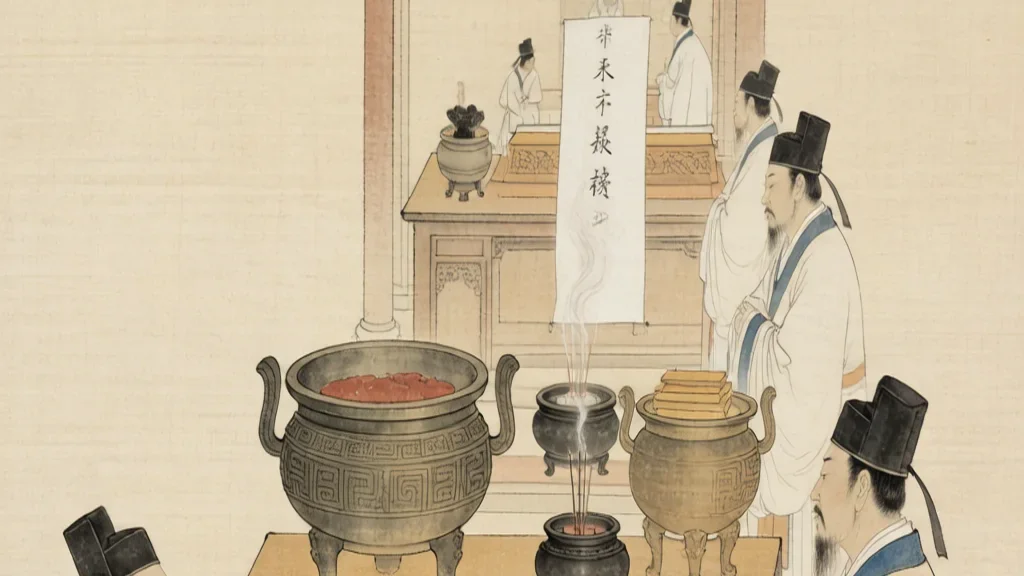
Confucian worship was never a religion in the Western sense, yet it shaped Chinese spiritual and political life for more than two thousand years. Centered on reverence for Heaven (天, Tiān), ancestors, and the sages, it supplied the rituals that bound family, state, and cosmos into a single moral order. Through solemn ceremonies at ancestral altars and magnificent state temples, Confucian worship taught that proper ritual (礼, lǐ) is the very fabric of a humane society. This is the story of how the memory of one teacher became a civil religion of an empire.
Heaven and the Moral Order
Confucian thinkers spoke of Tian, "Heaven," not as a personal deity who answers prayers but as the supreme source and pattern of moral order. The ruler was called the "Son of Heaven" (天子, Tiānzǐ) because his legitimacy rested on aligning human government with cosmic virtue. When floods, droughts, or eclipses struck, they were read as signs that the sovereign had lost Heaven's Mandate (天命, Tiānmìng).
This belief gave Chinese politics a profoundly ethical cast. Power was never merely force; it was a trust conferred by Heaven and judged by the welfare of the people. The emperor's duty was to perform the great seasonal sacrifices so that the rhythms of nature and society stayed in harmony — a task at once religious, political, and ecological.
Ancestral Rites
At the family level, Confucian worship centered on the ancestors. Nearly every home kept a tablet or altar (神主, shénzhǔ) bearing the names of departed parents and grandparents, before which descendants offered incense, food, wine, and paper money at New Year, Qingming, and the autumn equinox. These rites were not bribes to spirits but acts of gratitude and remembrance.
By honoring the dead, the living affirmed their place in an unbroken chain of generations. Filial piety (孝, xiào) thus extended beyond the grave: to serve one's ancestors properly was to cultivate the same reverence expected of a loyal subject and a good neighbor. The ancestral hall (祠堂, cítáng) became the heart of clan identity across southern China.
Temples of Confucius
Across the empire, Confucian temples (文庙, wénmiào, "temples of culture") honored Confucius and his disciples with sacrifices of meat, grain, music, and dance. The greatest stood at Qufu, the sage's birthplace in Shandong, where emperors from many dynasties traveled to pay homage. Local officials and degree-holders attended the spring and autumn ceremonies, reinforcing the ideal that government should rest on moral cultivation.
Inside the main hall, the spirit tablet of Confucius was flanked by the "Four Correlates" (四配, sìpèi) — Yan Hui, Zengzi, Zisi, and Mencius — and by rows of "Twelve Philosophers." The layout was less a house of worship than a classroom in stone, reminding every visitor that the state was founded on learning and virtue rather than on birth alone.
The State Cult and the Examinations
What made Confucian worship a true "state cult" was its marriage to the civil service examination system. The empire that tested its officials on the Confucian classics also required them to participate in the rites. To succeed was to enter a shared community of memory stretching from the village altar to the imperial altar of soil and grain.
This created a civil religion that bound the educated elite — millions of scholars and officials — to the dynasty and to one another. Whatever their native province or dialect, they knelt in the same postures, recited the same liturgies, and vowed the same loyalty to the Sage. Ritual became the silent grammar of a unified realm.
The Ritual Classics
Confucian worship drew its form from the classical ritual texts: the Record of Rites (礼记, Lǐjì), the Etiquette and Ritual (仪礼, Yílǐ), and the Rites of Zhou (周礼, Zhōulǐ). These works prescribed in exhaustive detail how a gentleman should bow, mourn, marry, and sacrifice, treating every gesture as a bearer of meaning.
For Confucians, lǐ was far more than etiquette. It was the outward shape of inner reverence, the discipline by which raw human feeling is refined into humanity (仁, rén). To perform the rites correctly was to participate in the ordering of the world itself — a conviction that made ritual study a matter of the highest seriousness.
Sacrifices to Soil and Grain
At the apex of state worship stood the altar of soil and grain (社稷, shèjì), the symbolic center of the realm. The emperor sacrificed there to the gods of earth and grain, acknowledging that his throne depended on the land's fertility and the people's sustenance. To "lose the Sheji" was a poetic way of saying a dynasty had fallen.
Parallel rites honored the spirits of wind, rain, mountains, and rivers, weaving the natural world into the fabric of royal duty. The famous Temple of Heaven (天坛, Tiāntán) in Beijing, with its circular altar and echoing Hall of Prayer for Good Harvests, is the surviving masterpiece of this cosmology made architecture.
The Sage's Disciples and the Canon
Confucian worship is inseparable from the veneration of the master's disciples. The "Four Correlates" and "Twelve Philosophers" received their own tablets and seasonal offerings, while worthy officials and local worthies were sometimes enshrined in side halls. To be admitted to a Confucian temple was the highest posthumous honor a scholar could receive.
The canon recited in these rites — the Analects, the Great Learning, the Doctrine of the Mean, and the Mencius — was treated almost as scripture. Chanting them in the presence of the Sage's tablet was both an act of worship and an act of renewal, keeping the words alive in the bodies and voices of each new generation of officials.
Music and Dance in Worship
No Confucian ceremony was complete without yǎyuè (雅乐, "elegant music"), the stately court music believed to calm the heart and attune the worshiper to cosmic harmony. Performed with bells, chime stones, flutes, and strings, it accompanied the slower, the offerings, and the reading of the prayer of supplication.
The dance was equally codified. The highest rites employed the "eight-row dance" (八佾, bāyì), in which sixty-four young men waved feathered wands in precise formation — a privilege reserved for the emperor and, by extension, for the Sage. Music and movement together turned doctrine into experience, schooling the body in reverence before the mind could analyze it.
Worship Under Empire and Republic
Confucian state worship reached its formal peak under the Ming and Qing dynasties, when the emperor's seasonal sacrifices were the most important events on the ritual calendar. But the fall of the empire in 1912 abolished the state cult, and the New Culture Movement of the 1910s and 1920s criticized Confucius as a symbol of backwardness.
Yet the tradition proved resilient. The family rites survived in private, and in recent decades the ceremonies at Qufu have been revived with replicas of the ancient instruments and costumes. Confucian worship is no longer the official religion of the state, but it endures as cultural memory, civic ritual, and a living link between generations.
Continuity in Family Life
More than temples or thrones, it was the household that carried Confucian worship forward. The domestic ritual manuals (家礼, jiālǐ) — popularized by the Neo-Confucian Zhu Xi — taught ordinary families how to arrange an altar, mourn a parent, and greet the New Year. These small, repeated acts kept the cosmic order intimate and near.
Today, many Chinese families still lay out food for ancestors at major festivals, clean their graves at Qingming, and speak their elders' names with respect. The forms have loosened, but the underlying conviction remains: that the living and the dead belong to one continuing family, and that reverence is the foundation of a good life.
📝 Chinese Vocabulary
🎉 Fun Facts
❓ Frequently Asked Questions
Q: What exactly is worshipped in Confucian worship?
A: Confucius, his disciples, and loyal or filial exemplars are honored in formal ceremony, alongside ancestors and Heaven.
Q: Where does Confucian worship take place?
A: At Confucian temples (wenmiao) and the imperial altar of soil and grain, as well as at family ancestral altars and graves.
Q: Why was it called a state cult?
A: It bound the examination elite and the empire together through shared rites, functioning as the civil religion of the state.
Q: Is Confucianism really a religion?
A: Scholars debate this; it is best understood as a ritual and ethical tradition centered on reverence rather than on a personal god.
Q: What role did music play in the rites?
A: Elegant music (yayue) and codified dance attuned worshippers to cosmic harmony and embodied reverence in movement.
Q: Does Confucian worship survive today?
A: Yes — the Qufu ceremonies have been revived, and ancestor rites remain alive in family life across the Chinese world.