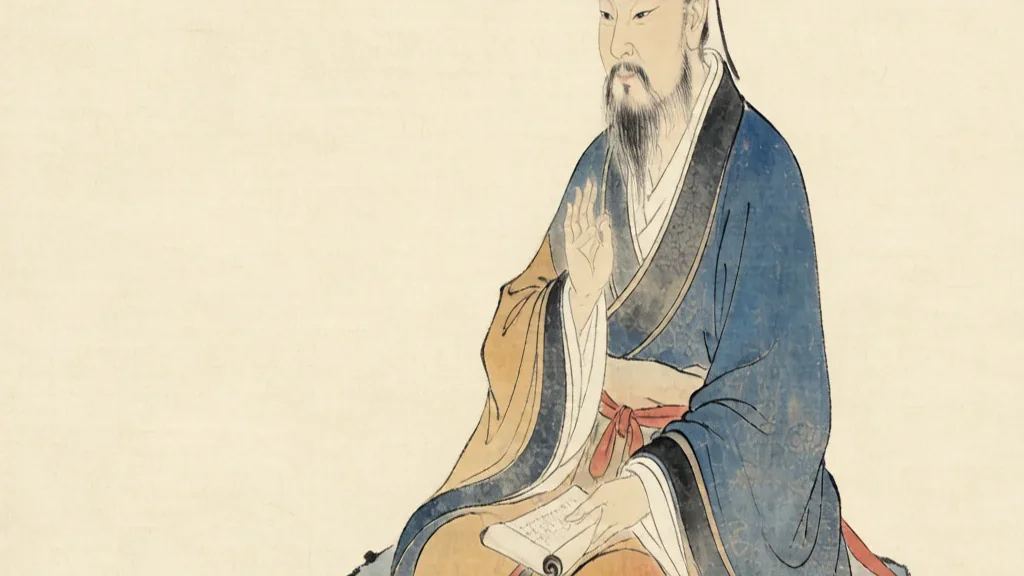
The Three-in-One Teaching (三一教, Sānyī Jiào) was among the most ambitious religious experiments of late imperial China. Born in the coastal counties of Fujian during the Ming dynasty, it proposed that Confucianism, Daoism, and Buddhism—the "three teachings" that had shaped Chinese civilization—were not rivals but three expressions of a single truth. Its founder, Lin Zhao'en (1517–1598), organized this insight into a graded path of self-cultivation, scripture, and charity that survived his death, spread across Southeast China, and still maintains temples and devotees in Fujian, Taiwan, and the overseas Chinese world. In a culture often suspicious of rigid doctrine, Sanyi offered a characteristically Chinese answer to religious division: not the triumph of one tradition, but their higher union.
Lin Zhao'en and the Vision of Unity
Lin Zhao'en was born into a Confucian gentry family in Putian, Fujian, and excelled in the examination curriculum. Yet a series of illnesses, visions, and spiritual crises turned him from official ambition toward teaching. He studied with masters of Confucianism, Buddhism, and Daoism in turn, concluding that each had grasped part of the same reality. Around the 1560s he began gathering disciples and promulgating a synthesis he called the "Three-in-One" (三一) or "Unity of the Three Teachings" (三教合一).
Lin was no lazy eclectic. He argued that Confucius, Laozi, and the Buddha were fellow-sages who taught the same ultimate principle to different audiences: Confucian ethics supplied the foundation of daily conduct, Daoist inner alchemy the method of self-cultivation, and Buddhist emptiness the final goal of liberation. He reorganized rituals, scriptures, and meditation into a single disciplined curriculum, earning respect as a healer and teacher across Fujian.
The Three Teachings as One
The doctrine of sanjiao heyi (三教合一) was not invented by Lin—earlier thinkers from the Tang onward had spoken of the three teachings complementing one another—but he gave it institutional form. In Sanyi cosmology, the three traditions correspond to stages on one road: first establish the Confucian virtues of filial piety and righteousness, then practice Daoist breath and energy cultivation, and finally realize the Buddhist insight that the self is empty and one with the absolute.
This graded path reassured followers that they need not abandon loyalty to family or state. Sanyi was, in a sense, a lay movement: it asked devotees to be better Confucians in daily life while using Daoist and Buddhist techniques to transform the self. The result was a practical spirituality suited to merchants, farmers, and gentry alike.
Practice, Ritual, and Meditation
Sanyi worship blended the three faiths overtly. Temple altars placed statues or tablets of Confucius, Laozi, and the Buddha side by side, visually declaring their unity. Devotees observed Confucian rites for ancestors, recited Buddhist sutras such as the Heart Sutra, and practiced Daoist quiet-sitting (静坐), breathing exercises, and energy circulation drawn from inner alchemy.
Lin composed new scriptures in vernacular Chinese so that ordinary people could understand them, a departure from the classical-language texts of the elite traditions. Regular gatherings combined lecture, meditation, and chanting. The movement thus democratized advanced spiritual practice, bringing techniques once confined to monks and adepts into the marketplace and the village.
Organization and Social Charity
Beyond worship, Sanyi was a social force. Local lineages organized around the faith, and the community engaged in charity: building bridges, repairing roads, digging wells, founding schools, and caring for the sick and poor. Lin Zhao'en himself was known as a healer who combined acupuncture with spiritual methods, and during epidemics his followers organized relief.
This public virtue cemented Sanyi's standing. In a period of local disorder and weak central administration, a community that fed the hungry and mended the roads earned the trust of neighbors and officials. The teaching's emphasis on good works made it, in practice, a civic as well as a religious association.
The Scriptures and the Vernacular Turn
Lin and his disciples produced a substantial body of literature, much of it in accessible Chinese rather than classical allusion. Key works expound the "three steps" of cultivation and weave together quotations from the Confucian classics, the Dao De Jing, and Buddhist sutras. The aim was not scholarly novelty but a usable manual for transformation, memorizable and teachable in small groups.
The vernacular approach distinguished Sanyi from rival literati movements and helped it spread among the less educated. It also reflected Lin's conviction that the highest truth is simple enough for a farmer to live by—a democratic impulse rare in Ming religious writing.
Persecution, Survival, and Adaptation
Sanyi's success drew suspicion. Late-Ming and Qing authorities, wary of unregulated sects, at times suppressed or restricted it, and rival groups sometimes blurred its reputation. Yet the movement proved resilient: it adapted by stressing its Confucian loyalty and charitable service, surviving underground or within lineage structures. Local elites who valued its morality shielded it from the harshest measures.
After Lin's death the movement split into branches with differing emphases—some more meditative, some more ritual—but all kept the altar of the three sages. Its flexibility was itself a form of survival: by being many things to many devotees, Sanyi endured where stricter sects were outlawed.
Legacy in Fujian, Taiwan, and the Diaspora
Although Sanyi never became a state religion, it left a deep mark on Fujianese culture. Migrants carried it to Taiwan and Southeast Asia, where "Sanyi temples" (三一教祠) still hold annual festivals, chant scriptures, and perform the quiet-sitting Lin taught. In parts of Malaysia and Singapore, Fujianese communities keep the tradition alive as a marker of homeland identity.
Its influence also seeped into broader folk religion: the habit of honoring Confucius, Laozi, and the Buddha together, and of blending self-cultivation with charity, became a quiet norm in southern Chinese piety. Sanyi thus shaped not only its own temples but the syncretic temperament of popular religion itself.
Sanyi in Comparative Perspective
Scholars have compared Sanyi to other inclusive movements—Unitarian Universalism for its embrace of multiple sources of truth, or the "perennial philosophy" for its claim of one ground beneath many paths. What is distinctively Chinese is its this-worldly, family-centered form: unity is pursued not by abandoning society but by perfecting one's role within it.
In an era of religious competition and sectarian conflict, the Three-in-One Teaching remains a reminder that synthesis is also a tradition. It asks not "which teaching is right?" but "what do they share?"—a question as relevant to interfaith dialogue today as it was in a Ming village four centuries ago.
❓ Frequently Asked Questions
What is the Three-in-One Teaching?
It is a Ming-dynasty Chinese religious movement holding that Confucianism, Daoism, and Buddhism are three faces of one truth, organized by Lin Zhao'en into a single graded path of ethics, cultivation, and liberation.
Who founded it?
Lin Zhao'en (1517–1598), a Putian gentry scholar who experienced spiritual crises, studied all three traditions, and systematized their union into a lay devotional movement.
Why is it called "syncretic"?
It deliberately reconciles the three great Chinese traditions rather than choosing one, assigning each a role—Confucian conduct, Daoist practice, Buddhist goal—within a single synthesis.
How do Sanyi followers worship?
They honor Confucius, Laozi, and the Buddha together on one altar, keep Confucian ancestral rites, recite Buddhist sutras, and practice Daoist quiet-sitting and breathing exercises.
Does Sanyi still exist?
Yes; temples and devotee communities persist in Fujian, Taiwan, and Southeast Asian Chinese diasporas, holding festivals and the meditation practices Lin established.
How did Sanyi differ from other sects?
It stayed lay-centered and family-friendly, stressed public charity, and used vernacular scriptures, surviving persecution by emphasizing Confucian loyalty rather than separation from society.