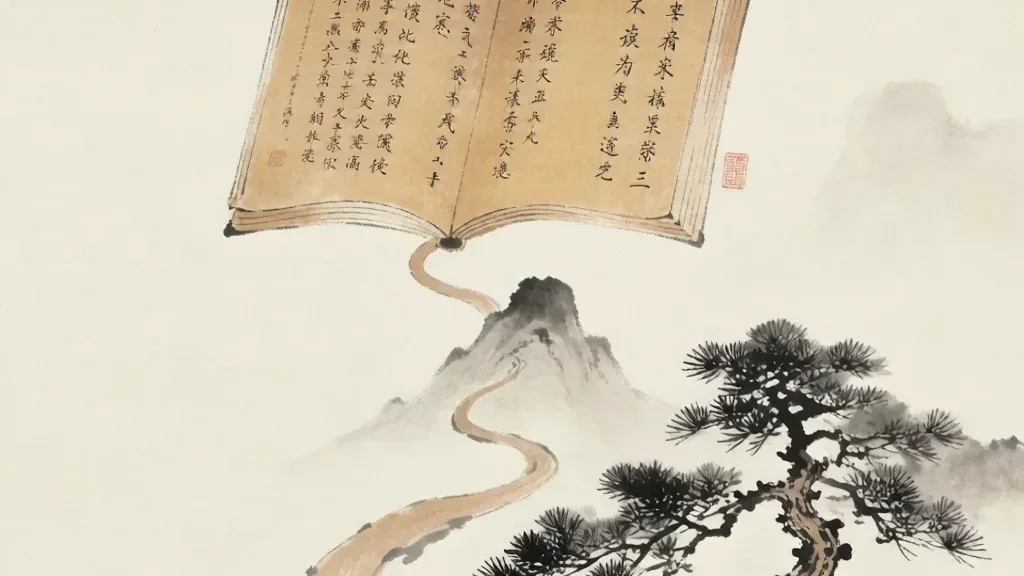
The Zhuangzi (庄子), named after its central figure Master Zhuang, is the most luminous and playful masterpiece of the Daoist tradition and one of the great works of world literature. Attributed to the philosopher Zhuang Zhou (庄周, c. 369–286 BCE) and shaped by his followers over later centuries, it uses parables, jokes, dialogues, and startling paradoxes to loosen the grip of fixed opinions about reality, usefulness, language, and the self. Where the Dao De Jing speaks in oracular brevity, the Zhuangzi wanders—through butterfly dreams, useless trees, deformed sages, and conversations with skulls—inviting the reader to laugh, doubt, and finally let go. For two thousand years it has nourished Chinese poetry, painting, and the spontaneous spirit of Chan Buddhism, and today it still offers a radical cure for the anxiety of taking our own certainties too seriously.
Zhuang Zhou: The Philosopher of Freedom
Zhuang Zhou lived in the Warring States period, an age of fractured kingdoms, ceaseless warfare, and furious intellectual debate among the "Hundred Schools." Unlike the Confucians, who sought to restore order through ritual, duty, and moral cultivation, Zhuangzi questioned whether the categories by which society judged success, worth, and truth were anything more than human inventions. He is said to have served briefly as a minor keeper of a lacquer garden but refused every offer of high office, comparing a minister's post to a dead rat that a startled owl drops when a soaring phoenix passes by. For Zhuangzi, freedom was not withdrawal from the world but an inner liberation practiced within it.
His biography, preserved in the Shi Ji (Records of the Grand Historian), portrays a man poor enough to weave sandals for a living yet regally indifferent to wealth and power. When friends mourned his death, a disciple reportedly laughed, having learned from the master that life and death are simply transformations of the single breath of the cosmos. This anecdote captures the tone of the whole book: cheerful, untethered, and quietly subversive of grief itself.
The Butterfly Dream
The most famous passage in the Zhuangzi opens the second chapter. Zhuang Zhou dreams he is a butterfly, fluttering happily, unaware of any human self. When he wakes, he cannot tell whether he is Zhuang Zhou who dreamed of being a butterfly, or a butterfly now dreaming that it is Zhuang Zhou. The boundary between dreamer and dream, self and other, dissolves. The episode is not a claim that nothing is real but a gentle demonstration that the "I" we defend so fiercely may be far more porous and provisional than we assume.
The butterfly has become a permanent image in Chinese art and literature. Poets from Li Shangyin to the present have invoked it; painters place a single butterfly above misty water to signal the dreamlike quality of existence. In the Zhuangzi itself, the butterfly prepares the reader for the book's deeper argument that all distinctions—right and wrong, life and death, big and small—are perspectives, not absolute truths.
Useless Trees and Cook Ding
Zhuangzi delights in what the world calls useless. A gnarled, crooked tree growing by the road survives to a great age precisely because no carpenter wants its timber; a withered, deformed man is exempt from military service and taxes and lives out his days in peace. Usefulness, the book suggests, is measured by a single narrow human purpose, and what is "useless" to that purpose may be most free, most whole, most alive.
In the parable of Cook Ding (庖丁解牛), a butcher carves an ox with such effortless grace that his blade never dulls, because he follows the natural openings and hollows of the carcass rather than hacking against the bone. Lord Wenhuij sees in the cook's art a lesson for living: move with the grain of things, yield to necessity, and what seems difficult becomes spontaneous. Skill here is not force but attunement.
The Equality of Things
The chapter "Qiwulun" (齐物论, Discussion on Making All Things Equal) is the philosophical heart of the book. Zhuangzi argues that the ten thousand things are "one" when seen from the perspective of the Dao, and that disputes over right and wrong arise because each party mistakes its limited viewpoint for the whole. "A bird's-eye view" is impossible for any single creature; the sage, instead of judging, "rides" the transformations of the world and finds peace in not-knowing.
The famous image of the "pipes of heaven" (天籁) contrasts the human noise of arguing voices with the spontaneous sound of wind moving through hollows. Each opening emits its own note, none more "correct" than another. The lesson is not relativism for its own sake but a call to humility: when we recognize that our truths are songs of a particular hollow, we can speak without cruelty and listen without fear.
The Joy of Fish and the Limits of Words
In a celebrated debate, Zhuangzi and his friend Huizi stand on a bridge over the Hao River. Zhuangzi says, "The minnows swim about so freely—this is the joy of fish." Huizi objects that Zhuangzi is not a fish and cannot know the fish's joy. Zhuangzi replies that by the same logic, since Huizi is not Zhuangzi, he cannot know that Zhuangzi does not know the fish's joy. The exchange playfully exposes the limits of logical refutation and hints that some knowledge comes through participation and sympathy rather than argument.
The book repeatedly mocks language as a net that catches only shadows of reality. Words are like footprints left after the hare has run; the "uncarved block" of direct experience lies beyond them. Yet the Zhuangzi uses language exuberantly—precisely because, like a fisherman who discards the trap once the fish is caught, the reader is meant to drop the words and wake to what they point toward.
Death, Transformation, and the Drumming Sage
Zhuangzi's treatment of death is among the most comforting in all philosophy. When his wife dies, he is found drumming on a basin and singing. Asked how he can be so unfeeling, he explains that at first he grieved, but then realized she had simply returned to the great unity from which she came, just as autumn follows summer. To wail against this would be to "not understand fate." Death is not annihilation but a transformation, perhaps even a release.
In another passage a skull, encountered in a dream, tells Zhuangzi that the dead know no ruler, no cold or hunger, and roam freely with the seasons—free of the toil of living. These passages do not preach annihilationism but reframe mortality as one phase in an endless circulation of qi (vital breath), robbing death of its terror and returning it to the natural rhythm of things.
Skill, Spontaneity, and the Perfect Man
Beyond Cook Ding, the Zhuangzi fills its pages with artisan-sages: a wheelwright who carves so truly he cannot teach his son the knack; a hunchback who catches cicadas with the steadiness of a post; a ferryman whose boat seems to move of itself. Each embodies "skill reaching the Dao" (技进乎道)—the moment when deliberate effort falls away and action becomes one with the situation. This ideal deeply shaped later Chinese aesthetics, where the highest art looks unforced.
The "perfect man" (至人), "spirit man" (神人), and "true man" (真人) of the Zhuangzi are not moral exemplars in the Confucian sense but beings who have forgotten self-importance, who ride the clouds, and who are unmoved by praise or blame. They model a freedom that is at once metaphysical and thoroughly practical: do not strain, do not cling, and the world will carry you.
Critics of Confucius and Robber Zhi
The Zhuangzi frequently places Confucius in its stories, sometimes respectful, often gently ridiculed, and occasionally upstaged by a Daoist sage. In the startling chapter on Robber Zhi, a bandit lectures Confucius on the hypocrisy of moralists who praise the ancient kings while pursuing their own glory. The portrait is not a defense of crime but a rhetorical jolt: it asks whether the "sage" might be a creature of convention, and whether the outlaw sees more clearly than the court.
These provocations are part of the book's method. By letting Confucius learn from Daoists, or letting a madman speak the truest lines, the Zhuangzi refuses to settle into a single authoritative voice. Its pluralism is the point: truth is too large for any school to monopolize.
Zhuangzi and the Wider Daoist Tradition
Together with the Dao De Jing, the Zhuangzi forms the philosophical core of Daoism (道家). Later, as Daoism developed into an organized religion (道教), Zhuangzi was honored as one of the "Three Purities'" interpreters and his work became a scripture of meditation and inner alchemy. Yet the Zhuangzi itself is pre-religious in tone—more a therapy of the mind than a liturgy—and its influence reached far beyond Daoism into Buddhism, Neo-Confucianism, and the literati culture of scholars who retired to gardens and wine.
The book we have today is traditionally divided into thirty-three chapters, organized by later editors into "inner" (seven chapters, considered closest to Zhuang Zhou), "outer," and "miscellaneous" sections. The inner chapters are the most coherent and poetic; the later layers add fables, essays, and echoes of other schools, enriching the whole without breaking its voice.
Influence on Chinese Art, Poetry, and Beyond
The Zhuangzi's spirit is visible wherever Chinese culture values spontaneity over polish: in the "mad" poetry of Li Bai, who boasted he would rather chase the moon in wine than bow to a prince; in Su Shi's essays written in exile; in the misty, empty mountains of landscape painting where a tiny figure sits forgotten by a stream. Chan (Zen) Buddhism drew directly on Zhuangzi's paradoxes and love of wordless awakening.
In the modern world the butterfly dream has been read as an ancestor of phenomenology and even of postmodern skepticism about the self. Translators from Burton Watson to Angus Graham have carried it into English, and its laughter still works its old magic: reminding us that the serious edifice of our certainties may, in the end, be only one more dream we are free to wake from.
❓ Frequently Asked Questions
What exactly is the Zhuangzi?
It is a Daoist masterpiece attributed to the philosopher Zhuang Zhou (c. 4th century BCE) and his followers, a collection of parables, dialogues, and paradoxes about freedom, perspective, and the limits of knowledge, organized into thirty-three chapters.
Who wrote it?
Tradition names the sage Zhuang Zhou as author of the seven "inner" chapters, while later disciples and editors shaped the "outer" and "miscellaneous" chapters, making it a layered text rather than a single pen's work.
What happens in the butterfly dream?
Zhuang Zhou dreams he is a butterfly, then wakes unsure whether he is a man who dreamed of a butterfly or a butterfly now dreaming he is a man—dissolving the boundary between self, other, dream, and reality.
What does "xiaoyao" (free and easy wandering) mean?
It is the book's ideal of liberation: not fleeing the world but moving through it without being bound by fixed views, social ambition, or fear of death—freedom within ordinary life.
How does the Zhuangzi differ from the Dao De Jing?
The Dao De Jing is terse and oracular, offering guidance on rulers and naturalness; the Zhuangzi is long, playful, and literary, using humor and story to loosen the mind rather than to instruct it.
Why is the Zhuangzi so playful?
Playfulness is its method: jokes, absurd characters, and paradoxes defuse our attachment to being "right," opening a space where the reader can let go of rigid certainties and meet reality freshly.