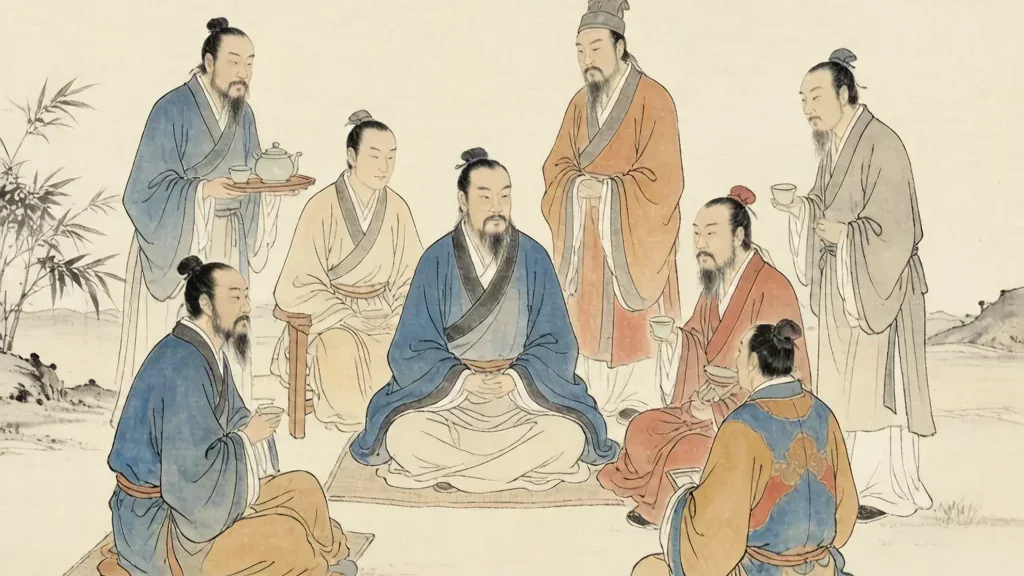
In the waning years of the Eastern Han Dynasty (25-220 CE), as the imperial order crumbled under the weight of corruption, natural disasters, and the Yellow Turban Rebellion, a remarkable religious movement emerged in the mountainous regions of what is now Sichuan Province. In 142 CE, a man named Zhang Daoling (张道陵) claimed to have received a revelation from the deified Laozi, who bestowed upon him the title Celestial Master and charged him with establishing a new covenant with humanity. This event marks the founding of the Way of Celestial Masters (天师道, Tianshi Dao), the first organized Daoist religious institution in Chinese history. Unlike the philosophical Daoism of Laozi and Zhuangzi, which emphasized individual cultivation and retreat from society, the Celestial Masters created a comprehensive religious community with priests, rituals, ethical codes, and administrative structures.
Zhang Daoling and the Founding Revelation of 142 CE
Zhang Daoling, originally named Zhang Ling, was born around 34 CE in Feng County, in present-day Jiangsu Province. According to Daoist hagiographies such as the Shenxian Zhuan by Ge Hong (283-343 CE), Zhang traveled to the Heming Mountain in Sichuan, where he practiced alchemy and meditation for years. In 142 CE, on the summit of the mountain, the deified Laozi — now understood as Lord Lao, a cosmic deity rather than a historical philosopher — appeared to Zhang in a blaze of divine light. Laozi declared the existing religious covenants obsolete and invested Zhang with the Doctrine of Orthodox Unity, authorizing him to establish a new dispensation. Zhang established 24 administrative districts across the Sichuan basin, each headed by a libationer who served as both religious leader and civil administrator. The movement attracted followers with its promise of healing through confession of sins and its critique of expensive and bloody animal sacrifices.
Zhang Daoling's biography became a template for Daoist hagiography that would be imitated for centuries. The traditional account holds that Zhang lived to the age of 123 and ultimately achieved transcendence, ascending to heaven in broad daylight from Qingcheng Mountain in Sichuan. His descendants claimed that he did not die but merely shed his mortal shell, continuing to oversee the Celestial Masters movement from the celestial realm. This narrative of the founder's immortality served to legitimate the hereditary authority of the Zhang family, who have maintained the Celestial Master lineage for over 1,800 years. The current 65th Celestial Master, Zhang Jintao, resides in Taiwan, while the 64th Celestial Master, Zhang Yuanxian, is recognized by the Chinese government and presides at the Celestial Master's Temple on Longhu Mountain. This unbroken hereditary succession is one of the longest continuous family lineages in world religious history.
Celestial Masters Liturgy, Healing, and Community Life
The religious practices of the early Celestial Masters centered on healing, confession, and communal rituals that radically departed from the state-sanctioned religion of the Han Dynasty. The movement rejected the elaborate animal sacrifices that characterized Han official religion, replacing them with offerings of wine, rice, and vegetarian foods. Sickness was understood as the consequence of moral transgression, and healing was accomplished through the ritual of the Three Officials: the sick person wrote their sins in triplicate, with one copy buried for the Earth, one submerged in water, and one presented to Heaven. This written confession was accompanied by prayer, meditation, and the consumption of talismanic water — water that had been blessed by a priest and infused with the power of a written talisman. The movement's healing reputation was so effective that during a devastating plague that swept through Sichuan in the late second century, the Celestial Masters attracted tens of thousands of new adherents who had been abandoned by conventional medicine.
The community structure established by Zhang Daoling was as innovative as its theology. The 24 administrative districts, later expanded to 28, were organized on a grid system that reflected both cosmological principles and practical governance. Each district held regular community meals called Kitchen Gatherings, at which members shared vegetarian food, chanted scriptures, and renewed their commitment to the movement's ethical code. These gatherings served not only religious functions but also created social bonds that sustained the community through periods of persecution and hardship. Members were required to pay an annual tithe of five pecks of rice, which gave the early movement its popular name — the Way of the Five Pecks of Rice (Wudoumi Dao). This system of mutual support was particularly attractive to poor peasants and displaced farmers who had been abandoned by the failing Han welfare system. The movement's emphasis on collective responsibility and mutual aid created a template for religious community organization that would influence Chinese folk religion for centuries.
The Fu-Lu Tradition: Daoist Talismans and Registers
One of the most distinctive and enduring contributions of the Celestial Masters tradition is the fu-lu (符箓) system of talismans and registers. Fu are written talismans — intricate calligraphic characters and designs drawn on yellow paper with red ink, believed to channel the power of celestial deities. Lu are registers, or lists of deities and spirits, that served as credentials for Daoist priests, granting them authority over specific spiritual beings. The Celestial Masters were the first Daoist movement to systematize the use of talismans, creating a graded hierarchy of fu that corresponded to the priest's rank and spiritual power. The simplest fu were used for healing ailments and protecting against evil spirits, while the most powerful were reserved for high-ranking priests performing major rituals such as cosmic renewal ceremonies.
The production of talismans was a highly ritualized process governed by strict regulations. A priest could only write talismans after purifying himself through fasting, meditation, and sexual abstinence. The talisman had to be written at a specific time — often at midnight when the spiritual power was strongest — and on specially prepared paper made from bamboo fiber. The ink was mixed with cinnabar, a mineral believed to possess powerful yang energy and longevity-promoting properties. The calligraphic strokes of a talisman were not arbitrary but followed precise divine patterns revealed to the Celestial Masters by Lord Lao. Each stroke had to be executed without interruption or error; a single mistake was believed to render the talisman not merely ineffective but potentially dangerous, as a flawed talisman could attract malevolent spirits rather than benevolent ones. The fu-lu tradition remains central to Zhengyi Daoist practice today, and Celestial Masters priests continue to produce talismans using methods transmitted through an unbroken line of succession from Zhang Daoling himself.
Theocracy in Hanzhong: Zhang Lu's Millennial Kingdom (191-215 CE)
The Celestial Masters movement reached its political zenith under Zhang Lu, the grandson of Zhang Daoling, who established a theocratic state in the Hanzhong region of southern Shaanxi between 191 and 215 CE. Zhang Lu's governance, described in the Records of the Three Kingdoms by Chen Shou (233-297 CE), implemented a distinctive form of religious socialism. The state established charity lodges along roads where travelers could find free food and lodging — an early form of social welfare. Criminals were forgiven three times before punishment, reflecting the movement's emphasis on moral reform over retribution. The most distinctive feature was the Three Officials system of healing: the sick wrote down their sins in triplicate — one copy buried for the Official of Earth, one submerged for the Official of Water, and one burned for the Official of Heaven. In 215 CE, the warlord Cao Cao conquered Hanzhong, but rather than suppressing the Celestial Masters, he incorporated Zhang Lu into his administration, allowing the movement to spread to northern China.
Key Doctrines: The Xiang'er Commentary on the Dao De Jing
The Xiang'er Commentary represents the only known Celestial Masters interpretation of the Dao De Jing and is thus an invaluable window into the movement's theological worldview. Discovered among the Dunhuang manuscripts in 1900 and now held in the British Library, this commentary transforms Laozi's philosophical text into a manual for religious practice. Where the original Dao De Jing speaks in abstract terms about the Dao as the ineffable source of all things, the Xiang'er interprets every passage as a concrete instruction for moral and spiritual cultivation. For example, where Laozi writes that the sage acts without action, the Xiang'er explains that this means the sage refrains from violence, greed, and sexual excess. The commentary introduces the concept of long life as a reward for ethical behavior and short life as punishment for wrongdoing, connecting moral conduct directly to physical longevity.
The Xiang'er also provides insight into the Celestial Masters' distinctive understanding of the Dao itself. Unlike the abstract, impersonal Dao of philosophical Daoism, the Celestial Masters conceived of the Dao as a personal, conscious deity who actively intervened in human affairs. This theistic turn represents one of the most significant transformations in Daoist history, as it laid the groundwork for the elaborate pantheon of gods and immortals that characterizes later religious Daoism. The commentary emphasizes the importance of correct ritual practice and obedience to the Celestial Master, establishing a hierarchical religious authority that would become a model for later Daoist institutions. The Xiang'er's fusion of ethical precept, ritual practice, and theological doctrine exemplifies the Celestial Masters' genius for making esoteric philosophical concepts accessible and actionable for ordinary people.
Evolution, Schisms, and the Zhengyi Tradition
Following the fall of the Han Dynasty in 220 CE, the Celestial Masters movement dispersed across China, evolving into several distinct lineages. The fourth-century Celestial Masters adapted their practices to the aristocratic culture of the southern dynasties, incorporating elements of the Shangqing and Lingbao revelations that emerged between 364 and 400 CE. In the north, the Celestial Master Kou Qianzhi (365-448 CE) reformed the movement under the patronage of the Northern Wei Dynasty. The most significant development came during the Tang Dynasty (618-907 CE), when the Celestial Master lineage was formally recognized by the imperial court. Emperor Xuanzong bestowed the title Celestial Master on the 12th-generation descendant of Zhang Daoling, establishing a hereditary line that continues to this day. The current 65th Celestial Master, Zhang Jintao (born 1964), presides over the ancestral temple at Longhu Mountain in Jiangxi Province.
Longhu Mountain: The Spiritual Heart of the Celestial Masters
Longhu Mountain (龙虎山, Dragon Tiger Mountain) in Jiangxi Province has been the spiritual and administrative center of the Celestial Masters tradition since the late Han Dynasty. According to tradition, Zhang Daoling refined the elixir of immortality on this mountain, causing a celestial phenomenon in which a dragon and a tiger appeared in the clouds — hence the mountain's name. The Celestial Masters Temple on Longhu Mountain, known as the Shangqing Palace, has been the hereditary seat of the Celestial Master lineage since the 4th century CE. The temple complex, covering over 30,000 square meters, includes halls dedicated to the Three Pure Ones, the Celestial Master Zhang Daoling, and various Daoist deities. The mountain itself is dotted with 99 peaks and 24 waterfalls, each associated with a specific Daoist legend. Longhu Mountain was designated a UNESCO Global Geopark in 2008 and a National Park of China, attracting both pilgrims and tourists. The cliff burials dating to the Spring and Autumn period that dot the mountain's sheer rock faces add an archaeological dimension to its spiritual significance.
The Celestial Masters' Enduring Religious and Cultural Legacy
The religious innovations of the Celestial Masters permanently transformed Chinese spiritual culture. The movement's emphasis on written communication with the divine — petitions, talismans, and registers — established a bureaucratic model of religion that mirrored the structure of the imperial state. The Celestial Masters' moral code, preserved in texts such as the Xiang'er Commentary on the Laozi, integrated Daoist philosophical principles with practical ethical precepts, promoting values of non-violence, sexual moderation, and environmental stewardship. The Five Pecks of Rice, an early name for the movement referring to the contribution of rice required from adherents, represents one of the earliest documented systems of religious tithing in world history. Modern scholarship, particularly the work of French sinologist Kristofer Schipper (1934-2021), has rehabilitated the Celestial Masters from earlier dismissals as a superstitious sect to recognition as the foundational institution of organized Daoism.