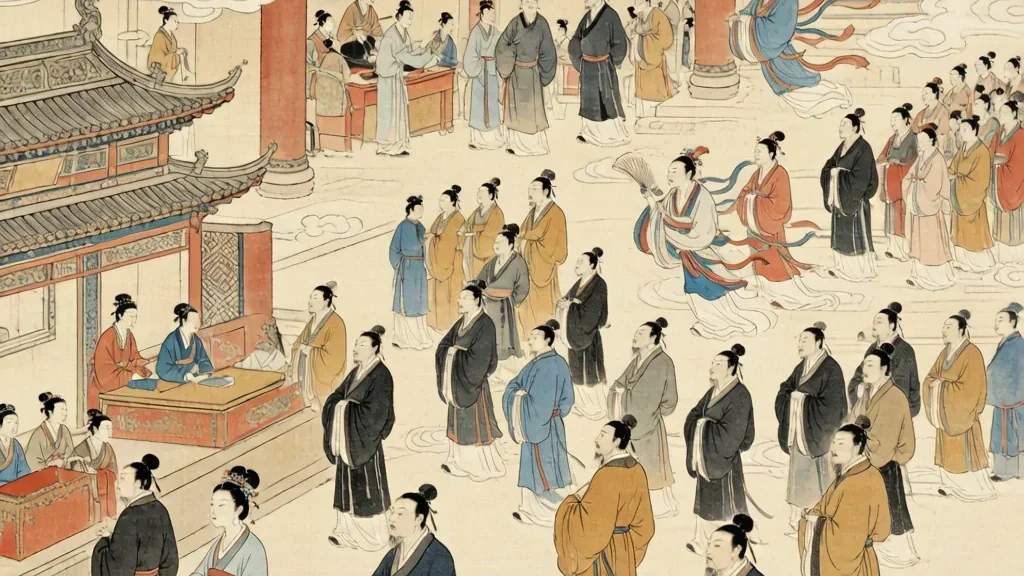
Step into a Taoist temple and you enter a world of dizzying complexity. Dozens of deities gaze down from altars, each with a specific title, jurisdiction, and rank. Incense smoke curls past statues of celestial officials in elaborate robes. This is not chaos — it is a celestial bureaucracy, a heavenly government that mirrors the imperial administration of ancient China with astonishing precision.
The Model of Heaven: Mirroring Earthly Power
Why does the Taoist pantheon look like a government? The answer lies in the Chinese worldview. For millennia, the Chinese imagined the cosmos as a unified system in which heaven, earth, and humanity operated according to the same principles. The emperor governed the human realm as the Son of Heaven (天子, tiānzǐ), and the Jade Emperor governed the celestial realm. Both realms had ministries, officials, inspectors, and a strict hierarchy.
This bureaucratic model served multiple purposes. It made the divine realm comprehensible — people understood how government worked, so they could understand how heaven worked. It also reinforced the legitimacy of earthly authority: if even the gods had an emperor, how could humans question theirs? Yet it also provided a framework for cosmic justice, since corrupt officials on earth would ultimately answer to their incorruptible counterparts in heaven.
The Taoist pantheon is not static. Gods can be promoted or demoted based on their conduct. Mortals who cultivate virtue and achieve immortality can ascend to positions in the heavenly bureaucracy. The system is meritocratic, at least in theory — a reflection of the Confucian examination system that governed imperial China.
The Supreme Trinity: The Three Pure Ones
At the very apex of the Taoist pantheon stand the Three Pure Ones (三清, Sānqīng), the highest deities of religious Taoism. They are not personal gods in the Western sense but rather personifications of the fundamental principles of the Tao itself.
The Jade Pure One (元始天尊, Yuánshǐ Tiānzūn), or the "Celestial Venerable of the Primordial Beginning," occupies the central position. He represents the origin of all things, the primordial state before creation. In iconography, he holds a pearl, symbolizing the undifferentiated unity from which the cosmos emerged.
The Supreme Pure One (灵宝天尊, Língbǎo Tiānzūn), the "Celestial Venerable of the Numinous Treasure," sits to the left. He represents the phase of cosmic differentiation and the emergence of the Taoist scriptures, which are understood as emanations of the Tao itself.
The Grand Pure One (道德天尊, Dàodé Tiānzūn), the "Celestial Venerable of the Tao and Its Virtue," sits to the right. He is identified with Laozi (老子), the legendary author of the Tao Te Ching, who is revered as the personification of the Tao's teaching for humanity. He holds a fan, symbolizing the power to sweep away ignorance.
Below the Three Pure Ones, the hierarchy fans out into a vast administrative structure. At its head sits the Jade Emperor (玉皇大帝, Yùhuáng Dàdì), the supreme ruler of heaven. Unlike the Three Pure Ones, who embody abstract principles, the Jade Emperor is a personal god who actively governs the cosmos. He presides over a celestial court with ministers, generals, and departments that manage everything from weather to human destiny.
The Eight Immortals: Taoism's Beloved Heroes
If the Three Pure Ones are distant and awe-inspiring, the Eight Immortals (八仙, Bāxiān) are approachable and deeply human. These legendary figures achieved immortality through Taoist cultivation, and their stories have been told and retold for centuries in opera, painting, and folk tales.
Each immortal has a distinctive personality, appearance, and magical attribute. Lü Dongbin (吕洞宾), the leader, carries a sword that vanquishes evil spirits and is the patron of scholars. He Xiangu (何仙姑), the only woman among them, holds a lotus flower and embodies purity. Zhang Guolao (张果老) rides a white donkey backwards and carries a bamboo tube drum — his eccentricity symbolizing the Taoist ideal of going against conventional wisdom.
Han Xiangzi (韩湘子) plays a flute that makes flowers bloom. Li Tieguai (李铁拐), the "Iron Crutch Li," walks with a limp and carries a gourd of medicine — his ugly exterior hiding profound spiritual attainment. Lan Caihe (蓝采和), of ambiguous gender, carries a flower basket and represents freedom from social convention. Zhongli Quan (钟离权) wields a fan that can revive the dead. And Cao Guojiu (曹国舅), a former aristocrat, carries jade clappers and represents the possibility of renouncing worldly status for spiritual cultivation.
The most famous story about the Eight Immortals tells of their journey across the Eastern Sea. When the Dragon King's son tried to steal their treasures, a great battle erupted. The immortals ultimately triumphed, but the conflict illustrates an important theme: even enlightened beings must sometimes fight to protect what is right.
The Eight Immortals represent the Taoist ideal that immortality is accessible to all — not just scholars and sages but also beggars, women, aristocrats, and eccentrics. Their diversity embodies the Taoist principle that the Tao manifests through all forms of life.
The Celestial Ministries
Beneath the Jade Emperor, the heavenly bureaucracy divides into specialized departments. The Ministry of Thunder (雷部, Léibù), headed by the thunder god Leigong, punishes evil-doers with lightning strikes. The Ministry of Epidemics (瘟部, Wēnbù) controls the spread of disease — a grimly practical concern in pre-modern China. The Ministry of Fire (火部, Huǒbù) oversees both destructive and creative uses of fire.
There are gods of literature (文昌帝君, Wénchāng Dìjūn) who preside over examinations, gods of wealth (财神, Cáishén) who distribute prosperity, and city gods (城隍, Chénghuáng) who function like divine magistrates, judging the dead and protecting the living within their jurisdictions.
This system reflects a profound Chinese conviction: the cosmos is orderly, rational, and governed by principles of justice. The gods are not arbitrary forces but officials with defined responsibilities, subject to rules and oversight. If a deity fails to answer prayers, it may be because the proper bureaucratic channels were not followed — perhaps the wrong department was petitioned, or the proper offerings were not made.
A Living Pantheon
Today, the Taoist celestial bureaucracy remains vibrantly alive. Temples across China, Taiwan, and Southeast Asian Chinese communities continue to honor these deities. During festivals, the Eight Immortals appear in parades and operas. Businesspeople pray to the God of Wealth, students to the God of Literature, and families to the Kitchen God.
The celestial bureaucracy may seem elaborate, even comical, to modern sensibilities. But it expresses something profound: the conviction that the universe is not indifferent but ordered, that justice is woven into the fabric of reality, and that every human life — no matter how humble — has a place in the cosmic scheme.
The Jade Emperor's Heavenly Court
Below the abstract Three Pure Ones sits the Jade Emperor, the personal ruler who actually governs the cosmos through a vast celestial court. Modeled on the imperial bureaucracy of Earth, his administration has ministers, generals, and departments, each with a defined duty such as managing weather, destiny, or the harvest. Petitioners on Earth were expected to address the correct office, much as a subject approached a government bureau, and offerings served as formal requests filed with the right authority. This mirror of earthly power made heaven comprehensible to ordinary people and also reinforced the legitimacy of imperial rule, since even the gods honored a single emperor. The court's endless ranks of named officials gave the cosmos a reassuring order, where no event was random and every prayer had, in theory, a proper channel.
City Gods and Local Deities
While the Jade Emperor rules from above, Chinese popular religion is richest at the local level, where city gods and neighborhood deities manage daily life. The city god, or Chenghuang, acted as a divine magistrate for a specific town, judging the dead, recording conduct, and protecting the walls and people. Beneath him stood a host of smaller gods: the stove god in the kitchen, the earth god of the soil, and the guardian of bridges and wells. Many such deities began as real historical figures, local heroes, or devoted officials later enshrined by grateful communities, so the pantheon constantly grew from below as much as from above. This layered system meant that a person could pray to a cosmic emperor for the world yet turn to a familiar local god for the practical cares of home, harvest, and family safety.
Ritual and the Heavenly Bureaucracy
Daoist practice gives the celestial bureaucracy a living voice through ritual. Priests present written petitions on symbolic paper, burn them so the message rises to heaven, and chant liturgies addressed to specific deities by name and title, much like filing documents with a ministry. Talismans, incense, and timed ceremonies mark the correct moment to approach a given office, since each god has auspicious days and jurisdictions. Funerals and New Year rites especially invoke the hierarchy, asking local and heavenly officials to register the dead, forgive faults, and grant peace. For believers this was not superstition but a working relationship with an orderly cosmos, in which correct form and sincere conduct moved the right official to act. The bureaucracy of gods thus shaped not only belief but the actual rhythm of Chinese ritual life.
元始天尊 — : The Jade Pure One, the highest of the Three Pure Ones and the personification of primordial origin.
灵宝天尊 — : The Supreme Pure One, the second of the Three Pure Ones, linked to the emergence of the scriptures.
道德天尊 — : The Grand Pure One, identified with Laozi and the teaching of the Dao.
吕洞宾 — : Lü Dongbin, the leader of the Eight Immortals and patron of scholars and sword arts.
雷公 — : Leigong, the thunder god who heads the celestial ministry punishing evildoers with lightning.
城隍 — : The city god, a local divine magistrate who judges the dead and protects his city.
财神 — : The God of Wealth, invoked by merchants and families for prosperity.
文昌帝君 — : The God of Literature, who presides over examinations and scholarly success.
❓ Frequently Asked Questions
🎉 Fun Facts
- The Eight Immortals are so popular that the phrase "Eight Immortals crossing the sea, each showing their divine power" (八仙过海,各显神通) is a common Chinese idiom meaning "everyone contributes their unique talents."
- In traditional Taoist cosmology, the Jade Emperor's birthday is celebrated on the ninth day of the first lunar month, a major festival for Chinese communities worldwide.
- The Taoist pantheon includes over 36,000 deities, organized in a hierarchy as complex as any earthly government.
- In Daoist belief gods can be promoted or demoted for their conduct, and exceptional mortals who cultivate virtue may rise into the heavenly bureaucracy after death.
- The Kitchen God reports the deeds of each household to heaven once a year, usually at the close of the lunar year, which is why families offer sticky treats to sweeten his account.
- Many local deities began as historical officials, heroes, or even ordinary people later enshrined by their communities, showing how the pantheon keeps growing from below.
- In Daoist belief gods can be promoted or demoted for their conduct, and exceptional mortals who cultivate virtue may rise into the heavenly bureaucracy after death.
- The Kitchen God reports the deeds of each household to heaven once a year, usually at the close of the lunar year, which is why families offer sticky treats to sweeten his account.
- Many local deities began as historical officials, heroes, or even ordinary people later enshrined by their communities, showing how the pantheon keeps growing from below.