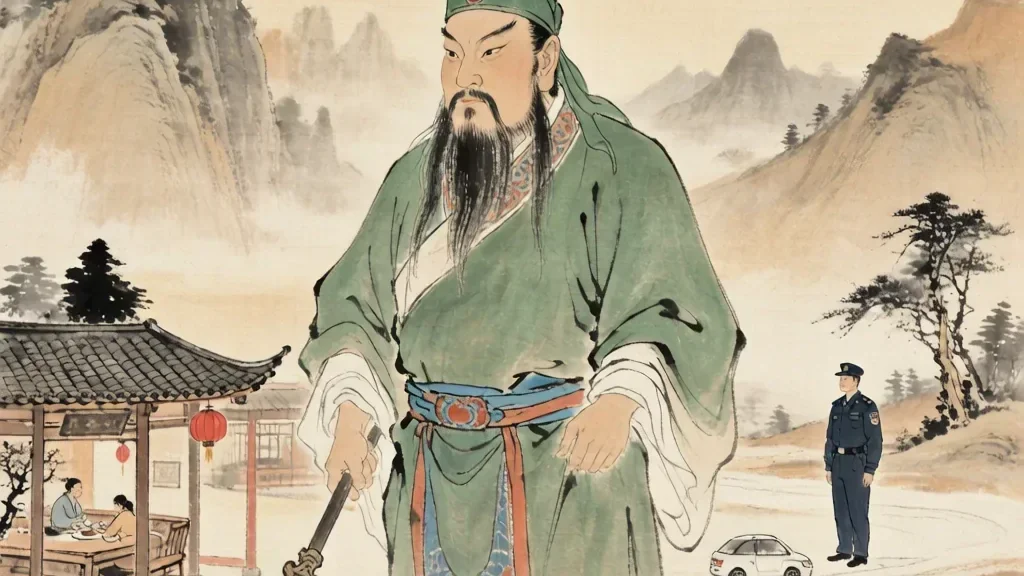
Walk into a Chinese restaurant, a police station, or a triad headquarters anywhere in the world, and you are likely to see the same figure: a fierce-looking man with a red face, a long black beard, and a crescent-moon blade. This is Guan Gong (关公), also known as Guan Yu (关羽) or Guan Di (关帝) — a historical general from the turbulent Three Kingdoms period who, over the centuries, ascended to become one of the most widely worshipped deities in the Chinese world. His journey from mortal soldier to divine protector is one of the most remarkable transformations in religious history.
The Historical Guan Yu
Guan Yu was born around 160 CE in what is now Shanxi Province, during the final decades of the Eastern Han Dynasty — a time of corruption, famine, and rebellion. He was a man of imposing physical presence: historical records describe him as tall, powerful, and possessing a magnificent beard that earned him the nickname "Lord of the Beautiful Beard" (美髯公, Měirán Gōng).
His life changed forever when he met Liu Bei (刘备), a distant imperial relative with grand ambitions, and Zhang Fei (张飞), a butcher of fearsome temper. In the famous Peach Garden Oath (桃园结义, Táoyuán Jiéyì), the three men swore an oath of brotherhood, pledging to live and die together in their quest to restore the Han Dynasty. This oath — "Though we were not born on the same day, we wish to die on the same day" — became the supreme symbol of loyalty in Chinese culture.
Guan Yu served as Liu Bei's most trusted general, known for his courage in battle and his unwavering loyalty. His most famous military exploit came in 200 CE, when Liu Bei's forces were scattered by the warlord Cao Cao. Guan Yu was captured but treated with extraordinary honor by Cao Cao, who admired his martial prowess and hoped to win his allegiance. Cao Cao showered him with gifts, titles, and a magnificent horse. Guan Yu accepted the gifts but made it clear that his loyalty belonged to Liu Bei alone.
When Guan Yu learned of Liu Bei's whereabouts, he set out to rejoin his oath brother — but not before performing a service for Cao Cao to repay his kindness. At the Battle of Boma, Guan Yu charged into the enemy ranks and personally slew the opposing general, Yan Liang, in single combat. His debt of honor repaid, he departed Cao Cao's service, leaving behind all the gifts he had received and taking only his signature weapon, the Green Dragon Crescent Blade (青龙偃月刀, Qīnglóng Yǎnyuè Dāo).
This episode — loyalty to his brother, gratitude to a benefactor, and strict adherence to a code of honor — became the template for Guan Yu's later deification. He was not merely a great warrior; he was a man of principle, whose actions embodied the Confucian virtues of loyalty (忠, zhōng) and righteousness (义, yì).
The Death of a Hero
Guan Yu's end was tragic. In 219 CE, while defending the strategic city of Jingzhou, he was betrayed by allies and captured by the forces of Sun Quan, a rival warlord. Refusing to surrender, he was executed. His severed head was sent to Cao Cao as a tribute, while his body was buried with full honors by Sun Quan.
But Guan Yu's story did not end with his death. In the centuries that followed, something extraordinary happened: the defeated general began to be worshipped as a god.
The process began in the region around Jingzhou, where locals reported strange occurrences near his burial site — ghostly apparitions, unexplained sounds, and a pervasive sense of supernatural presence. People began making offerings to appease his restless spirit. Over time, these offerings shifted from appeasement to veneration. The ghost of Guan Yu was no longer a source of fear but a source of protection.
The Making of a God
Guan Yu's elevation from hero to deity was not accidental. It was actively promoted by successive imperial dynasties, each of which found political value in his cult.
The Tang Dynasty (618–907) began the process by including Guan Yu among the honored figures of the past. But the real transformation came during the Song Dynasty (960–1279), when Guan Yu was formally recognized as a deity and granted increasingly elaborate titles. The Ming Dynasty (1368–1644) elevated him further, naming him "Holy Emperor Guan, the Great God of War Who Subdues Demons" (关圣帝君, Guān Shèng Dìjūn). By the Qing Dynasty (1644–1912), Guan Yu was being worshipped in over 1,600 official temples across the empire.
Why did the imperial state promote Guan Yu? The answer lies in his symbolic value. Guan Yu represented absolute loyalty to one's sovereign — a virtue that every dynasty wished to instill in its subjects. By elevating the god of loyalty, the emperor elevated the principle of loyalty itself. A subject who worshipped Guan Yu was, in theory, a subject who would never rebel.
The Qing Dynasty, ruled by Manchu conquerors, embraced Guan Yu with particular enthusiasm. The Manchus identified with Guan Yu because, like him, they were warriors from the frontier who had come to rule China. They promoted his cult as a way of legitimizing their rule and connecting themselves to Chinese cultural traditions.
The Many Faces of Guan Gong
What makes Guan Gong unique is the extraordinary diversity of his worshippers. He is simultaneously the patron of soldiers and scholars, businesspeople and police officers, gangsters and government officials.
For soldiers and martial artists, he is the God of War (武圣, Wǔshèng), the supreme martial deity whose courage in battle inspires warriors to this day. For businesspeople, he is a god of wealth and prosperity — his reputation for honesty and righteousness makes him an ideal patron for commercial transactions, and his image is displayed in countless shops and restaurants. For police officers, he represents justice and the righteous use of force. For triad members, he embodies the code of brotherhood and loyalty — the Peach Garden Oath is ritually reenacted in triad initiation ceremonies.
This diversity reflects Guan Gong's remarkable adaptability. He is not a god of one thing but of many things — a divine figure whose meaning shifts depending on who is doing the worshipping. At his core, however, he always represents the same values: loyalty, righteousness, courage, and integrity.
Guan Gong in Worship Today
Today, Guan Gong temples can be found throughout China, Taiwan, Hong Kong, and overseas Chinese communities. His image is instantly recognizable: the red face (symbolizing loyalty and courage), the long black beard, the green robe over armor, and the crescent-moon blade. He is often flanked by two attendants — his son Guan Ping and his sword-bearer Zhou Cang.
Worshippers approach Guan Gong with a wide range of requests: protection from harm, success in business, justice in legal disputes, and the strength to remain loyal to one's principles. Offerings typically include incense, fruit, and — in a nod to his military identity — paper weapons and armor.
In a world of shifting allegiances and moral ambiguity, Guan Gong offers something rare: a figure of unwavering principle. His red face does not blush with shame because he never compromised his values. His blade does not waver because he never wavered in his loyalty. For millions of worshippers, Guan Gong is not merely a god — he is a model of how to live.
Guan Yu in Literature and Opera
Guan Yu's transformation from general to cultural icon owes much to storytelling, especially the novel Romance of the Three Kingdoms and the operatic stage. The novel, written long after his death, wove his deeds into a sweeping epic and polished him into the flawless model of loyalty and honor, fixing images like the red face and the green robe in the popular mind. On stage, Guan Yu roles are among the most demanding in Chinese opera, performed with stylized, solemn movement because the character is treated with near-reverent respect; actors often observe rituals before playing him. Through these art forms his story reached every village and household, so that even people who never read history knew the Peach Garden Oath and the crescent blade. Literature and opera thus did the work of deification, carrying the man into myth.
Guan Gong as God of Wealth
Among merchants and shopkeepers Guan Gong is worshipped less as a warrior than as a guarantor of honest wealth. His legendary refusal to keep Cao Cao's gifts, returning everything but his blade, made him a symbol of integrity that businesspeople prized as the foundation of fair trade. A statue of the red-faced general in a shop is meant both to attract prosperity and to remind the owner to deal righteously, since the god rewards the just and punishes the crooked. This commercial cult blends easily with the older god-of-wealth figures, and during the New Year many businesses burn incense to him for a profitable year. In the market as in the army, his core virtue of loyalty to principle is what his followers seek to borrow, recasting martial honor as mercantile trust.
Guan Gong in the Chinese Diaspora
Wherever Chinese migrants settled, they carried Guan Gong with them, and his temples became anchors of community life abroad. In Taiwan, Southeast Asia, and beyond, clan and trade associations built ornate Guan Di temples that doubled as meeting halls where disputes were settled and oaths sworn before his image. For overseas Chinese, the god stood for the loyalty binding families and brotherhoods far from home, and his impartial justice offered protection in unfamiliar places. Triad and fraternal groups likewise adopted his cult, ritually reenacting the Peach Garden Oath to seal loyalty among members. In these diaspora settings Guan Gong helped preserve a shared identity and a moral code, making the deified general a transnational figure whose red face watches over scattered communities as readily as over a mainland village.
关羽 — : Guan Yu, the historical Three Kingdoms general on whom the deity Guan Gong is based.
刘备 — : Liu Bei, the oath brother and lord whom Guan Yu served with unwavering loyalty.
张飞 — : Zhang Fei, the fiery oath brother who with Liu Bei and Guan Yu swore the Peach Garden Oath.
关帝 — : Guan Di, the imperial title Emperor Guan granted as the general's cult was raised to state religion.
关圣帝君 — : Holy Emperor Guan, the high Ming-dynasty title naming him the god who subdues demons.
美髯公 — : Lord of the Beautiful Beard, the nickname for Guan Yu drawn from his magnificent long beard.
周仓 — : Zhou Cang, the loyal sword-bearer who attends Guan Gong in temple images.
关平 — : Guan Ping, Guan Yu's son, shown beside him as a constant attendant in worship.
❓ Frequently Asked Questions
🎉 Fun Facts
- Guan Yu is one of the few historical figures worshipped across all three major Chinese religious traditions: Buddhism (as a temple guardian), Taoism (as a deity), and Confucianism (as a moral exemplar).
- In Hong Kong, nearly every police station has a shrine to Guan Gong, and officers routinely make offerings before their shifts.
- The world's largest Guan Gong statue stands 58 meters (190 feet) tall in Jingzhou, China — the city where the historical Guan Yu met his end.
- In Chinese opera and temple art Guan Yu's face is painted red to signal loyalty and courage, a convention so fixed that red face became a shorthand for trustworthiness.
- The novel Romance of the Three Kingdoms, written centuries after his death, fixed Guan Yu's image as the ideal of honor and turned his exploits into household stories.
- Guan Yu's birthday is still celebrated in many temples with operas and processions, treating the deified general much like a living patron saint of the community.
- In Chinese opera and temple art Guan Yu's face is painted red to signal loyalty and courage, a convention so fixed that red face became a shorthand for trustworthiness.
- The novel Romance of the Three Kingdoms, written centuries after his death, fixed Guan Yu's image as the ideal of honor and turned his exploits into household stories.
- Guan Yu's birthday is still celebrated in many temples with operas and processions, treating the deified general much like a living patron saint of the community.