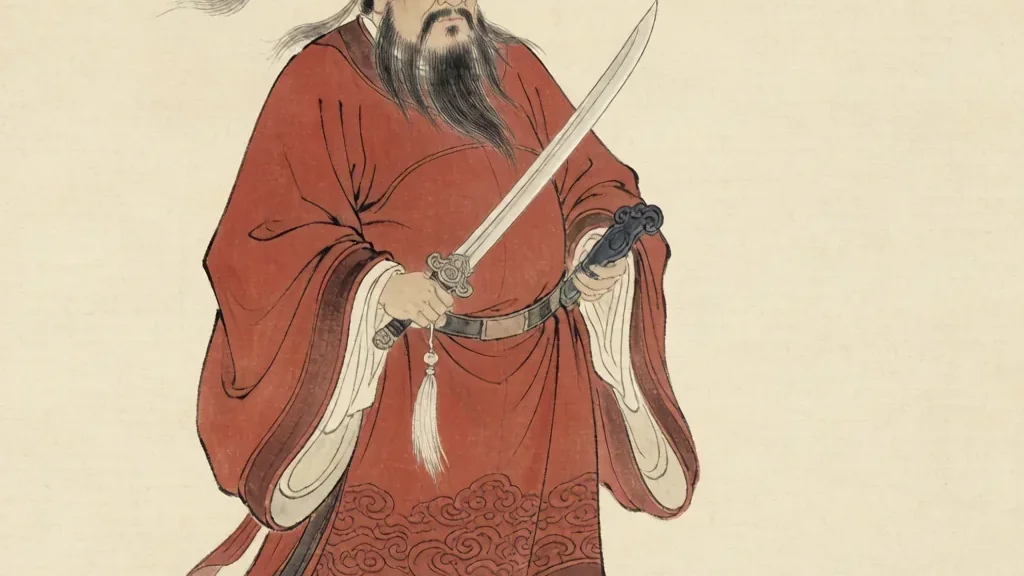
Among the pantheon of Chinese deities, one figure stands apart for his sheer ferocity. His face is dark and twisted, with bulging eyes, a bristling beard, and a mouth frozen in a snarl. He wears the robes of a scholar but carries a demon-vanquishing sword. This is Zhong Kui (钟馗), the king of ghosts and the sworn enemy of evil spirits. His story — of humiliation, suicide, and ultimate vindication — is one of the most haunting in Chinese folklore.
The Ugliest Scholar in the Empire
Zhong Kui's story begins during the Tang Dynasty (618–907 CE), the golden age of Chinese civilization. He was born in the Zhongnan Mountains, a region long associated with Taoist hermits and spiritual cultivation. From an early age, Zhong Kui displayed extraordinary intelligence. He mastered the Confucian classics, excelled at calligraphy, and seemed destined for a brilliant career as a scholar-official.
But Zhong Kui had one devastating disadvantage: his appearance. Historical descriptions paint a picture of almost grotesque ugliness — a face so misshapen that children fled at the sight of him, features so coarse that even his own family struggled to look at him without flinching. In a culture that valued refined appearance almost as highly as refined intellect, this was a crippling handicap.
Despite this, Zhong Kui persevered. He traveled to the imperial capital of Chang'an to sit for the highest level of the civil service examination — the jinshi (进士) degree, which opened the door to the most prestigious positions in the empire. His essays were brilliant, his arguments incisive. The examiners ranked him first among all candidates.
But when Zhong Kui presented himself at court to receive his honors, disaster struck. The emperor, upon seeing his hideous face, recoiled in disgust. Despite the protests of senior officials who praised Zhong Kui's scholarship, the emperor refused to grant the degree to someone so unsightly. In a moment of public humiliation, Zhong Kui was stripped of his achievement and cast out of the palace.
Unable to bear the shame, Zhong Kui threw himself against the palace steps and died. His suicide was a protest against the superficiality of a world that valued appearance over substance, and a cry of despair from a man who had done everything right and been rejected for something he could not control.
The Emperor's Dream
Zhong Kui's story would have ended there, a minor tragedy in the vast sweep of Tang history, were it not for a remarkable dream.
Not long after Zhong Kui's death, Emperor Xuanzong (唐玄宗), one of the Tang Dynasty's greatest rulers, fell gravely ill. Despite the best efforts of the imperial physicians, his condition worsened. He was tormented by feverish dreams in which a small demon tormented him, stealing his belongings and mocking his helplessness.
Then, one night, the emperor dreamed again. The small demon appeared as before, but this time it was pursued by a much larger figure — a fearsome spirit with a dark face, bulging eyes, and a scholar's robes. The large spirit caught the demon, tore out its eyes, and devoured it alive.
The emperor, trembling, asked the spirit who he was. "I am Zhong Kui," the spirit replied, "the scholar who died on the palace steps. Though the court rejected me in life, I have sworn to protect Your Majesty from all demons and evil spirits in death."
When the emperor awoke, his fever had broken. He summoned his court painter, Wu Daozi (吴道子), the greatest artist of the age, and described the figure from his dream. Wu Daozi painted Zhong Kui exactly as the emperor described — dark-faced, fierce-eyed, wearing scholar's robes and a black cap, holding a sword in one hand and grasping a demon in the other.
The emperor, astonished by the accuracy of the painting, issued a decree: Zhong Kui was to be recognized as the King of Ghosts (驱鬼大神, Qūguǐ Dàshén), and his image was to be displayed throughout the empire to drive away evil spirits. The scholar who had been rejected in life became a protector in death — perhaps the most dramatic posthumous vindication in Chinese history.
The Fifth Moon: Zhong Kui and the Dragon Boat Festival
Zhong Kui's association with the Dragon Boat Festival (端午节, Duānwǔ Jié) adds another layer to his mythology. The festival falls on the fifth day of the fifth lunar month, a time that traditional Chinese belief considers particularly dangerous — a moment when the boundary between the human and spirit worlds thins, and evil forces grow bold.
During the Dragon Boat Festival, the Chinese world erupts with protective rituals: realgar wine is drunk to ward off poison, mugwort and calamus are hung on doors to repel evil, and — crucially — images of Zhong Kui are displayed prominently. His fierce visage is believed to terrify malevolent spirits and prevent them from entering homes.
This tradition is especially strong in southern China and Taiwan, where Zhong Kui's image appears everywhere during the festival: on paper scrolls pasted above doorways, on talismans carried in pockets, and in temple processions. The connection between Zhong Kui and the fifth month is so strong that he is sometimes called "the god of the fifth month" (五月神, Wǔyuè Shén).
The Demon-Vanquishing Sword
In iconography, Zhong Kui is almost always depicted with his demon-vanquishing sword (斩鬼剑, Zhǎnguǐ Jiàn), a weapon of supernatural power. The sword is not merely a physical blade but a spiritual instrument — its edge is sharpened by righteousness, and its power derives from Zhong Kui's unwavering commitment to protecting the innocent.
The sword's symbolism runs deep. In Chinese culture, the written word itself has power, and scholars were believed to possess a kind of spiritual authority. Zhong Kui's sword can be understood as an extension of his scholarly identity: his brush could not win him justice in life, but his sword dispenses it in death.
Zhong Kui is often depicted in dynamic poses — leaping, striking, or standing with one foot raised, ready to pounce. He may be shown subduing a demon under his foot, capturing evil spirits in a sack, or commanding an army of lesser ghost-officials. Despite his terrifying appearance, his role is unequivocally protective: he is not a monster but a monster-hunter.
The Door God Tradition
Zhong Kui belongs to a broader tradition of door gods (门神, Ménshén) — protective deities whose images are placed on doors to prevent evil spirits from entering. The most famous door gods are the historical generals Qin Qiong and Yuchi Gong, who are said to have guarded Emperor Taizong's door against haunting spirits.
But Zhong Kui occupies a special place within this tradition. Unlike the military door gods, who protect against external threats, Zhong Kui is specifically associated with hunting and destroying demons. His image is often placed on inner doors rather than outer gates — suggesting that he does not merely block evil but actively pursues and eliminates it.
During the Lunar New Year and the Dragon Boat Festival, the sale and display of Zhong Kui images becomes a thriving trade. Woodblock prints, painted scrolls, paper cutouts, and even embroidered images of the demon hunter appear in markets and homes across China. Each image is a prayer for protection, a declaration that no evil spirit will find welcome within these walls.
Zhong Kui in the Modern World
Today, Zhong Kui remains a vivid presence in Chinese popular culture. His story has been adapted into countless operas, films, television series, and video games. The 1993 Hong Kong comedy-horror film Zhong Kui: The Demon Hunter and the 2015 fantasy epic Zhong Kui: Snow Girl and the Dark Crystal are just two examples of his enduring appeal as a cinematic hero.
But beyond entertainment, Zhong Kui's deeper significance endures. He represents the hope that justice will prevail — that those who are wronged in life will find vindication, and that the ugly, the rejected, and the humiliated have a place in the cosmic order. The scholar whose face cost him everything became the face that millions turn to for protection.
In a world that still judges by appearances, Zhong Kui's story carries a timeless message: true worth is not visible to the eye. The ugliest face may hide the noblest heart, and the most rejected person may become the most powerful protector.
Zhong Kui in New Year Prints and Folk Art
For centuries, Zhong Kui's protective power was carried less by temples than by the humble woodblock print. In workshops from Yangliuqing to Weifang and Taohuawu, artisans carved his scowling face, scholar's cap, and sword into pear-wood blocks, then printed them in vermilion and ink for households to paste above doors at New Year and the fifth month. These nianhua prints turned a courtly dream into a mass-produced guardian, affordable to the poorest family. The best examples balance menace and charm, a demon squirming under his boot, a bat of fortune hovering nearby, so the image protects while it amuses. Collectors today prize early Zhong Kui prints for their bold lines, and museums exhibit them as folk masterpieces rather than mere charms. Through this popular medium, the rejected scholar became a familiar, almost domestic presence in Chinese homes.
Zhong Kui Across Regions and the Diaspora
While Zhong Kui's cult began at the Tang court, it took distinct local forms as it spread. In Fujian and Taiwan, his fifth-month displays merge with the burning of paper effigies and boisterous procession floats, where young men in painted masks leap as the demon-queller to sweep villages of disease. In Guangdong, he is honored alongside the door gods at both New Year and the Dragon Boat Festival, his portrait pasted on inner lintels rather than outer gates. Among overseas Chinese communities in Southeast Asia, Zhong Kui prints travel with migrants as portable guardians of shop-houses and clan halls. Though the rituals vary, the core plea is constant, keep evil from the threshold. This regional elasticity is precisely why a single Tang-dynasty dream could seed a protective figure recognized from Fuzhou to Penang, adapted yet unmistakable wherever Chinese families settle.
唐玄宗 — : The Tang dynasty emperor whose dream of a demon-quelling scholar established Zhong Kui's cult.
吴道子 — : The celebrated Tang court painter who created the first portrait of Zhong Kui from the emperor's description.
端午节 — : The Dragon Boat Festival, held on the fifth day of the fifth lunar month, when Zhong Kui images are displayed to ward off evil.
五月神 — : God of the Fifth Month, a title given to Zhong Kui because of his strong association with the dangerous fifth lunar month.
朱砂 — : Cinnabar, the vermilion pigment used to write the protective talismans that bear Zhong Kui's name.
傩 — : The ancient Chinese exorcistic ritual-performance tradition from which masked demon-quelling figures like Zhong Kui evolved.
判官 — : The underworld judge-officials who, in folklore, serve under Zhong Kui as the king of ghosts.
镇宅 — : Guarding the household, the protective purpose behind hanging Zhong Kui's image above doors.
❓ Frequently Asked Questions
🎉 Fun Facts
- The original painting of Zhong Kui by Wu Daozi is said to have been so lifelike that the emperor felt he could reach out and touch it — a testament to Wu Daozi's legendary skill as China's "Sage of Painting."
- In some regions of China, performers dressed as Zhong Kui stage ritual dances during the Dragon Boat Festival, wielding real swords to symbolically "cut" evil from the community.
- Zhong Kui's image is sometimes hung upside down in homes — not as a mistake, but because the Chinese phrase for "upside down" (倒, dào) sounds identical to the word for "arrived" (到), symbolizing that good fortune has arrived.
- A famous related tale, Zhong Kui Marries Off His Sister, shows the fierce demon-queller returning from the underworld to arrange his living sister's marriage, a beloved opera plot that reveals his tender, familial side.
- The rare character Kui in his name suggests a crossroads or the open way, fitting a spirit who patrols the threshold between the living and the dead.
- Although most Chinese door gods are displayed in symmetric pairs, Zhong Kui is frequently hung alone, underscoring his lone, self-appointed role as a roaming demon hunter.
- A famous related tale, Zhong Kui Marries Off His Sister, shows the fierce demon-queller returning from the underworld to arrange his living sister's marriage, a beloved opera plot that reveals his tender, familial side.
- The rare character Kui in his name suggests a crossroads or the open way, fitting a spirit who patrols the threshold between the living and the dead.
- Although most Chinese door gods are displayed in symmetric pairs, Zhong Kui is frequently hung alone, underscoring his lone, self-appointed role as a roaming demon hunter.