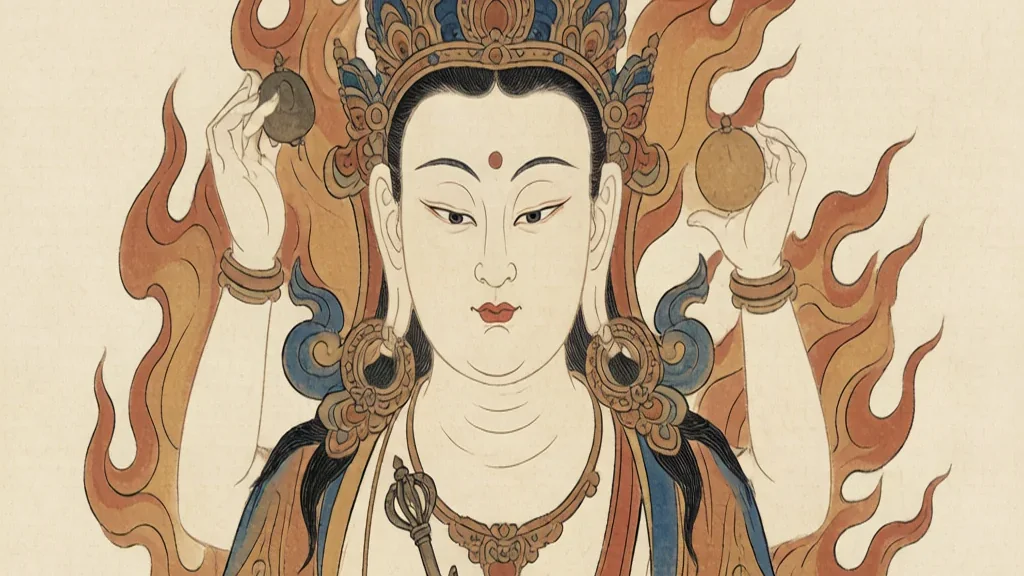
Tantric Buddhism (密宗, Mìzōng), known in the West as Esoteric Buddhism and in Tibet as Vajrayana, reached China during the flourishing Tang dynasty and introduced a vivid world of mantras, mandalas, mudras, and fierce deities. Unlike the philosophical schools that relied on scripture and reason, the esoteric path promised swift liberation through ritual identification with a buddha or bodhisattva, transmitted only through initiation from a qualified master. Though the lineage did not long survive as an independent school on Chinese soil, it left an indelible mark on Chinese Buddhist art, on Tibetan Buddhism, and on the Japanese Shingon tradition carried overseas by Kūkai. To understand Tang China is to understand a cosmopolitan empire in which Indian, Central Asian, and Chinese spiritual currents met, and tantric ritual stood at the glittering center of that encounter.
Origins in India and the Journey East
Tantric Buddhism grew out of the later Mahayana synthesis in India, where older meditation and devotion were fused with new ritual technologies of sound, gesture, and visualization. By the seventh century, esoteric texts and masters were traveling the Silk Road and sea routes into China. The three “great translators” of the early Tang—Śubhakarasimha (善无畏, Shanwuwei), Vajrabodhi (金刚智, Jingangzhi), and Amoghavajra (不空, Bukong)—established the first esoteric ordination lineages at the Tang capital of Chang’an. They rendered central scriptures such as the Mahavairocana Sutra and the Vajrasekhara Sutra into polished Chinese, and they trained Chinese disciples who would carry the teachings forward. The arrival of these masters marks the moment when Chinese Buddhism gained access to a complete, systematic esoteric curriculum rather than scattered magical practices.
The Three Mysteries of Body, Speech, and Mind
The defining practice of tantric Buddhism is the “three mysteries” (三密, sānmì): the mystery of body expressed through mudras or ritual hand gestures, the mystery of speech expressed through mantras or sacred syllables, and the mystery of mind expressed through visualizations of deities and mandalas. The practitioner seeks to unite these three with the corresponding mysteries of the buddha, so that the divided human psyche is gradually transformed into awakened awareness. This is not symbolic play alone but a disciplined technology of identity; by assuming the posture, sound, and image of a deity, one comes to inhabit its realization. The method promised what exoteric paths offered only gradually: the possibility of buddhahood in a single lifetime, attainable through the faithful performance of ritual rather than through eons of merit accumulation.
Mandalas: Maps of the Cosmos
A mandala (曼荼罗, màntúluó) is a cosmic diagram, usually circular or square, in which a central deity is surrounded by an ordered assembly of enlightened beings. In Tang esotericism the two principal mandalas were the Garbbhadhatu (Womb Realm), representing compassion and the nurturing ground of existence, and the Vajradhatu (Diamond Realm), representing wisdom and indestructible insight. To be initiated into a mandala was to be consecrated at its center, ritually reborn as a child of the buddha. Monks memorized the placement of dozens of figures, and painters produced vast silk and wall mandalas for temple halls. These diagrams were not mere decoration; they were contemplative maps through which the practitioner located himself within the enlightened order of the universe and learned to see the world as the radiant body of Mahavairocana, the cosmic buddha.
The Vajra and the Diamond Vehicle
Central to tantric symbolism is the vajra (金刚, jīngāng), the thunderbolt or diamond scepter that gives Vajrayana its name. The diamond stands for awakening that is luminous, indivisible, and indestructible, cutting through ignorance like a thunderbolt through the sky. Paired with the bell, which represents wisdom and the feminine principle of emptiness, the vajra is wielded in countless rituals to summon and dissolve the energies of the mandala. Fierce protector deities, many-headed and many-armed, brandish vajras and garlands of skulls, embodying the compassionate wrath that destroys obstacles to liberation. For the uninitiated, these images can look frightening; within the tradition they are understood as skillful means that transform fear and aggression into the fuel of enlightenment rather than repressing them.
Imperial Patronage at the Tang Court
Esoteric Buddhism enjoyed extraordinary favor under the Tang emperors, who valued its rituals for the protection of the state. Amoghavajra, the most politically active of the masters, performed rain-making ceremonies during droughts, consecrated new palaces, and conducted apotropaic rites to guard the empire against calamity and rebellion. Emperors such as Xuanzong, Suzong, and Daizong received esoteric initiations and granted the monasteries land and official status. The tantric clergy thus stood close to the centers of power, functioning as both spiritual advisers and ritual technicians of sovereignty. This imperial alliance brought the school wealth and influence, but it also made it vulnerable: when court patronage shifted or when suspicion of foreign ritual grew, the fragile institutional base of Chinese tantra could not easily survive on its own.
Art and the Visual Language of the Esoteric
The tantric presence is most visible today in the surviving art of the Tang and its successors. At the Mogao caves of Dunhuang, the Yulin caves, and the rock temples of Sichuan, one finds majestic mural mandalas, crowned and bejeweled buddhas, and fearsome guardian kings rendered with a new opulence. The esoteric aesthetic favored symmetry, rich color, and cosmological precision, leaving a template that Tibetan thangka painting would later inherit and elaborate. Ritual implements—vajras, bells, skull cups, and flaming sword—entered the permanent inventory of Chinese Buddhist altar furnishings. Even after the lineage faded, its visual vocabulary was absorbed into mainstream temple art, so that the “esoteric look” became a permanent layer of Chinese religious imagination rather than a discontinued style.
Decline in China and Survival in Tibet
The great persecution of Buddhism in 845 CE under Emperor Wuzong struck all schools, but it hit the esoteric lineage especially hard because its small, initiation-bound communities depended on continuous master-to-disciple transmission and on court favor. Many tantric texts and ritual objects were destroyed, and the unbroken Chinese lineages largely dissolved. Yet the teachings did not vanish; they were absorbed into the practices of other Chinese schools and, crucially, had already been transmitted to Tibet, where esoteric Buddhism became the dominant and state-protected form as Vajrayana. In Tibet the Indian-Tang synthesis flourished into the rich orders of Nyingma, Kagyu, Sakya, and Gelug. Thus the Chinese tantric moment was less an ending than a relay, passing the flame westward even as it dimmed at home.
The Shingon Legacy in Japan
The most enduring offspring of Chinese tantra lies overseas in Japan. The monk Kūkai (空海, 774–835), who studied in Chang’an and received initiation in the esoteric lineages, returned to found the Shingon (真言, “True Word”) school on Mount Kōya. Shingon preserves, in remarkably faithful form, the Tang mandalas, mudras, and mantras, and its rituals still echo the practices of Amoghavajra’s circle. Through Shingon and its offshoot Tendai, tantric Buddhism shaped Japanese aesthetics, from garden design to the consecration of imperial regalia. The survival of Chinese tantra in Japan is a historical irony: a school that largely disappeared in its birthplace lives on, intact and revered, across the sea. For scholars, Japanese Shingon is therefore a living window into what Tang-dynasty esoteric Buddhism actually looked and sounded like.
Echoes in Chinese Folk Religion
Even where formal tantra receded, its idioms seeped into the broader stream of Chinese popular religion. The use of incantations, talismans, and consecrated water; the veneration of guardian kings at temple gates; and the art of protective ritual against demons all carry a tantric inheritance. Daoist ritual, too, borrowed extensively from esoteric gesture and sound, blending them into its own ceremonies of purification and ascent. In this sense tantric Buddhism never wholly died in China; it dissolved into the syncretic religious culture of the people, where the boundary between Buddhist, Daoist, and folk practice is porous. The thunderbolt, the mantra, and the cosmic diagram remain quiet tributaries feeding the great river of Chinese spirituality, even when the school that named them is no longer counted among the living lineages.
📝 Chinese Vocabulary
🎉 Fun Facts
❓ Frequently Asked Questions
What is tantric Buddhism?
It is an esoteric path of mantras, mudras, and mandalas through which the practitioner identifies with a buddha to gain swift liberation, transmitted only by initiation.
Who brought tantra to China?
Indian and Central Asian masters including Śubhakarasimha, Vajrabodhi, and Amoghavajra, who worked at the Tang court in Chang’an.
Why is it called “esoteric”?
Because its core methods required secret initiation and direct master-to-disciple transmission rather than open public study.
What are the three mysteries?
Body (mudra), speech (mantra), and mind (visualization), which the practitioner unites with the corresponding mysteries of the buddha.
Why did tantra decline in China?
The 845 CE persecution destroyed its small initiation-bound communities, but the teachings survived in Tibet and were carried to Japan as Shingon.
How did tantra influence Chinese culture?
Its mandalas, vajras, fierce deities, and incantations entered temple art, Daoist ritual, and folk religion, becoming a lasting layer of Chinese spirituality.