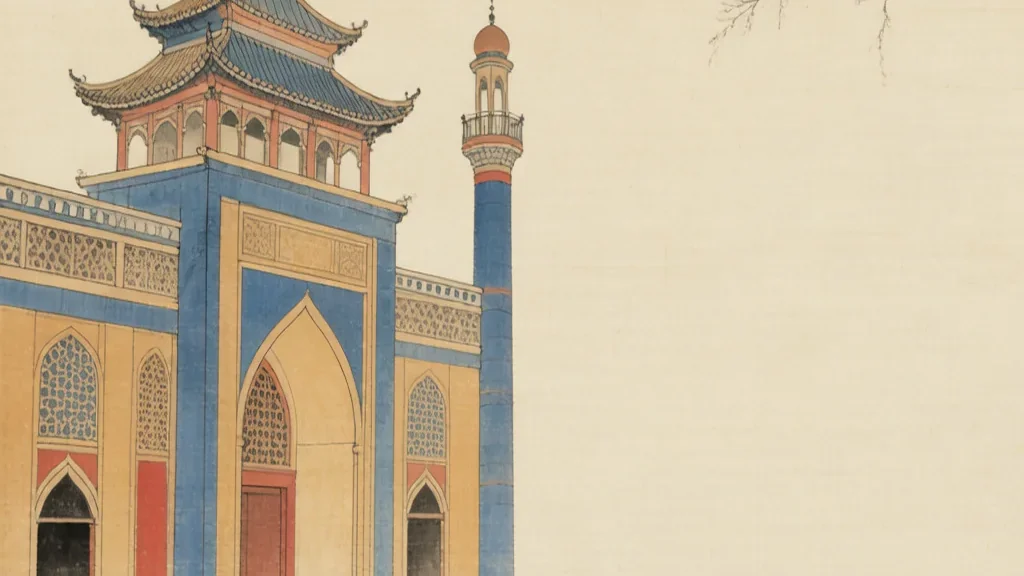
Islam in China is one of the longest continuous chapters in the global history of the faith, stretching from the Tang dynasty to the present day. Reaching Chinese soil through Arab and Persian merchants on the Silk Roads and the southern seaports, Islam took root among communities that wove the crescent into the fabric of Chinese life. Today China is home to ten officially recognized Muslim peoples—most prominently the Hui and the Uyghurs—each with its own language, culture, and forms of devotion. Chinese mosques, with their pagoda roofs and courtyard halls, stand as quiet monuments to a civilization that learned to be both Muslim and Chinese at once, a synthesis as remarkable as it is enduring.
The Arrival of Islam on the Silk Roads
Islam entered China during the Tang dynasty (618–907 CE), carried not by armies but by traders. Arab and Persian merchants sailed the maritime route to the ports of Guangzhou, Quanzhou, and Yangzhou, while overland caravans crossed Central Asia into Chang'an, then the world's largest city. These merchants formed settled communities, married locally, and built the first mosques on Chinese soil. The Huaisheng Mosque ("Remembering the Sage") in Guangzhou is traditionally dated to this early period and is named for a companion of the Prophet Muhammad.
The Tang court, confident and cosmopolitan, tolerated the foreign faith as one among many. A famous inscription notes that in 651 CE an embassy from the Caliphate reached the Tang capital, a date often cited as the formal arrival of Islam in China. What began as a merchant religion slowly became a Chinese one as generations were born, married, and died within the empire's borders.
The Hui: Chinese-Speaking Muslims
The Hui (回族) are the largest Muslim group within China proper and the clearest example of Islamic life lived in Chinese. Descended from Arab, Persian, and Central Asian immigrants who intermarried with Han Chinese, the Hui speak Chinese (Mandarin and regional dialects), eat halal-adapted Chinese cuisine, and worship in mosques built like Chinese temples. Their identity is defined by faith and lineage rather than a separate language, setting them apart from the Turkic-speaking Uyghurs of Xinjiang.
Hui communities have long been woven into the everyday economy of China—as traders, cooks, herbalists, and scholars. The Ming admiral Zheng He, who led vast fleets across the Indian Ocean, was a Hui Muslim, and his voyages were partly sustained by the maritime Muslim network that linked China to the Islamic world. The Hui show that "Chinese" and "Muslim" have never been mutually exclusive.
The Uyghurs and the Peoples of the West
In the northwest, the Uyghurs (维吾尔族) and related Turkic peoples—Kazakhs, Kyrgyz, Tajiks, Uzbeks, Tatars, and others—practice Islam in its Central Asian form, with Turkic languages and a heritage shaped by the Silk Road and the oasis cities of the Tarim Basin. Islam spread among the Uyghurs after the Kara-Khanid conversion in the 10th century, gradually replacing earlier Buddhism and Manichaeism across the Tarim oases.
These communities preserved a rich tradition of Sufi orders, shrine pilgrimage, and vernacular literature in Chagatai and later Uyghur. The great oasis towns of Kashgar, Khotan, and Turpan became centers where caravan trade, scholarship, and devotion met. Their Islam is deeply local, expressed in music, dance, and the architecture of the region's distinctive mosques and mausoleums.
The Great Mosque of Xi'an and Fusion Architecture
The Great Mosque of Xi'an, founded in 742 CE and rebuilt across the Ming and Qing dynasties, is the supreme example of Chinese-Islamic architecture. Its layout follows the courtyard plan of a Confucian temple: a central axis, successive gates, pavilions, and a final prayer hall—yet the hall's interior orients the worshipper toward Mecca, and Arabic calligraphy mingles with Chinese inscriptions. Minarets take the form of pagodas; gardens and moon-gates replace the open courtyards of the Middle East.
This architectural hybridity is more than decorative. It announces that Muslim worship belongs within Chinese civilization, not apart from it. Similar fusions appear in Quanzhou's清净寺 (Qingjing Mosque) and in countless smaller Hui mosques, where glazed tiles, carved beams, and Chinese gardens frame a thoroughly Islamic liturgy.
Mosque Architecture: Pagodas Instead of Domes
Visitors expecting the domes and pointed arches of Istanbul or Isfahan are often surprised by Chinese mosques. Built of wood with tiled, sloping roofs, they use the structural and decorative vocabulary of Chinese palace and temple architecture. The prayer hall is the sacred core; it always faces west toward Mecca, but its exterior could be mistaken for a Daoist shrine or a Confucian academy. Calligraphic panels in Arabic and Chinese hang side by side.
This style reflects both climate and culture: timber-frame construction suited Chinese builders, while the absence of domes reflected local craft tradition rather than theological difference. The result is a visual theology of harmony—proof that a faith can dress in the garments of the culture that hosts it without losing its soul.
Sufism, Orders, and Scholarship
From the Ming period onward, Sufi orders (menhuan, 门宦) took root among Chinese Muslims, especially in the northwest. Theseorders, organized around shaykhs and lineages, combined Islamic mysticism with local customs and produced a flourishing of scholarship in Arabic, Persian, and Chinese. The "scripture hall" (jingtang) education system taught Islamic texts alongside Chinese classics, producing scholar-teachers who could explain the Quran in the language of Confucius.
Figures such as Wang Daiyu and Liu Zhi (17th–18th centuries) wrote elegant Chinese expositions of Islam, using Confucian and Neo-Confucian terms to translate concepts like tawhid (the oneness of God) and imitation of the Prophet. Their work embodies the Chinese Muslim conviction that the truths of Islam and the values of Chinese civilization could be expressed in a single vocabulary.
Islamic Law, Diet, and Daily Life
Chinese Muslim life is marked by the observance of halal (清真, qingzhen, "pure and true") dietary law, the five daily prayers, the Ramadan fast, and the obligation of pilgrimage for those able. The term qingzhen came to designate everything properly Islamic—food, slaughter, mosques, and even a moral temperament of purity and sincerity. Hui neighborhoods typically center on a mosque (qingzhen si, 清真寺) that serves as school, community hall, and festival ground.
Festivals such as Eid al-Fitr and Eid al-Adha are public moments of community, with shared meals of hand-pulled noodles, roasted lamb, and sweet pastries. The call to prayer, the rhythm of the lunar calendar, and the ablution before worship give structure to daily life, knitting faith into the ordinary textures of Chinese towns and oasis markets alike.
Islam Across the Dynasties
Successive dynasties treated Muslims with varying degrees of acceptance. The Yuan (Mongol) era elevated many Central Asian Muslims to high office, while the Ming sometimes suspected them yet relied on Hui commanders and traders. The Qing conquest of the northwest brought both integration and periodic revolt, as local Muslim polities resisted central control. Through it all, Islam endured by adapting—translating its classics, building its mosques in local style, and contributing to Chinese commerce and culture.
The Republican period (early 20th century) saw a Muslim reform and educational movement, founding schools and journals that framed Chinese Muslims as loyal citizens of a modern nation. This laid groundwork for the community's place in contemporary China, even as conditions for practice shifted with the times.
Islam in Modern China
Today Islam is recognized among China's five official religions, and mosques, halal restaurants, and Islamic schools operate across Hui and Uyghur regions. The Hui generally participate openly in Chinese social and economic life, and Islamic culture contributes visibly to cities from Xi'an to Beijing. The situation in Xinjiang is more contested and has drawn significant international attention regarding policy, security, and cultural rights.
What remains constant is the simple fact of presence: for nearly fourteen centuries, the call to prayer has risen over Chinese rooftops. The story of Islam in China is the story of a faith that traveled the Silk Road and chose, again and again, to become at home—building not a separate world but a shared one.
❓ Frequently Asked Questions
When did Islam first arrive in China?
Islam reached China during the Tang dynasty (7th–8th centuries CE) through Arab and Persian merchants on the maritime and overland Silk Roads, with the first mosques built in port cities like Guangzhou.
Who are Chinese Muslims?
China recognizes ten Muslim peoples, chiefly the Hui (Chinese-speaking Muslims) and the Uyghurs (Turkic-speaking Muslims of Xinjiang), along with Kazakhs, Kyrgyz, Tajiks, and others, each with distinct languages and cultures.
Why do Chinese mosques look like temples?
Built by Chinese craftsmen, they use timber-frame construction, tiled roofs, and courtyard layouts from Chinese temple architecture, while orienting the prayer hall toward Mecca—a visual fusion of two civilizations.
What does "qingzhen" mean?
Qingzhen (清真) means "pure and true" and is the Chinese term for halal and, more broadly, for everything properly Islamic—mosques, food, and moral sincerity.
How did Chinese Muslims reconcile faith and Chinese culture?
Scholars translated Islamic teachings into Confucian and Chinese terms, built mosques in local style, and participated fully in Chinese commerce and civil life, creating a distinct Sino-Islamic identity.
Is Islam still practiced in China today?
Yes; Islam is one of China's five officially recognized religions, with active mosques, halal culture, and festivals among Hui and Uyghur communities, though conditions vary by region.