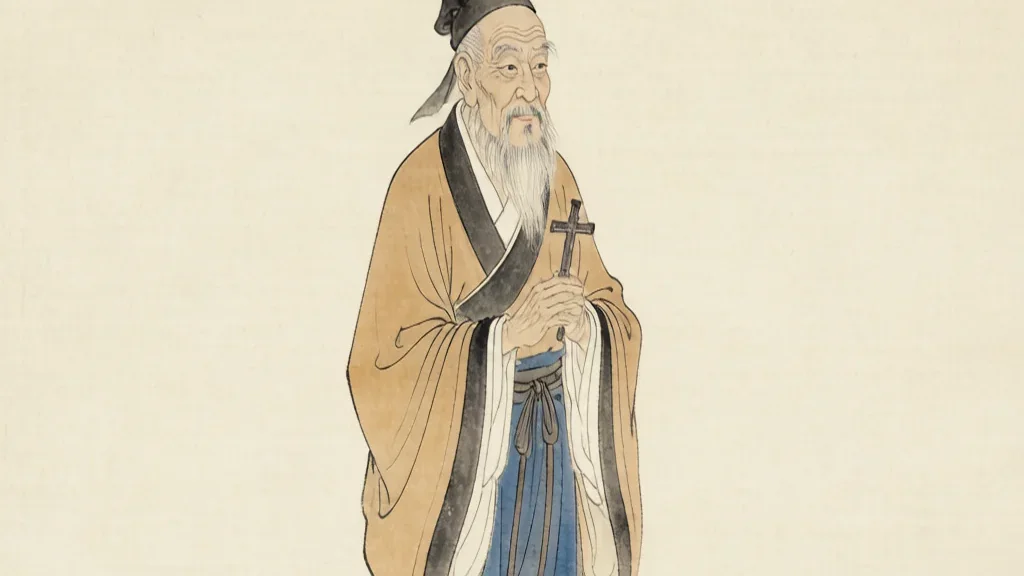
The Nestorian Church in China (景教, Jǐngjiào, the "Luminous Religion") represents one of the earliest encounters between Christianity and Chinese civilization. In the seventh century, Persian missionaries of the Church of the East brought a distinct branch of Eastern Christianity to the Tang capital Chang'an, where they built churches, translated scriptures, and won the favor of emperors. For two centuries their faith flourished under a tolerant dynasty, leaving behind a monument that would astonish the world a thousand years later. This is the story of the cross that once stood in the heart of Tang China.
The Stele of Xi'an
The most important evidence for early Christianity in China is the Nestorian Stele, erected in 781 CE and unearthed in Xi'an in 1625. Standing more than two meters tall, it bears a long inscription in Chinese alongside a shorter text in Syriac, the liturgical language of the Church of the East. The stone records the arrival of the missionary Alopen (阿罗本, Āluóběn) in 635 CE and recounts the faith's history at the Tang court.
What makes the stele extraordinary is its diplomacy of language. To explain Christian doctrine to Chinese readers, its composers borrowed the vocabulary of Buddhism and Daoism — speaking of the "true and still" deity, of "saving beings," and of a "Luminous Religion." The monument is thus a bilingual, bicultural artifact: proof that the first Christians in China translated not only scriptures but themselves.
Doctrine and Adaptation
Nestorian Christians held to the theology of Nestorius, the fifth-century patriarch of Constantinople, who stressed the distinctness of the divine and human natures of Christ. This emphasis on distinction set them apart from the Byzantine mainstream and, after the Council of Ephesus (431), led to their separation as the Church of the East.
In China they described God as a transcendent creator (often using the Buddhist term 天尊, Tiānzūn, "Heavenly Honored One") and presented Jesus as a teacher of compassion. They adapted rituals to local sensibilities while keeping the core creed. Monastic communities practiced asceticism and devoted themselves to tending the sick and the poor — a quiet witness that won them respect in a cosmopolitan capital.
The Luminous Religion in Chang'an
At its height the Nestorian community worshipped in churches called "temples of the Great Qin" (大秦寺, Dàqín sì), "Great Qin" being the Chinese name for the Roman Near East. The capital Chang'an, the largest city on earth, hosted a diverse population of Sogdian merchants, Persian clergy, and foreign envoys, and the Nestorians found a place among them.
Emperor Taizong (r. 626–649) received Alopen favorably and reportedly ordered the scripture translated and a church built. Later emperors granted further patronage; the stele credits the faith with bringing "peace to the four quarters." For a time the cross and the pagoda stood almost as neighbors in the same imperial city.
Nestorius and the Eastern Controversy
To understand the Chinese mission one must recall its origins. Nestorius taught that Mary should be called "Christ-bearer" (Christotokos) rather than "God-bearer" (Theotokos), wishing to protect the full humanity of Jesus. His opponents feared this divided Christ; the dispute convulsed the empire and ended with his condemnation and exile.
His followers carried their version of the faith eastward along the trade routes, establishing a vigorous church stretching from Persia to Central Asia and, eventually, to China. The very label "Nestorian" was often a nickname imposed by critics; the community itself preferred simply "the Church of the East." In China they shone under the gentler name "Luminous Religion."
Missionary Methods and Translation
The Nestorians were tireless translators. Working with Chinese collaborators, they rendered Christian hymns, biblical narratives, and treatises into elegant literary Chinese. The stele itself was composed by a cleric named Adam (景净, Jǐngjìng), who also joined Buddhist monks in translating scripture — a remarkable instance of interreligious cooperation.
They presented Jesus as "Messiah" (弥施诃, Míshīhē) and retold the stories of creation, the patriarchs, and the incarnation in terms intelligible to a Buddhist-and-Daoist audience. Surviving fragments show a faith that was neither a crude copy nor a retreat from orthodoxy, but a genuine attempt to plant the gospel in Chinese soil.
Monastic Life and Charity
Nestorian clergy in China lived in monastic communities modeled on those of the wider Church of the East. They observed celibacy, fasted, chanted the liturgy in Syriac, and maintained the daily offices. Crucially, they also ran hospices and cared for travelers, the sick, and the destitute — works of mercy that echoed the gospel and built local goodwill.
This blend of contemplation and service gave the community a quiet strength. In a city crowded with rival faiths — Buddhism, Daoism, Zoroastrianism, Manichaeism — the Christians were distinguished less by argument than by their steady compassion, a witness that outlasted many louder movements.
Persecution and Decline
Nestorian Christianity flourished under Tang tolerance but was dealt a blow in the mid-ninth century. In 845 the emperor Wuzong launched the "Huichang persecution" (会昌灭法, Huìchāng mièfǎ), targeting foreign religions to seize their wealth and land for the state. Buddhism was hardest hit, but Nestorian, Zoroastrian, and Manichaean communities were suppressed as well.
Churches were closed, clergy returned to lay life, and the faith retreated from the Chinese heartland. Though small pockets survived in the borderlands and along the Silk Road, the public Christian presence in the Tang realm was largely extinguished — not by theological defeat but by imperial decree.
Survival Under the Mongols
The story did not end there. Under the Mongol Yuan dynasty (1271–1368), the Church of the East reappeared across Asia, enjoying the favor of khans who themselves counted Nestorian Christians among their kin. Nestorian clergy served at the Mongol court, and the faith spread along the reopened trade routes from Beijing to Central Asia.
Among the most remarkable figures was Rabban Sauma, a Nestorian monk born in Khanbaliq (Beijing) who, in the 1280s, traveled westward all the way to Paris, Rome, and the courts of Europe — an Asian Christian ambassador to the Latin West. His journey shows how far the "Luminous Religion" had reached before its final eclipse in China.
Rediscovery in Modern Times
For centuries the stele lay buried or ignored until its dramatic rediscovery near Xi'an in 1625. When Jesuit missionaries such as Matteo Ricci learned of it, they recognized in its Chinese and Syriac lines the lost history of an ancient church. The stone became a sensation in scholarly Europe, cited as proof of Christianity's deep Asian roots.
Legend holds that one zealous Westerner even tried to ship the massive stele to Europe, only for local officials to intervene and keep it in China. Today it rests in the Stele Forest (碑林, Bēilín) museum in Xi'an, where visitors can read, in two ancient tongues, the story of a faith that once lit the Tang capital.
Legacy and Memory
The Nestorian episode matters because it reframes the history of Christianity as a global, Asian as well as European, story. Long before the modern missionary movements, a Syriac-speaking church had planted the cross in the heart of China and spoken of Christ in the language of the Dao.
For the study of Chinese religion, Jingjiao is a vivid case of translation and accommodation — how a foreign faith found a Chinese voice, and how that voice was silenced and rediscovered. The Luminous Religion left few descendants in blood, but its monument still shines, a reminder that the meeting of civilizations can be inscribed in stone for a thousand years.
📝 Chinese Vocabulary
🎉 Fun Facts
❓ Frequently Asked Questions
Q: When did Nestorian Christianity arrive in China?
A: In the Tang dynasty — the missionary Alopen reached Chang'an in 635 CE and won imperial favor.
Q: What is the Nestorian Stele?
A: A Tang monument of 781 CE, unearthed in Xi'an in 1625, that records the faith's history in Chinese and Syriac.
Q: What happened to the faith in China?
A: It was suppressed in the ninth-century Huichang persecution and largely vanished, surviving only in borderlands.
Q: What was distinctive about Nestorian doctrine?
A: It stressed the distinction between Christ's divine and human natures, a position that defined the Church of the East.
Q: How did the Nestorians adapt to Chinese culture?
A: They borrowed Buddhist and Daoist terms to explain Christian ideas and translated their scriptures into literary Chinese.
Q: Did Nestorian Christianity ever return?
A: Briefly, under the Mongol Yuan dynasty, when the Church of the East had followers at the court before fading again.