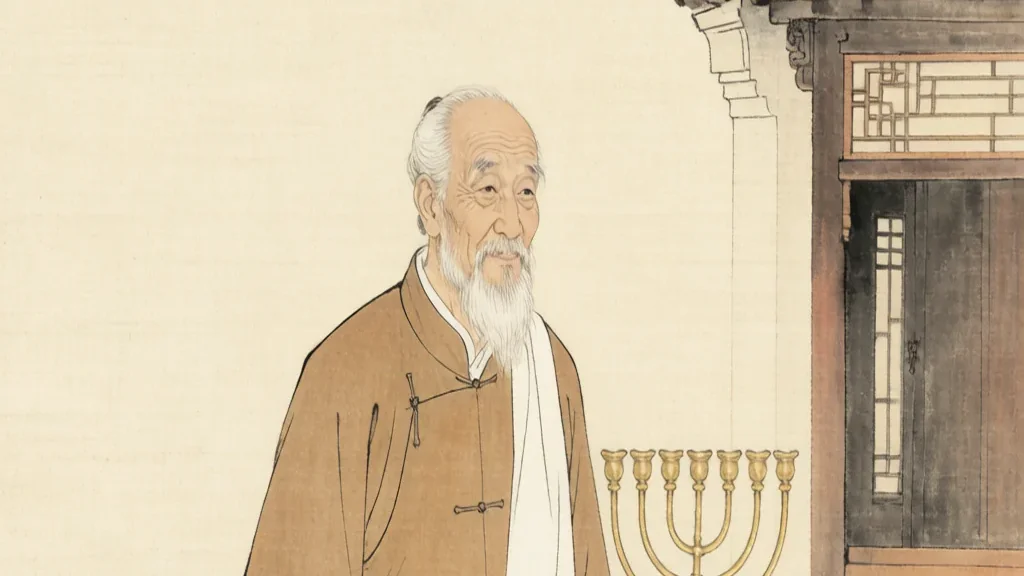
The Jews of Kaifeng form one of the most curious and poignant stories in the history of the Chinese people and of the Jewish diaspora. For perhaps eight centuries, a community of Israelites flourished in the northern city of Kaifeng, capital of the Northern Song dynasty, keeping a synagogue, the Torah, and the Sabbath within a thoroughly Confucian society. They called themselves the "Israel" (一赐乐业) lineage and were known to their neighbors as the "Plucked Sinew sect" (挑筋教) for their kosher butchery. By the nineteenth century the community had largely faded into the surrounding population—yet its stone tablets, memories, and descendants remain a living testimony to a remarkable experiment in coexistence.
The Arrival of Jews in Kaifeng
The precise date of Jewish arrival in Kaifeng is uncertain, but the strongest evidence places them there during the Northern Song dynasty (960–1127 CE), likely arriving as merchants along the Silk Road from Persia or India. A later inscription records that the community built its synagogue in 1163, by which time they were already established and accepted. Chinese authorities, notably the Ming, granted them official recognition and even gave them Chinese surnames, treating them as one of the "registered" peoples of the realm.
Kaifeng, a grand canal city and imperial capital, was a natural home for a trading diaspora. The Jews dealt in textiles, medicine, and finance, and several entered the civil service through the rigorous examination system. Their presence was peaceful and, for most of their history, unremarkable to their neighbors—a quiet integration rare in the pre-modern world.
The Synagogue of Kaifeng
The Kaifeng synagogue, first erected in 1163 and rebuilt several times after floods, was a marvel of cultural fusion. It followed the courtyard plan of a Chinese academy or temple, with successive gates, a scripture hall, classrooms, a ritual bath (mikveh), and a main sanctuary. Uniquely, the sanctuary faced east toward Jerusalem rather than the Chinese auspicious south, and at its heart stood the Torah ark. At its height the complex covered well over ten thousand square meters.
Inside, the community kept scrolls of the Law, recited the Hebrew scriptures, and maintained a liturgy drawn from the broader Jewish world. The building's Chinese exterior and Jewish orientation captured the community's dual identity: Chinese in form, Israelite in faith. When the Yellow River flooded and the structure finally fell into ruin in the mid-nineteenth century, the physical heart of the community was lost.
Community Life and Religious Practice
For centuries the Kaifeng Jews observed the core commandments: Sabbath rest, circumcision of sons, kosher dietary laws (including the removal of the sciatic nerve that gave them their Chinese nickname), and public reading of the Torah. They celebrated the festivals of Passover and the New Year and maintained hereditary lines of priests (Levites and Cohens among their surnames survive in records).
At the same time they were exemplary Chinese subjects. They took Confucian surnames, venerated ancestors, sat for examinations, and served as officials. Their Judaism absorbed local color—one inscription even paraphrases Confucian ideals alongside biblical narrative—showing a community that honored both Sinai and the Sage without seeing contradiction.
The Stone Tablets and Their Inscription
The community's story survives largely through three remarkable stone stelae, erected in 1489, 1512, and 1663, which record its history in Chinese. These inscriptions trace the Jews' descent from Abraham, recount the building of the synagogue, and praise the Ming emperors' tolerance. They are among the most important documents of any Jewish community in the diaspora, preserving a self-portrait in the host culture's own language.
The tablets show how the community explained itself to Chinese society: as a people who "revered Heaven," upheld filial piety, and kept a single, formless God above images—doctrines that resonated, the inscriptions note, with certain Confucian and Daoist teachings. This rhetorical bridge allowed the Jews to be both visibly different and socially at home.
Rediscovery by the Jesuits
In 1605 a Kaifeng Jew named Ai Tian visited the Jesuit missionary Matteo Ricci in Beijing, having heard of a "foreign" teacher and mistakenly hoping to find a fellow believer in the one God. Ricci, astonished, realized he had met living descendants of the lost tribes. Jesuit reports of the community sparked intense European interest and a wave of letters home that fed the Western imagination for centuries.
Later missionaries, including the Jesuits and the London Society for Promoting Christianity amongst the Jews, visited Kaifeng, copied inscriptions, and acquired residual Torah scrolls. Their accounts, though sometimes paternalistic, preserved crucial knowledge at the very moment the community's Hebrew learning was vanishing.
Assimilation and the Fading of Memory
Several forces eroded the community. Repeated Yellow River floods destroyed the synagogue and scattered families; the loss of trained rabbis and teachers meant Hebrew and liturgy could no longer be transmitted; and intermarriage within a small, isolated population blurred boundaries. By the early twentieth century few Kaifeng Jews could read Hebrew or recite prayers, and the synagogue stood in ruins.
Yet the people did not disappear. Descendants with surnames like Ai, Shi, Gao, and Jin—some linked genealogically to the old community—remained in Kaifeng, often cherishing a family memory of "coming from the West." Their story is not a tragedy of destruction but a quiet tale of blending, in which a faith dissolved into a civilization even as its traces endured.
The Kaifeng Jews in Modern Memory
In the late twentieth and early twenty-first centuries, global Jewish organizations renewed contact with Kaifeng, supporting heritage education and, for some, pathways to emigration and formal conversion. Descendants have variously embraced, explored, or set aside the identity, and the Chinese state has approached the question with care. The community today numbers a small group of self-identified descendants rather than a functioning congregation.
The Kaifeng story matters because it is exceptional: almost nowhere else did a Jewish community assimilate so completely into a non-Western society while leaving such rich documentation. It complicates the usual narrative of diaspora survival and reminds us that coexistence can take many forms—including, finally, merger.
What the Kaifeng Jews Teach Us
The Jews of Kaifeng embody a distinctive model of minority life: loyalty to the host state, fluency in its culture, and quiet preservation of a distinct faith until circumstances allowed. They were neither persecuted outcasts nor isolated separatists but participants in Chinese civilization who happened to worship the God of Israel. Their tablets still stand as a monument to tolerance on both sides.
In an age attentive to the tensions between identity and belonging, Kaifeng offers a nuanced case study. It shows that difference and integration are not always opposites, and that a people may honor its ancestors while becoming, in every outward respect, the children of the land they inhabit.
❓ Frequently Asked Questions
When did Jews arrive in Kaifeng?
Most evidence points to the Northern Song dynasty (around the 11th–12th centuries CE), when Jewish merchants settled in Kaifeng, likely via the Silk Road from Persia or India, and built a synagogue in 1163.
What remained of their community?
A synagogue (until the 19th century), three Chinese stone stelae recording their history, and Torah scrolls that later passed to collectors; descendants with family memories survive in Kaifeng today.
Why is the Kaifeng community remarkable?
It is one of the rare cases of a Jewish community peacefully assimilating into a non-Western society while leaving detailed documentation, bridging Israelite faith and Confucian life.
How did they practice Judaism in China?
They observed the Sabbath, circumcised sons, kept kosher law, read the Torah, and venerated one formless God, while also taking Chinese surnames and sitting for civil exams.
Who rediscovered them for the West?
Jesuit missionaries, especially after Ai Tian met Matteo Ricci in Beijing in 1605, sent home accounts and inscriptions that ignited European interest in the "lost tribes of China."
Are there Kaifeng Jews today?
A small number of descendants in Kaifeng maintain family memory of the community and, with support from Jewish organizations, some have reconnect to Jewish heritage, though no full congregation remains.