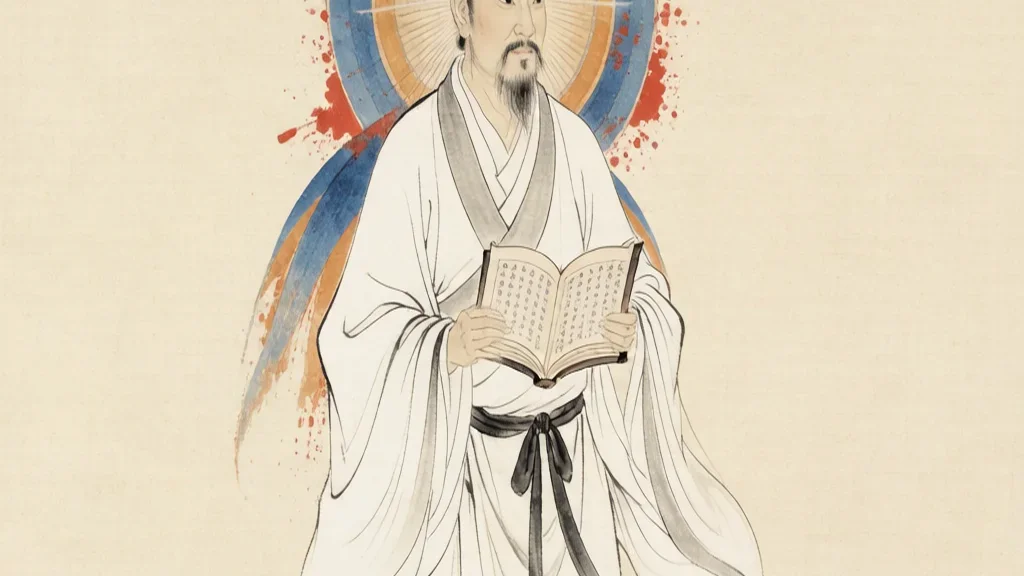
Manichaeism (摩尼教, Móní Jiào) reached China along the Silk Road in the seventh century and survived for centuries as a minority faith of merchants, exiles, and underground communities. Founded by the Persian prophet Mani in the third century CE, it taught that the universe is a battlefield between light and darkness and that the human soul is a particle of light trapped in the prison of matter. In China it was known as the "Religion of Light" (明教, Mingjiao), was briefly protected, then brutally suppressed, and finally absorbed into Buddhism and folk sects. Its beautiful manuscripts and cave paintings remain among the most haunting relics of medieval Eurasia.
The Prophet Mani
Mani was born around 216 CE in Mesopotamia, in a region of intense religious mixing. He proclaimed himself the final messenger in a line that included Buddha, Zoroaster, and Jesus, and he set out to unite their truths into one universal religion. A gifted painter and organizer, Mani composed scriptures in several languages and dispatched missionaries from the Roman Mediterranean to Central Asia. His central teaching offered a clear answer to the problem of evil: the world is not the work of a single good creator but a turbulent mixture of light and darkness, and the duty of the faithful is to liberate the light imprisoned within them.
Two Principles and Three Moments
Manichaean doctrine is summarized as the "Two Principles and Three Moments" (er zong san ji). The two principles are Light and Darkness, eternally distinct yet now entangled. The three moments describe cosmic history: a past age when light and darkness were separate; a present age of mixture in which the soul struggles to free itself; and a future age when light will be gathered back and darkness sealed away forever. This dramatic narrative gave followers a cosmic role: every act of purity, fasting, and chanting helped recover the scattered light and hasten the world's restoration.
The Arrival in Tang China
Manichaean missionaries entered the Tang empire through the western trade routes, and a community was established at Chang'an, the capital, by the mid-seventh century. The religion appealed especially to Sogdian and other Central Asian merchants who dominated Silk Road commerce, and for a time it enjoyed imperial tolerance. A surviving stele from 781, the "Sino-Manichaean Compendium," shows how the faith presented itself in Chinese, blending its cosmology with Buddhist and Daoist phrasing to win acceptance at court and among the literate elite.
Imperial Patronage and Persecution
The Uighur Turks, who ruled a steppe empire north of China, adopted Manichaeism as a state religion in the eighth century, and through their alliance with the Tang court the faith gained unusual protection. That fortune reversed in 843 CE, when the Tang emperor Wuzong launched a sweeping suppression of "foreign" religions—Buddhism, Christianity, and Manichaeism alike. Manichaean temples were destroyed, clergy were forced to return to lay life, and the open community was shattered. The faith retreated underground or migrated southeast into the hills of Fujian and Zhejiang.
Survival in the Southeast
In the remote villages of southeastern China, Manichaeism survived by disguise. Temples honored Mani as a Buddha-like figure, the "Buddha of Light" (摩尼光佛), and wove his image into local worship. Rituals of light, chanting, and vegetarian fasting continued under cover of folk religion. Communities in places such as Jinjiang in Fujian preserved their identity for centuries, and a remarkable Manichaean statue of the "Manichaean Light Buddha" still survives there, a quiet witness to a faith that refused to disappear entirely.
Manichaean Art and Manuscripts
Manichaeism produced some of the most exquisite religious art of the medieval world. Mani himself was credited with illustrated "picture-books" used to teach the faith, and this love of image continued among his followers. Turpan manuscripts show finely painted textual vignettes; Dunhuang yielded a Chinese Manichaean hymn scroll of extraordinary beauty; and cave sites preserve haloed, robed figures of light. The distinctive Manichaean script, invented by the prophet, carried texts across Central Asia in a flowing, literacy-building hand that scholars still decipher today.
Blending with Buddhism and Folk Sects
Because Manichaeism shared with Buddhism the language of light, liberation, and the saved soul, it was easy for the two to merge in popular practice. Manichaean vegetarianism, reverence for light, and apocalyptic hope fed into millenarian sects that periodically rose in late imperial China. The famous white-robed, light-worshipping groups of the Song and Yuan periods carried Manichaean DNA, even when their members no longer knew the name. In this way the Religion of Light survived not as an institution but as a current within Chinese popular religion.
Legacy in Literature and Memory
Manichaeism's dramatic dualism and its secret "Religion of Light" captured the Chinese imagination long after the organized church vanished. In the Ming-dynasty martial arts novel The Heaven Sword and Dragon Saber by Jin Yong, the Mingjiao appears as a persecuted but heroic brotherhood, romanticizing the historical faith for modern readers. Archaeologists and historians, meanwhile, continue to recover fragments—sutras, letters, painted banners—that piece together how a Persian prophet's vision traveled thousands of miles to take root, however briefly, in the soil of China.
Vocabulary
Fun Facts
Frequently Asked Questions
Q: What is Manichaeism?
A: A dualist faith from Persia teaching that the universe is a struggle between light and darkness, and the human soul is light trapped in matter; in China it was tolerated, then banned.
Q: Why is it called the "Light of the East"?
A: Its hymns and rituals spoke constantly of rescuing the light of the soul and returning it to the realm of pure light.
Q: How did Manichaeism enter China?
A: Along the Silk Road in the seventh century, carried by Central Asian merchants and missionaries who reached the Tang capital Chang'an.
Q: Why was it persecuted?
A: In 843 CE the Tang emperor Wuzong suppressed "foreign" religions; Manichaean temples were destroyed and the open community forced underground.
Q: What remained of the faith in China?
A: Its imagery and light-worship survived in Manichaean cave art, southeastern temple statues, and folk religious sects.
Q: How is Manichaeism remembered today?
A: Through recovered Turpan and Dunhuang manuscripts, the Jinjiang Light Buddha statue, and its romanticized role in wuxia fiction.