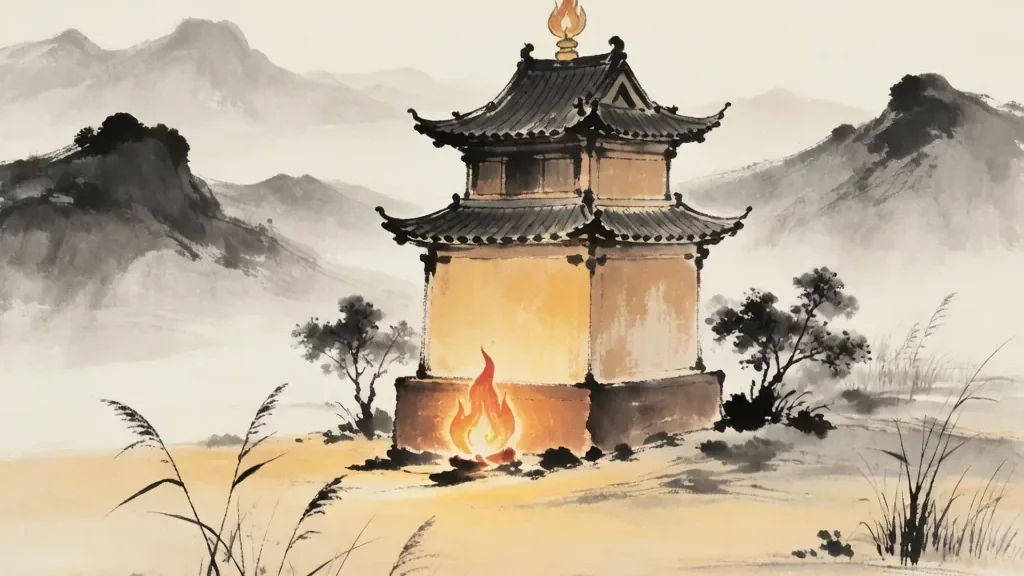
Zoroastrianism (祆教, Xiānjiào), the ancient Persian religion of fire, light, and cosmic dualism, reached Chinese soil along the Silk Road in the sixth century of the common era. To the Chinese it was one of several “western” or “barbarian” faiths practiced by foreign merchants and soldiers, alongside Buddhism, Manichaeism, Nestorian Christianity, and later Islam. Known loosely as the “Worship of Heaven” or the “Religion of the Celestials,” Zoroastrianism never became a Chinese mass religion, but for several centuries its fire temples stood in the great Tang cities, its festivals appeared in official records, and its vivid imagery of light against darkness left quiet traces in Chinese culture. The story of Zoroastrianism in China is the story of a fragile migrant faith that illuminated a cosmopolitan age and then, under changing politics and faiths, all but vanished.
Ahura Mazda and the Cosmic Struggle
Zoroastrianism was founded in ancient Iran by the prophet Zarathustra, known in Chinese as 琐罗亚斯德 (Suǒluóyàsīdé). Its central vision is a universe locked in moral and cosmic struggle between Ahura Mazda, the wise lord of light, truth, and order, and Angra Mainyu, the destructive spirit of darkness, falsehood, and chaos. Human beings are not passive spectators but active participants who must choose truth (asha) over falsehood (druj) in every deed, word, and thought. At the end of time a final judgment will purify the world and resolve the struggle in light’s favor. This stark dualism gave Zoroastrianism its unmistakable character and, with its emphasis on individual moral choice and a coming renovation of the world, exerted a wide influence on later religious traditions across Eurasia, including Judaism, Christianity, and Islam.
Fire as the Sacred Symbol
Although Zoroastrians do not “worship fire” in the idolatrous sense, the kept flame is the supreme symbol of divine light and purity, and the perpetual fire of the temple is tended with scrupulous care. Fire temples housed an altar where a clean, consecrated fire burned without interruption, tended by priests who wore masks to avoid polluting the flame with their breath. For the Chinese, who noticed the eternal flames tended by foreign priests, this gave the religion its memorable nickname and its association with the “west.” The veneration of light and fire dovetailed, intriguingly, with Chinese reverence for brightness and heaven, which may explain why the faith was sometimes described simply as the worship of “Heaven” (天, tiān) by the people who observed it.
The Sogdian Merchants of the Silk Road
The human carriers of Zoroastrianism into China were above all the Sogdians, a vigorous mercantile people from the oasis cities of Central Asia such as Samarkand and Bukhara. As the Silk Road’s principal traders, Sogdian communities planted themselves in the great Tang cities—Chang’an, Luoyang, and the northern frontier towns—and maintained their ancestral religion abroad. Chinese sources record Sogdian settlements with their own temples, leaders, and festivals, and Sogdian became for a time a kind of lingua franca of Central Asian commerce in China. Through these merchants, Zoroastrian ritual, art, and vocabulary entered the Chinese world; even the Sogdian word for temple, bagina, left echoes in Chinese usage. The faith was thus less a missionary religion than a diaspora community’s ancestral loyalty, sustained by trade and kinship.
Zoroastrians in Tang Chang’an
During the height of the Tang, the cosmopolitan capital of Chang’an was home to a remarkable assembly of foreign religions, and Zoroastrianism held a recognized, if minority, place among them. Imperial registers of the seventh and eighth centuries list “Xiān” (祆) temples and their clergy, and the state even appointed officials to supervise the affairs of the “western” faiths. Sogdian officers served in the Tang army, and Zoroastrian festivals of fire and sacrifice appear in official calendars. The religion enjoyed periods of imperial tolerance precisely because it was bound up with useful, loyal foreign populations. Yet it remained socially marked as a “barbarian” faith—the Chinese sometimes called it 胡天 (hú tiān), “barbarian heaven”—and its flourishing always depended on the goodwill of a court more fascinated by than committed to it.
Festivals and Ritual Life
Zoroastrian ritual life centered on the tending of the fire, the offering of purified substances such as haoma (a sacred plant extract), and communal festivals marking the agricultural and cosmic calendar. Tang records mention a festival rendered 赛祆 (sài xiān), a lively public celebration involving music, processions, and offerings that caught the attention of Chinese chroniclers. Priests, known as magi in the West and sometimes noted in Chinese sources, guarded the rituals of purity that defined the community. For the Sogdian families of Chang’an, these rites sustained identity in a foreign land, linking each household to the distant light of Iran. The color and sound of these festivals, glimpsed by Chinese neighbors, contributed to the exotic, multi-faith texture of Tang urban life that poets and painters later romanticized.
Encounters with Other Foreign Faiths
Zoroastrianism in China never lived alone; it shared the religious marketplace of the Tang with Buddhism, Manichaeism, Nestorian Christianity, and Judaism. Manichaeism in particular, itself born in a Zoroastrian cultural sphere, borrowed the imagery of light and darkness and sometimes confused observers who lumped the two “Persian” faiths together. The famous Nestorian Stele of Xi’an (781 CE) and the later discovery of Zoroastrian and Manichaean manuscripts at Dunhuang show how closely these communities brushed against one another. This crowded field of faiths meant that Zoroastrianism was both enriched by exchange and threatened by competition; when one foreign religion rose or fell under imperial favor, the others often rose or fell with it, bound together in the eyes of the state as exotic imports rather than native traditions.
Persecution and Decline
The turning point came in the mid-ninth century. The Tang state, facing fiscal crisis and alarmed by the wealth and foreignness of monastic institutions, launched the great persecution of 845 CE under Emperor Wuzong, which targeted Buddhism and, by extension, the other “western” religions tolerated under its umbrella. Zoroastrian and Manichaean temples were closed or destroyed, their property confiscated, and their priests dispersed. Compounding this, the rise of Islam across Central Asia cut the Sogdian homeland off from its Iranian roots, starving the Chinese communities of replenishment from abroad. Within a few generations, organized Zoroastrianism in China had effectively disappeared, surviving only in scattered memories, place names, and a few artifacts unearthed by modern archaeology.
Lasting Traces in Chinese Culture
Though the institutions vanished, Zoroastrianism left subtle marks on Chinese civilization. Its stark contrast of light and darkness, its fire symbolism, and its myth of a final cosmic judgment resonate in later folk and literary motifs of good versus evil and of purifying flame. Some scholars have speculated, cautiously, that the Iranian emphasis on a just heavenly order may have colored the Chinese discourse of the “Mandate of Heaven,” though this influence is debated and should not be overstated. Archaeological finds—stone pillars carved with Zoroastrian priestly figures, temple foundations, and manuscripts from Dunhuang—now allow historians to reconstruct a faith once thought almost entirely lost. Today Zoroastrianism survives globally among the Parsis of India and the Zoroastrians of Iran, a small but proud community keeping alive the fire that once also flickered, briefly and brightly, in Tang China.
📝 Chinese Vocabulary
🎉 Fun Facts
❓ Frequently Asked Questions
Who brought Zoroastrianism to China?
Sogdian merchants of the Silk Road, who built fire temples and maintained their rites in Tang cities such as Chang’an and Luoyang.
Why is it called the “fire of the west”?
Because its worship centered on a perpetually kept flame as a symbol of divine light, echoing its Persian homeland.
What is the core belief of Zoroastrianism?
A cosmic struggle between Ahura Mazda, the lord of light and truth, and Angra Mainyu, the spirit of darkness, in which humans must choose good.
What remained of the faith in China?
Temple artifacts, carved pillars, a few manuscripts from Dunhuang, and the memory of a vanished minority faith.
Why did Zoroastrianism decline in China?
The 845 CE persecution of foreign religions and the rise of Islam in Central Asia cut the faith off from both state support and its homeland.
Did it influence Chinese culture?
Its light-versus-darkness imagery and fire symbolism left subtle traces in folk motifs, and possibly in ideas of heavenly justice, though its institutions vanished.