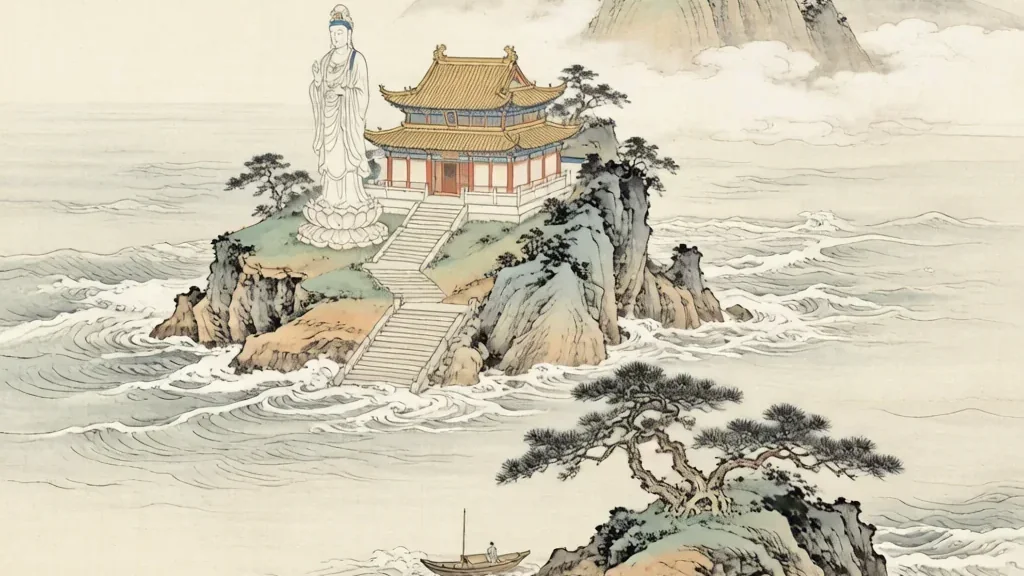
Putuo Mountain (Putuo Shan, 普陀山) is one of China's four sacred Buddhist mountains and the foremost bodhimanda — the earthly "domain of awakening" — of Guanyin, the Bodhisattva of Compassion. A small island in the Zhoushan archipelago off the coast of Zhejiang province, it has for over a millennium drawn pilgrims who come to seek the mercy of Guanyin, to witness miracles, and to walk the same cliffs and caves where the goddess is said to appear. Unlike the other sacred mountains devoted to fierce male protector-buddhas, Putuo is defined by a feminine, merciful presence and by the sea: its temples cling to headlands above the East China Sea, and its devotion is inseparable from the maritime culture of the southeast coast. Today it remains both a living monastery complex and a UNESCO-recognized scenic landscape.
Geography: an Island of the Eastern Sea
Putuo Shan occupies about twelve square kilometers at the mouth of the Hangzhou Bay, one of more than a thousand islands in the Zhoushan group. Its terrain is low and rounded rather than alpine, with forested hills, sea-eroded caves, and sheltered bays. The climate is mild and humid, and the sound of the ocean is a constant presence in its ritual life.
This insular, coastal setting shaped the mountain's character. Pilgrims historically arrived by boat, and the sea itself became part of the devotion — storms stilled by Guanyin's intervention, and the famous "Purple Bamboo Grove" (Zizhulin) where she was believed to dwell by the waves. The island's very isolation heightened its aura as a retreat from the worldly shore.
Guanyin and the Symbolism of Compassion
Guanyin (观音, "Perceiver of Sounds") is the Chinese form of Avalokiteshvara, the bodhisattva who hears the cries of suffering beings and vows never to rest until all are saved. In China Guanyin underwent a profound transformation from the Indian male bodhisattva into a predominantly female, maternal figure of mercy — a shift largely centered on Putuo.
On Putuo, Guanyin is honored in many forms: as the "Sending-down Children" Guanyin (Songzi Guanyin) for infertility, as the white-robed Guanyin (Baiyi Guanyin), and as the "South Sea" Guanyin seated above the waves. The island is thus the geographic anchor of her cult, and her compassion is imagined as extending specifically across the surrounding sea to those in peril upon it.
The Legend of the "Unfinished Guanyin"
A founding legend credits the Tang monk Huixiao, who in 858 CE was returning from Japan with a statue of Guanyin when his ship was halted at Putuo by a "metal lotus" that bloomed upon the water, preventing passage. Interpreting this as the goddess's wish to remain, he built the "Unfinished Guanyin Temple" (Bujian Guanyin Yuan) — so named because the monk died before completing it.
Another tradition links Putuo to the Indian monk Buhua, who in 916 brought a statue of the "Sounds-perceiving" Guanyin and was likewise prevented from leaving. These stories establish the island as chosen by Guanyin herself, a theme essential to its sacred status and to the miraculous "blocked ship" motif repeated in later miracle tales.
From Legend to Monastery
From the Tang foundations of the "Unwilling-to-leave Guanyin" shrine, Putuo slowly grew into a monastic center. By the Song dynasty a community of monks was established and the site received court recognition, and through the Yuan and Ming periods the scattered hermitages coalesced into the major temple complexes seen today. Its development thus tracks the rise of Guanyin devotion from a coastal miracle-cult into an institutional pillar of Chinese Buddhism.
Major Temples: Puji, Fayu, and Huiji
Putuo's monastic architecture centers on three great temples. Puji Chan Temple (普济禅寺, "Universal Salvation"), fronted by a lotus pond, is the island's largest and its ritual heart, housing the principal Guanyin hall. Fayu Temple (法雨寺, "Dharma Rain") stands on the mountainside to the east, famed for its layered halls and imperially bestowed plaques.
Huiji Temple (慧济寺, "Wisdom Salvation") crowns the highest peak, Foguang (Buddha Light) Summit, reached by a long stone staircase. Together these three — plus dozens of smaller hermitages, nunneries, and cliff shrines — form a sacred geography in which pilgrims circumambulate the island, stopping at each site for a prescribed devotion.
The Purple Bamboo Grove and Cave Shrines
Among Putuo's most venerated spots is the Purple Bamboo Grove (Zizhulin), a seaside grove where Guanyin was believed to reside and where the "South Sea Guanyin" statue now stands. Nearby, the Chaoyin Cave (潮音洞, "Tide-Sound Cave") and the Fabua Cave (梵音洞, "Brahma-Sound Cave") are clefts in the coastal rock where devotees have long watched for visions of the goddess in the mist and spray.
Pilgrims traditionally gazed into these caves at dawn, hoping to see Guanyin's reflected form in the moving water and light. The caves' acoustic drama — waves booming through narrow stone throats — was read as the bodhisattva's voice, and tokens thrown into them were considered offerings directly received.
Pilgrimage and the "Three Steps, One Bow"
Putuo has been a premier destination of Chinese Buddhist pilgrimage since the Song dynasty, especially during the second, sixth, and ninth lunar months. The devout perform the "three steps, one bow" (sanbu yi kou, 三步一叩) prostration, advancing the full length of a path on hands and knees in acts of penance and petition.
Pilgrims typically circumambulate the island, lighting incense at each of the three main temples and the cave shrines, and purchasing the island's signature souvenir: a small bottle of "Guanyin purified water" (Yangzhi Ganlu, 杨枝甘露). The journey by sea, the prostrations, and the sought-after dream-oracle of Guanyin together constitute a complete pilgrimage economy of body, vow, and miracle.
Putuo in the Four Sacred Mountains
Putuo is one of the "Four Great Sacred Mountains" (Si Da Mingshan) of Chinese Buddhism, each dedicated to a bodhisattva: Wutai to Manjushri (wisdom), Emei to Samantabhadra (practice), Jiuhua to Kshitigarbha (salvation of the dead), and Putuo to Guanyin (compassion). As the only one on the sea, Putuo uniquely binds Buddhist pilgrimage to maritime devotion.
This system crystallized in the Ming and Qing periods under state patronage, with the mountains receiving imperial donations and official recognition. Putuo's pairing with Guanyin also made it the feminine pole of the set, shaping its distinct atmosphere of mercy, fertility, and rescue rather than the martial or austere tones of the others.
Imperial Patronage and Decline
Putuo enjoyed repeated imperial favor. The Yuan and Ming courts granted lands and titles; the Kangxi and Qianlong emperors of the Qing donated funds and visited in poetry, and the name "Putuo" was formally associated with the island's temples. Such patronage financed the great halls and sustained large monastic populations.
The mountain suffered, however, in the upheavals of the nineteenth and twentieth centuries — the Opium Wars brought foreign troops to the island, and the Republican and later anti-religious campaigns reduced the monasteries. Recovery began in the late twentieth century, and today the temples are restored and active, though the monastic community is smaller than its historical peak.
Putuo Today: Living Mountain and World Heritage
Modern Putuo is both a functioning Buddhist site and a managed scenic area, connected to the mainland by frequent ferries from Zhoushan. It was inscribed as part of the UNESCO "Sacred Islands of the South China Sea" cultural landscape, recognizing its fusion of natural beauty and religious architecture.
The island receives millions of visitors annually, blending devout pilgrims with tourists. Monks and nuns maintain daily liturgy, and the great incense-burning cauldrons before Puji Temple still glow on festival days. As the earthly seat of Guanyin's compassion, Putuo endures as a rare place where the Buddhist ideal of mercy remains embedded in cliffs, caves, and the perpetual sound of the sea.
❓ Frequently Asked Questions
What is Putuo Mountain?
Putuo Shan is a small island off Zhejiang in the Zhoushan archipelago and one of China's four sacred Buddhist mountains. It is the foremost earthly seat (bodhimanda) of Guanyin, the Bodhisattva of Compassion.
Why is Putuo associated with Guanyin?
Tang-era legends say a monk's ship carrying a Guanyin statue was supernaturally halted from leaving the island, which was read as the goddess's wish to dwell there; her cult then centered on Putuo's cliffs, caves, and seas.
What are Putuo's three main temples?
They are Puji Chan Temple (the largest, on the plain), Fayu Temple (on the eastern hillside), and Huiji Temple (atop Foguang Summit) — around which pilgrims circumambulate the island.
How do pilgrims practice devotion on Putuo?
They arrive by ferry, burn incense at the three great temples and cave shrines, and perform the "three steps, one bow" prostration, often seeking a dream-oracle or a vision of Guanyin in the sea caves.
How does Putuo differ from the other sacred mountains?
The other three (Wutai, Emei, Jiuhua) honor male bodhisattvas and lie inland; Putuo alone is by the sea and is devoted to the compassionate, merciful, and maternal aspect of Guanyin.
Can visitors go to Putuo today?
Yes — Putuo is a restored, active monastery complex and managed scenic area reached by ferry from Zhoushan, receiving millions of pilgrims and tourists yearly and recognized as a UNESCO cultural landscape.