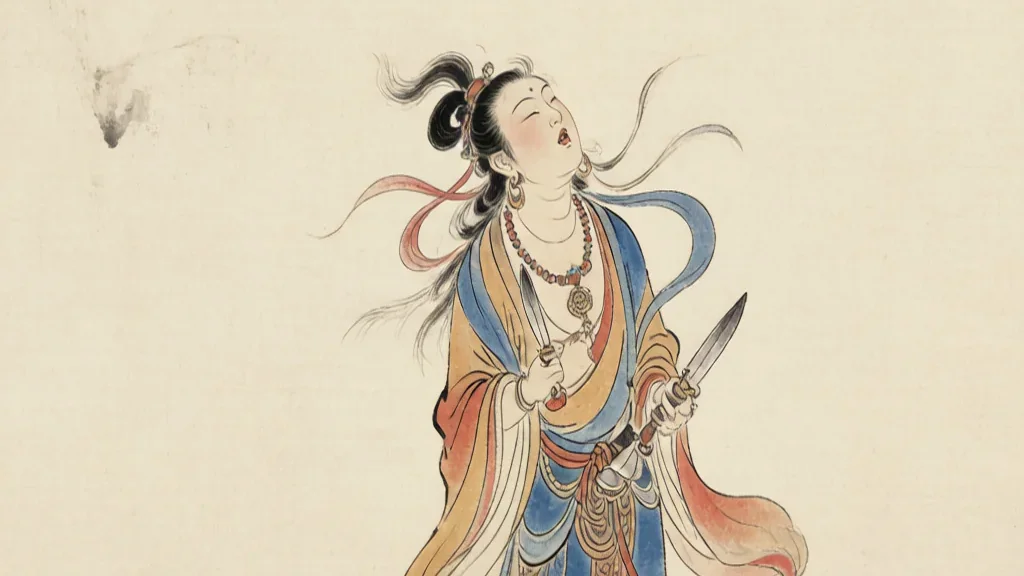
Spirit mediums, known in southern Chinese and Taiwanese usage as tongji (童乩) or jitong (乩童), are men and women who serve as living bridges between the human world and the spirit realm. Through trance and possession, they allow a deity, an ancestor, or a wandering soul to speak and act through their bodies, offering advice, healing, divination, and judgment to those who seek help. Far from a marginal curiosity, mediumship is a deep and ancient current of Chinese folk religion, especially vibrant in Fujian, Taiwan, and the overseas Chinese communities of Southeast Asia. To understand the medium is to understand a worldview in which the visible and invisible worlds are continuous, and in which the gods are not distant abstractions but neighbors who can be invited, bodily, to step into the room.
Becoming a Medium
Mediums rarely choose their vocation; rather, they are usually “chosen” by a deity through a dramatic crisis. The classic calling involves a prolonged illness that medicine cannot cure, troubling dreams, or a sudden episode of possession that leaves the family convinced a god has claimed the person. After recovery, the candidate undergoes training under an established master: learning the invocatory prayers, the proper sequence of incense and offerings, the gestures that invite the spirit to descend, and the ethical discipline expected of a vessel of the gods. When the deity finally “arrives” (the Chinese speak plainly of 神明附身, shénmíng fùshēn), the medium’s voice, expression, and bearing change, and worshippers address the god directly through the human vessel. The calling is thus both a burden and an honor, marking the person as set apart for service.
The Moment of Possession
The heart of mediumship is the rite of possession. Surrounded by the smoke of incense and the beat of drums or gongs, the medium enters a trance that may be gentle or violent depending on the deity and the tradition. Witnesses describe the eyes rolling back, the body shuddering, and then a sudden stillness as the god takes hold. From that point the medium no longer speaks as himself but as the possessing deity, answering questions, prescribing remedies, or scolding errant devotees. In many temples the god’s will is then recorded by an assistant, or the medium writes characters in the air or on sand. The drama of the transformation is itself a source of authority: the community believes because it sees the ordinary person unmistakably become another. This embodied theater of the sacred is central to the medium’s credibility.
Rituals and Social Roles
Mediums perform a remarkably wide range of services that place them at the center of local religious life. They diagnose illnesses believed to be caused by offended spirits or by “ghost affliction,” negotiate with restless ancestors, select auspicious dates for weddings and burials, recover lost objects, and adjudicate disputes that ordinary institutions cannot resolve. At temple festivals they lead processions, “inspect” the community on behalf of the god, and distribute blessed water or talismans. Their authority derives not from book learning or ordination but from demonstrated, repeatable contact with the divine. In many villages the local medium is as trusted as any physician or official, and sometimes more so, because he or she addresses problems—misfortune, haunting, ancestral anger—that lie outside the competence of secular authority.
Spirit Writing and the Planchette
A closely related practice is fuji (扶乩), or spirit writing, in which a possessed medium or a pair of practitioners guide a planchette across a tray of sand to produce characters dictated by a deity. The resulting “spirit writings” were historically compiled into precious scriptures, moral tracts, and instructions for community welfare, and some became the canonical texts of lay devotional societies. Unlike the vocal medium who speaks in trance, the planchette medium produces a written record that can be read, copied, and circulated. Both forms share the conviction that the gods remain active authors in the human world, dictating guidance for the perplexed. Spirit writing bridged the oral drama of possession and the written word of scripture, making the medium’s message durable and authoritative beyond the moment of the rite.
Self-Mortification and the Proof of Protection
Among the most striking features of southern mediumship are acts of self-mortification performed in trance: piercing the cheeks with metal skewers, climbing ladders of knife blades, walking barefoot over burning charcoal, or striking the back with spiked balls. These ordeals are understood not as self-harm but as public proof that the possessing deity shields the medium from pain and injury. The unharmed body becomes a sign of divine power and of the god’s protective contract with the community. Outsiders often mistake these acts for frenzy or spectacle, but within the tradition they are disciplined rituals requiring purification, fasting, and the god’s explicit sanction. The shock they provoke is part of their function: they arrest attention and convince onlookers that something genuinely beyond the ordinary is present.
The Deities Behind the Medium
Most mediums serve a specific patron deity and are possessed only by that god, never by others. In Fujian and Taiwan the most common patrons are martial and salvific figures of the popular pantheon—the Lord Marshal (元帅, a plague-subduing general), the Third Prince (三太子, Nezha), Guandi the god of war and loyalty, or the Empress of Heaven (Mazu). Each deity has a characteristic style of possession: some descend gently to give counsel, others arrive in a storm of martial energy suited to their protective role. The relationship between medium and deity is personal and lifelong, renewed at every festival. Because the god is known through the medium’s body, the medium also becomes the local face of that deity, and rival temples may be distinguished partly by the particular gods their mediums embody.
Mediumship in Modern Times
Mediumship has proven strikingly adaptable. In contemporary Taiwan, Southeast Asia, and diaspora communities, mediums consult by telephone and through social media, livestream temple rites, and incorporate modern concerns—business luck, migration, health—into their counsel. Some operate storefront temples in dense cities, while others serve rural communities much as they did centuries ago. This flexibility has allowed the practice to survive the pressures of urbanization and skepticism. At the same time, the performative and spectacular aspects of mediumship have made it a recognizable symbol of “folk” Chinese religion in films, festivals, and tourism. The medium’s survival shows that embodied, ecstatic religion retains a powerful appeal even in modern, literate societies where official doctrines have long since changed.
Controversy and Continuity
Mediumship has always drawn criticism. Confucian elites traditionally dismissed it as vulgar superstition that disturbed social order, and modern states have at times restricted or persecuted it as irrational or “feudal.” Medical and psychological frameworks explain trance as dissociation or suggestion. Yet for millions of devotees these objections miss the point: the medium resolves real anxieties, restores a sense of cosmic order, and maintains a live relationship with ancestors and gods. The practice persists precisely because it meets needs that courts, clinics, and scriptures do not fully address. Whether one interprets the trance as neurological, cultural, or genuinely spiritual, its social function is undeniable—it keeps the invisible world present, accountable, and close.
📝 Chinese Vocabulary
🎉 Fun Facts
❓ Frequently Asked Questions
What does a spirit medium do?
In trance the medium channels a deity to heal the sick, divine the future, settle disputes, and deliver the god’s guidance to devotees.
Is mediumship a form of shamanism?
Yes; it is a deep current of Chinese folk religion in which a human is possessed by a spirit, especially strong in the south and in Taiwan.
Where are mediums seen today?
At temple festivals and household rites of possession in Fujian, Taiwan, and Southeast Asian Chinese communities, and increasingly online.
How does someone become a medium?
Usually through a calling crisis—illness, dreams, or sudden possession—followed by training under a master in invocation and ritual.
Why do mediums pierce or burn themselves?
These ordeals are public proof that the possessing deity shields them from pain, confirming the god’s power to the community.
What is spirit writing?
A related practice in which a medium or planchette guides characters in sand, producing the god’s dictated messages as written scripture.