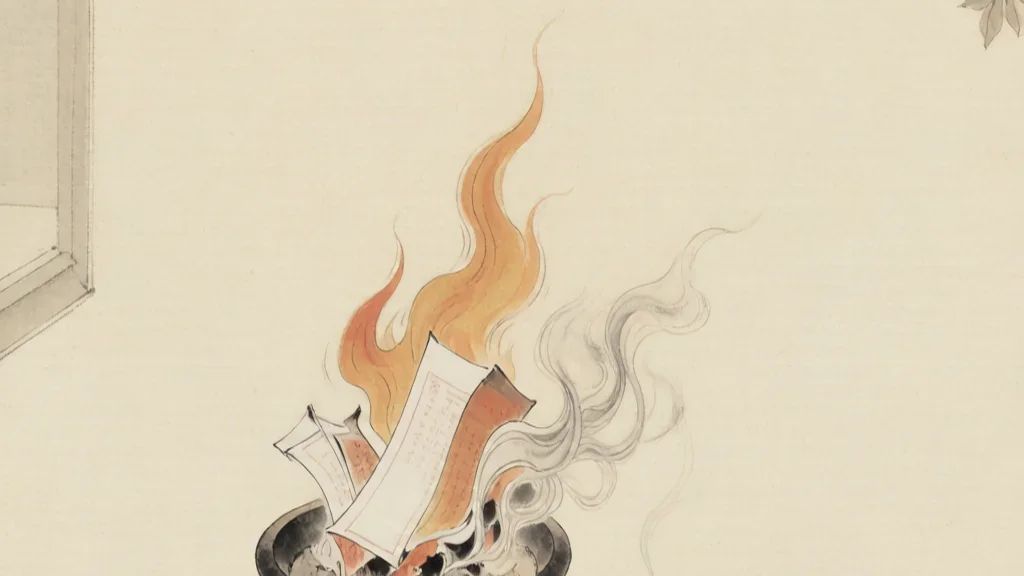
Burning spirit money (烧纸, shāo zhǐ) sends currency and goods to the dead, feeding, honoring, and comforting ancestors in the economy of the afterlife. Across China and wherever Chinese communities have settled, families gather at graves, temples, and roadside altars to set paper offerings aflame, trusting that the smoke carries their gifts across the boundary between worlds. More than a custom, it is an expression of filial piety made visible—a way of saying that kinship does not end at death, and that the living still have duties to those who came before.
Origins of Paper Offerings
The impulse to equip the dead for the next world is ancient. Aristocrats of the Shang and Zhou were buried with bronze vessels, jade, chariots, and sometimes sacrificed companions, so the deceased would lack nothing. The invention of paper in the Han dynasty made a cheaper, gentler substitute possible: instead of real wealth, families burned paper versions. By the Tang dynasty, paper money and paper goods had become standard funeral offerings, a humane shift from interring valuables to symbolically transmitting them through fire. The practice thus grew from both reverence and practicality.
Types of Spirit Money
Spirit money comes in a surprising variety. "Hell Bank Notes" (mingchao) mimic modern banknotes but are issued by the "Bank of Hell" and bear the image of the Jade Emperor or other deities. Gold and silver paper ingots (jinyuanbao) represent stored precious metal. Plain "ghost money" squares with a foil center are burned in great quantities for general offerings. Beyond currency, people burn paper clothing, houses, cars, and even smartphones and credit cards, adapting the afterlife wardrobe to modern life. Each item is chosen to meet a need the ancestors are imagined to have.
The Ritual of Burning
Burning follows a learned etiquette. Offerings are often stamped with a red seal to "validate" them for the other world, then placed in a brazier or a temple furnace. Incense is lit, the ancestor's name may be spoken or written, and a few words of greeting or request are offered as the flames rise. The smoke is the vehicle: what burns here becomes real there. Families take care that the paper is fully consumed, since an unburned corner is thought to arrive incomplete. The act is at once practical, reverent, and quietly intimate.
Qingming and the Tomb-Sweeping Rite
The most important occasion for paper burning is Qingming, the Tomb-Sweeping Festival in early spring, when families return to ancestral graves to weed them, repaint the stone, lay food, and burn spirit money. The outing blends memory and care: children learn genealogy by visiting the graves of relatives they never met. Qingming affirms a continuing relationship across generations, and the burning of paper is its central gesture—a tangible gift sent to those who can no longer be fed at the family table.
The Hungry Ghost Festival
In the seventh lunar month, the Zhongyuan or Hungry Ghost Festival opens the gates of the underworld, and restless, forgotten spirits roam the world. Families and communities burn paper money not only for their own ancestors but for these hungry ghosts, lest they cause mischief. Temporary altars, operas, and river lanterns accompany the burnings. The festival broadens the logic of offering from private filial piety to public compassion, acknowledging all the dead, not just one's own.
Ancestor Veneration and Filial Piety
Paper burning sits within the larger Confucian-influenced duty of xiao, filial piety, which extends beyond the lifetime of one's parents. To care for the dead is to complete the relationship begun in life; neglect, by contrast, was traditionally feared to bring family misfortune. The practice thus weaves individual grief into a social and ethical fabric, linking the household to its lineage and the present to a deep past. Even the irreligious often burn a little paper, caught between skepticism and love.
Modern Forms and Digital Spirit Money
The custom keeps reinventing itself. Today one can buy paper replicas of iPhones, designer bags, and even passports, and "merits" can be transferred through apps and QR codes that claim to deliver offerings digitally. Some temples offer proxy burning services for the diaspora who cannot travel home. These updates show the persistence of the underlying wish—to give, to remember, to stay connected—even as the technology of the gift changes with the times.
Debates: Smoke, Safety, and Heritage
In crowded modern cities, open paper burning has become controversial. Fire hazards, air pollution, and clogged streets have led many municipalities to ban roadside fires and confine burning to temple furnaces or designated sites. Critics argue the smoke harms public health; defenders call it intangible cultural heritage and a vital bond with ancestors. The tension mirrors a wider question in Chinese life: how to honor tradition in a dense, modern, environmental age. Most families, when allowed, continue—quietly, seasonally, and with feeling.
Vocabulary
Fun Facts
Frequently Asked Questions
Q: What is spirit money?
A: Hell bank notes and paper goods that are burned so the dead receive them as real wealth and possessions in the afterlife.
Q: Why burn it rather than bury it?
A: Fire and its smoke are believed to transmit the gift from this world to the other, delivering comfort to the ancestors.
Q: When is paper burning done?
A: Mainly at Qingming (Tomb-Sweeping Day), the Hungry Ghost Festival, and at funerals, plus memorial days for the family.
Q: Is burning paper only for one's own ancestors?
A: Mostly, but during the Hungry Ghost Festival people also burn for wandering, forgotten spirits out of compassion.
Q: Is the practice legal in modern China?
A: It is widely practiced but restricted in many cities because of fire risk and pollution, often limited to temple furnaces.
Q: How has the custom modernized?
A: Offerings now include paper iPhones and cars, and apps allow digital "merit transfers" and proxy burning by temples.