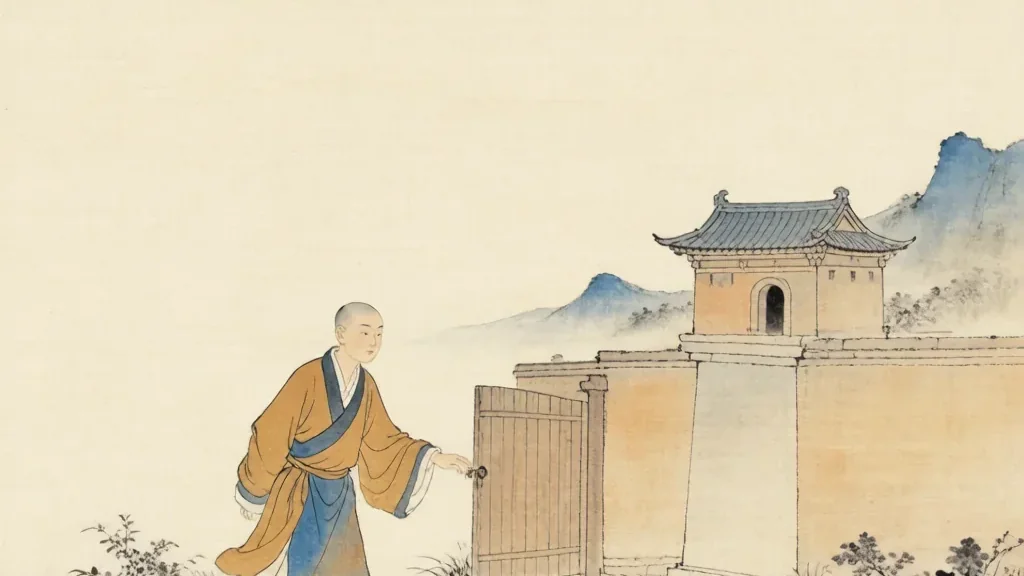
In the year 629, a young Chinese monk slipped past the closed border of the Tang empire and set out alone across the deserts of Central Asia toward India, driven by a single burning question: what did the Buddha truly teach? That monk was 玄奘 (Xuán Zàng), and his sixteen-year pilgrimage became one of the greatest journeys of the human spirit. He returned with hundreds of Sanskrit texts, founded a school of philosophy, and left a travel memoir that is still read today. This article follows Xuanzang from his forbidden departure to his legacy as the Pilgrim of the Scriptures.
The Young Monk and His Doubt
Xuanzang was born around 602 in Goushi, near Luoyang, into a family touched by learning. He became a monk as a boy and quickly distinguished himself by his memory and insight. In an era when Chinese Buddhism possessed many scriptures but often in conflicting translations, Xuanzang grew troubled by contradictions in the doctrine of consciousness and the stages of the path. He resolved to go to India, the land of the Buddha, to study the original teachings at their source.
His plan ran into a wall of imperial policy. The Tang, newly founded and wary of foreign contact, had banned private travel westward. When his petition to leave was refused, Xuanzang waited for an amnesty during a famine, slipped out of the capital by night, and began the perilous road alone. This act of quiet defiance—risking death for the sake of understanding—sets the tone for his entire life: a scholar whose courage was as great as his erudition.
The Perilous Journey West
Xuanzang's route took him across the Gobi Desert, where he famously lost his water sack and, half-mad with thirst, pressed on rather than turn back. He traversed the Tarim Basin, climbed the Pamirs, and passed through the kingdoms of Kashgar, Samarkand, and Bactria before reaching the Indian subcontinent. Along the way he studied with local masters, mastered several languages, and collected manuscripts and relics.
In India he spent years at the great monastic university of Nalanda, then the foremost center of Buddhist learning, studying under the venerable Abbot Śīlabhadra. He debated rival scholars—including adherents of Hindu and Buddhist orthodoxies—and earned a reputation for unmatched learning. A famous episode describes a great public assembly convened by the monarch Harsha, where Xuanzang defended his views against all challengers and emerged undefeated, a triumph later celebrated in both Chinese and Indian sources.
Study at Nalanda and the Yogacara School
At Nalanda, Xuanzang immersed himself in Yogacara, the "Consciousness-Only" school of Mahayana philosophy founded by the brothers Asanga and Vasubandhu. Yogacara teaches that the world as we ordinarily perceive it is a construction of the eight kinds of consciousness, and that liberation comes through transforming consciousness into the mirror-like wisdom of a buddha. This subtle psychology of mind answered precisely the questions that had driven Xuanzang from China.
After returning home, Xuanzang translated and systematized these teachings, founding the Chinese school of 法相宗 (Fǎxiàng Zōng), the "Dharma-Character school," also called Weishi (Consciousness-Only). Though it remained influential for only a few generations in China—its dense scholasticism was hard for many to sustain—it profoundly shaped later East Asian Buddhist thought and was transmitted to Japan as the Hosso school, where its analysis of mind endures.
The Return and the Translation Project
Xuanzang returned to Chang'an in 645 carrying some 657 scriptures and a vast collection of relics and images. The Tang emperor Taizong, though initially cool, came to honor him and ordered the building of the 大雁塔 (Dàyàn Tǎ), the Giant Wild Goose Pagoda, to house the translated texts. For the rest of his life Xuanzang led a monumental translation bureau, rendering dozens of major sutras and treatises into Chinese with unprecedented accuracy.
His method was collaborative and rigorous: he dictated from the Sanskrit, discussed difficult passages with a team of monks, and revised for clarity. Among his translations, the Heart Sutra in his rendering became the standard version still chanted across East Asia, and his translation of the immense Yogacarabhumi treatise preserved a cornerstone of Mahayana scholarship. By sheer scholarly output he raised the quality of Chinese Buddhist translation to its peak.
The Record of the Western Regions
Beyond scripture, Xuanzang left a second treasure: the 大唐西域记 (Dà Táng Xīyù Jì), the "Great Tang Record of the Western Regions," dictated to his disciple Bianji. This地理 account describes more than a hundred kingdoms of Central and South Asia—their geography, customs, religions, and monuments—with a precision that astonished later historians. It remains an indispensable source for the history of India, especially the reign of Harsha, for which it is virtually the only detailed contemporary record.
Modern archaeology has repeatedly confirmed Xuanzang's descriptions, identifying ruined sites he visited and validating his accounts of stupas and monasteries. The Record thus bridges literature and history: a pilgrim's memoir that became a textbook for explorers like the nineteenth-century British surveyors of India. Few travel books have retained such scholarly value thirteen centuries after composition.
From History to Legend: Journey to the West
Xuanzang's sober piety could not resist the gravity of folklore. Within a few centuries his journey morphed into the comic novel 西游记 (Journey to the West), in which the monk becomes the timid, somewhat gullible Tripitaka, escorted to India by the irreverent Monkey King, the pig-spirit Zhu Bajie, and a cast of misfit disciples. The novel transforms the arduous pilgrimage into an allegory of spiritual discipline and testing.
The gap between the historical Xuanzang and the fictional Tripitaka is wide, yet the novel kept his memory alive in every Chinese household. Today, when people hear "Xuanzang," many first picture the book's beleaguered monk—but behind that gentle caricature stands the real pilgrim whose scholarship, endurance, and fidelity to truth built a bridge of doctrine and friendship between China and India that has never been forgotten.
Xuanzang and the Silk Road World
Xuanzang's journey was a crossing of the whole Silk Road world of the seventh century. He passed oasis kingdoms of the Tarim Basin, climbed the Pamir mountains, and moved through the courts of Central Asia before reaching India, meeting rulers, monks, and merchants of many faiths along the way. His memoir records the languages, monuments, and customs of more than a hundred lands with a traveler's eye, making it an early work of cross-cultural geography. The route ran both ways: he returned laden with scriptures that would enrich Chinese Buddhism, and his account later guided modern explorers who retraced his steps to identify lost sites. In this sense Xuanzang was not only a pilgrim but a link in the long exchange of goods, art, and ideas between China and India.
The Faxiang School After Xuanzang
The Faxiang school that Xuanzang founded enjoyed brilliant but brief supremacy in China. Its detailed analysis of the eight consciousnesses and the stages of the path attracted top minds, and his disciple Kuiji wrote the systematic commentaries that defined the tradition. Yet its dense scholasticism, requiring mastery of a vast technical vocabulary, proved hard to sustain among the broader clergy, and within a few generations Faxiang was absorbed into the wider Buddhist mainstream. Its survival was secure in Japan, where it became the Hosso school and kept the Yogacara analysis alive. In China, the school's insights fed Huayan and Chan thought, so that even after the order faded as a separate lineage, Xuanzang's rigorous mind continued to shape how Chinese Buddhists understood the workings of consciousness and the path to awakening.
❓ Frequently Asked Questions
📝 Chinese Vocabulary
玄奘 — : Xuanzang, the pilgrim monk and translator.
法相宗 — : The Dharma-Character (Consciousness-Only) school he founded.
唯识 — : Consciousness-Only, the Yogacara doctrine.
大雁塔 — : The Giant Wild Goose Pagoda built to house his texts.
大唐西域记 — : The Record of the Western Regions.
那烂陀寺 — : Nalanda Monastery, the great Indian university where Xuanzang studied under Silabhadra.
瑜伽行派 — : The Yogacara school, the Consciousness-Only philosophy that Xuanzang transmitted to China.
窥基 — : Kuiji, Xuanzang's chief disciple who systematized the Faxiang teachings.
🎉 Fun Facts
- Xuanzang left China in defiance of a ban on westward travel and crossed the Gobi after losing his water sack.
- He studied at Nalanda, the Harvard-of-its-day of seventh-century Indian Buddhism, under Abbot Śīlabhadra.
- His translation of the Heart Sutra became the standard version still chanted across East Asia.
- The Giant Wild Goose Pagoda in Xi'an still stands, built specifically to store his imported scriptures.
- Xuanzang's translation bureau at Chang'an employed dozens of monks and set a standard of accuracy that later Chinese Buddhist translation never surpassed.
- The emperor Taizong, originally cool to his return, grew so impressed that he wrote the preface to Xuanzang's translation of the Heart Sutra, lending imperial prestige to the work.