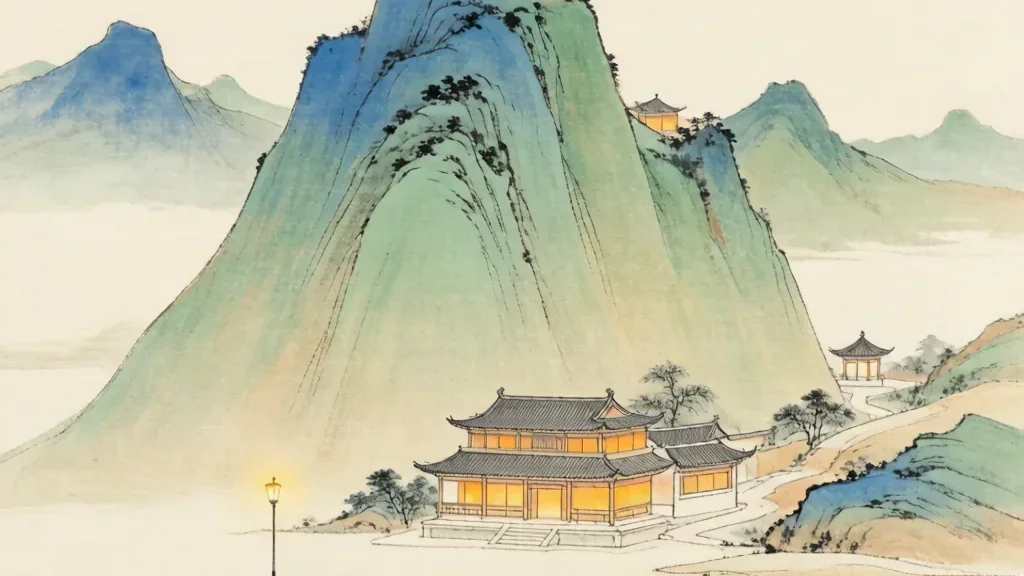
In the green mountains of Anhui stands a peak whose monasteries glow at dusk with the lamps of those who pray for the dead. This is 九华 (Jiǔ Huá), Mount Jiuhua, the sacred mountain of 地藏 (Dìzàng), Ksitigarbha, the bodhisattva who vowed never to become a Buddha until the hells are emptied. Of the Four Sacred Mountains of Chinese Buddhism, Jiuhua is the realm of earthly treasure and of the solemn duty to rescue souls in the underworld. This article tells how a Korean prince's bones came to rest on a Chinese peak and made it the great shrine of vows that reach even into hell.
Ksitigarbha and the Vow to the Dead
Ksitigarbha, known in Chinese as 地藏菩萨 (Dìzàng Púsà), is the bodhisattva of the great vow and the special protector of beings in the lower realms and during the liminal period after death. His defining pledge is stark and tender: "If I do not enter the hells, who will? I vow not to achieve Buddhahood until all beings in the six paths are saved." He therefore remains a bodhisattva forever working in the darkest places, guiding the deceased toward better rebirth.
In art he is shown as a monk with a shaven head, holding a staff whose rings jingle to awaken the suffering and a wish-granting jewel that lights the darkness. His monk's robe marks him as the "earth store" who guards the treasures of the Dharma buried in the world, and his association with the underworld made him the focus of Confucian-flavored ancestor rites, where filial children seek his aid for parents who have passed.
The Legend of the Korean Monk Jin Qiaojue
Jiuhua's sanctity began with a remarkable visitor. In the mid-eighth century, a Silla (Korean) prince named 金乔觉 (Jīn Qiáojue) renounced his royal life, became a monk, and sailed to China, settling in meditation in the crags of Mount Jiuhua. He lived as a hermit, eating only the wild plants, and his austerity and holiness drew local followers, who built him a hermitage.
When Jin Qiaojue died at an advanced age, his body reportedly remained incorrupt, and a year later, when his coffin was opened, his flesh was still fresh and his joints flexed like a living person's—signs, in Chinese Buddhist tradition, of an enlightened being. A monk present recognized him as a manifestation of Ksitigarbha, and the mountain was proclaimed the bodhisattva's earthly residence. His preserved relics became the sacred core of Jiuhua's worship, a direct地理 link between the Korean saint and the Chinese peak.
Development as a Sacred Mountain
From the Tang onward, Jiuhua grew into one of the great Buddhist centers of the empire. The Song, Ming, and Qing dynasties saw the construction of hundreds of temples and the settlement of thousands of monks. The Qing emperors endorsed it as the fourth of the sacred mountains, completing the set alongside Wutai, Emei, and Putuo, and granting it imperial plaques and lands.
At its height Jiuhua reportedly held over three hundred monasteries and nunneries, a "Buddha-country in the clouds." Though wars and the twentieth century reduced their number, the mountain remains densely monastic, especially rich in nunneries, and is renowned for the preserved "flesh bodies" (肉身, ròushēn) of accomplished monks and nuns whose uncorrupted remains are enshrined as relics. These mummified bodies are a distinctive feature of Jiuhua's living tradition.
Pilgrimage, Rites, and the Ghost Festival
Pilgrims come to Jiuhua primarily to honor ancestors and pray for the deceased. The central practice is the transfer of merit and the chanting of the Ksitigarbha Sutra, which promises relief to souls in the intermediate state. Families climb the steps to the 化城寺 (Huàchéng Sì), the "Transformation City Temple," the mountain's oldest and ceremonial center, to offer lamps and food for their departed kin.
The most important annual event is the 盂兰盆节 (Yúlánpén Jié), the Ghost Festival on the fifteenth of the seventh lunar month, when the gates of the underworld are said to open and the living make offerings for hungry ghosts. Jiuhua becomes a focus of these rites, with monks performing liberation ceremonies. The mountain thus serves a function unique among the four: it is the great necropolis-shrine where the duties of filial piety and compassion for the dead are fulfilled side by side.
Jiuhua's Place Among the Four Mountains
Each of the Four Sacred Mountains embodies a quality of the bodhisattva ideal. Wutai (Manjushri) gives wisdom; Emei (Samantabhadra) gives practice; Putuo (Guanyin) gives compassion; and Jiuhua (Ksitigarbha) gives the vow that refuses enlightenment until all are saved. Together they form a complete map of the Buddhist path, and Jiuhua anchors its most selfless, downward-reaching pole.
For the believer, a visit to Jiuhua is not only a pious tour but an act of family duty and a confrontation with mortality. To stand among its misty peaks is to remember that compassion does not stop at the grave, and that the deepest vow is to descend, like Ksitigarbha, into suffering itself. In an age that often prefers to forget death, Jiuhua keeps alive the consoling teaching that no one is abandoned, and that even in the darkest realm a lamp is lit and a hand is offered.
The Iconography of Ksitigarbha
Ksitigarbha is among the most recognizable figures in Chinese Buddhist art. He is shown as a shaven-headed monk in plain robes, a form that stresses his closeness to ordinary practitioners rather than distant majesty. In his left hand he holds a wish-fulfilling jewel that casts light into the darkest realms; in his right he raises a ringed staff, the sound of whose rings awakens suffering beings and drives away guarding demons. Sometimes he stands on a lotus or is flanked by a dog and a boy, figures from his legends as the guardian of the underworld. Unlike the serene, jeweled bodhisattvas of other paradises, Ksitigarbha looks like a humble wanderer, visually announcing his willingness to enter the hells where no other savior goes. This plain, compassionate image made him especially beloved among families grieving the dead.
Jiuhua's Monastic Life and Nunneries
Jiuhua is unusual among the Four Sacred Mountains for the prominence of its nunneries. Historical records describe the mountain holding more than three hundred monasteries at its height, a considerable share of them convents where nuns maintained the same rigorous schedule of chanting, meditation, and care for the flesh-body relics. Monks and nuns rise before dawn for the Ksitigarbha liturgy, tend gardens on terraced slopes, and receive the streams of pilgrims who come to pray for the dead. The preserved flesh bodies of attained masters remain the mountain's signature: after death, certain adepts are enshrined in lacquered seated statues, their uncorrupted forms treated as living proof of realization. This blending of active monastic labor with ancestor-centered devotion gives Jiuhua a distinctly domestic, family-like atmosphere unlike the scholarly aura of Wutai or the imperial grandeur of Putuo.
The Vow and Chinese Filial Piety
Ksitigarbha's appeal in China is inseparable from the Confucian virtue of filial piety. His defining pledge to refuse buddhahood until the hells are emptied resonates with the duty to care for parents not only in life but beyond death. Families turn to him precisely when Confucian ritual leaves them anxious, after a relative has passed, seeking assurance that the deceased is guided rather than abandoned. The Ksitigarbha Sutra explicitly promises that offerings made in the bodhisattva's name can relieve the suffering of one's ancestors, binding Buddhist merit-making to the Chinese cult of the dead. In this synthesis, Jiuhua became a place where filial love and Buddhist compassion meet: a son or daughter climbs the mountain not for personal gain but to repay a debt of gratitude that death could not cancel.
❓ Frequently Asked Questions
📝 Chinese Vocabulary
九华 — : Mount Jiuhua, sacred to Ksitigarbha.
地藏 — : Ksitigarbha, the bodhisattva of the great vow.
金乔觉 — : The Silla prince-monk recognized as Ksitigarbha's manifestation.
肉身 — : "Flesh body," the preserved remains of an attained master.
盂兰盆节 — : The Ghost Festival for the deceased.
幽冥教主 — : Honorific title for Ksitigarbha as the sovereign and teacher of the underworld.
化城寺 — : The Transformation City Temple, Jiuhua's oldest monastic center and ceremonial heart.
地藏菩萨本愿经 — : The Sutra of the Past Vows of Earth Store Bodhisattva, chanted for the salvation of the dead.
🎉 Fun Facts
- Mount Jiuhua's sanctity began with a Korean royal monk, making it a early symbol of China-Korea Buddhist exchange.
- Ksitigarbha's staff rings are said to awaken suffering beings in the hells so they may hear the Dharma.
- Jiuhua is especially rich in nunneries and in preserved "flesh-body" relics of holy monks and nuns.
- It is the only one of the Four Sacred Mountains devoted to the salvation of the dead rather than the living.
- The name Jiuhua means Nine Glories, referring to the nine rounded peaks that radiate from the mountain like lotus petals.
- Pilgrims to Jiuhua traditionally circle the summit at dawn carrying lighted lamps, a practice called the lamp-walking that echoes Ksitigarbha's vow to light the darkness of the hells.