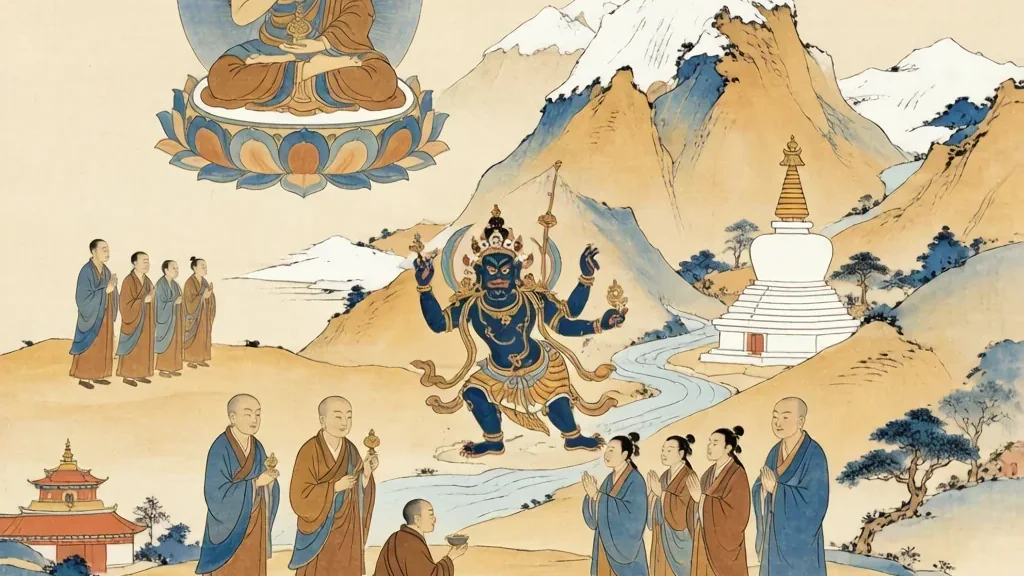
Tibetan Buddhism, known in Chinese as Zangchuan Fojiao (藏传佛教) or Tibetan-transmitted Buddhism, represents one of the most distinctive and spiritually rich branches of the Buddhist tradition. Emerging from the encounter between Indian Mahayana and Vajrayana Buddhism and the indigenous Bon religion of Tibet, this tradition developed a unique synthesis of esoteric rituals, philosophical sophistication, and institutional structures that have shaped Tibetan culture for over 1,300 years. From the first introduction of Buddhism during the reign of Songtsen Gampo (circa 605-650 CE) to the establishment of the Dalai Lama lineage in the 16th century, Tibetan Buddhism has demonstrated remarkable resilience and adaptability. Today, it is practiced not only on the Tibetan Plateau but throughout China, Mongolia, Bhutan, Nepal, and increasingly in Western countries, where its teachings on compassion, mindfulness, and the nature of mind have attracted millions of followers.
Historical Introduction and Early Development (7th-11th Centuries)
Buddhism first entered Tibet during the reign of King Songtsen Gampo, the 33rd king of the Yarlung Dynasty, who unified the Tibetan plateau and established Lhasa as the capital. Songtsen Gampo married two Buddhist princesses — Princess Wencheng of Tang China and Princess Bhrikuti of Nepal — both of whom brought Buddhist statues, texts, and monks to Tibet. The Chinese princess arrived in 641 CE carrying a statue of Shakyamuni Buddha at age twelve, which would later be enshrined in the Jokhang Temple, Tibet's most sacred Buddhist site. However, it was not until the reign of King Trisong Detsen (reigned 755-797 CE) that Buddhism was formally established as the state religion. Trisong Detsen invited the Indian tantric master Padmasambhava (Guru Rinpoche) to Tibet, who, according to tradition, subdued the local Bon deities and bound them by oath to serve as protectors of the Dharma. Together with the Indian abbot Shantarakshita, Padmasambhava founded Samye Monastery in 779 CE, Tibet's first Buddhist monastery.
The Second Propagation: Revival and the New Translation Schools
Following the persecution of Buddhism under King Langdarma (reigned 838-842 CE), who launched a violent campaign that destroyed monasteries and killed monks, Buddhism went into a period of decline in Tibet that lasted nearly a century. The revival began in the late 10th century, when the Tibetan king Lha Lama Yeshe Ö sent the translator Rinchen Zangpo (958-1055 CE) to India to study Buddhist texts and invite Indian masters to Tibet. Rinchen Zangpo returned with hundreds of manuscripts and built numerous monasteries in Western Tibet, including the magnificent Tabo Monastery founded in 996 CE, which still contains some of the best-preserved Buddhist murals in the Himalayas. The most pivotal figure of this revival was the great Indian master Atisha Dipamkara (982-1054 CE), who arrived in Tibet in 1042 CE at the invitation of the king of Ngari. Atisha's teachings laid the foundation for the Kadam school, which later evolved into the Gelug tradition. He composed the acclaimed work Lamp for the Path to Enlightenment, which systematically outlined the stages of the bodhisattva path and became one of the most influential texts in Tibetan Buddhism.
The second propagation also saw an unprecedented flourishing of translation activity. Tibetan translators, working in teams with Indian pandits, produced translations of Sanskrit Buddhist texts of extraordinary accuracy and literary quality. The Tibetan language, with its systematic grammatical structure and precise terminology, proved remarkably well-suited for translating Sanskrit philosophical texts. Between the 11th and 13th centuries, over 4,000 Indian Buddhist texts were translated into Tibetan, preserving works that were later lost in their original Sanskrit due to the destruction of Buddhist institutions in India. This translated canon, organized into the Kangyur (the words of the Buddha) and Tengyur (the commentaries), represents the largest collection of Indian Buddhist literature in any language. The preservation of these texts is one of Tibetan Buddhism's most significant contributions to world culture, as modern scholars rely on Tibetan translations to reconstruct lost Sanskrit originals.
The Four Major Schools: Nyingma, Kagyu, Sakya, and Gelug
Tibetan Buddhism crystallized into four principal schools, each with distinctive lineages, teachings, and institutional structures. The Nyingma (Ancient Ones) trace their origins to Padmasambhava and emphasize the Dzogchen (Great Perfection) teachings, which point directly to the primordial awareness that is the ground of all existence. Nyingma monasteries are concentrated in eastern Tibet and are known for their elaborate ritual traditions, including the famous cham masked dances. The Kagyu (Oral Transmission) school was founded by Marpa the Translator (1012-1097 CE) and his disciple Milarepa (1040-1123 CE), Tibet's most famous yogi-poet. The Kagyu specialize in the Mahamudra (Great Seal) teachings, which focus on direct realization of the mind's true nature through meditation. Milarepa's songs of realization, spontaneously composed verses expressing his enlightenment experience, are among the most beloved texts in Tibetan literature and have been translated into numerous languages.
The Sakya (Pale Earth) school rose to political prominence when Sakya Pandita (1182-1251 CE) established a patron-priest relationship with the Mongol ruler Godan Khan in 1247 CE, which gave the Sakya lamas authority over Tibet under Mongol protection. The Sakya are renowned for their scholastic tradition, particularly the study of the "Path and Result" (Lamdre) teachings. The school's most distinctive architectural contribution is the Sakya Monastery in southern Tibet, whose library contains one of the world's largest collections of Buddhist manuscripts, including many texts that no longer exist in Sanskrit or Chinese. The Gelug (Virtuous Ones), founded by Je Tsongkhapa (1357-1419 CE), emerged as a reform movement emphasizing strict monastic discipline and rigorous scholastic training. Tsongkhapa's great work, The Great Treatise on the Stages of the Path to Enlightenment, systematically synthesized the entire Buddhist path into a single integrated practice manual. The Gelug became Tibet's dominant political power when the Fifth Dalai Lama established the Ganden Phodrang government that ruled Tibet until 1959.
The Tulku System: Tibetan Buddhism's Unique Institution
One of the most distinctive features of Tibetan Buddhism is the tulku system — the recognition of reincarnate lamas who are believed to be voluntary rebirths of enlightened beings. The first recognized tulku in Tibetan history was the Karmapa, head of the Karma Kagyu lineage, whose reincarnation was identified in 1193 CE, predating the Dalai Lama lineage by three centuries. The Dalai Lama lineage began with the posthumous recognition of the First Dalai Lama, Gedun Drub (1391-1474), who was identified as a reincarnation of the bodhisattva Avalokiteshvara. The process of identifying a tulku involves a complex search procedure: after the death of a high lama, his disciples consult oracles, interpret dreams, and search for signs. Candidates undergo a series of tests, including recognizing objects that belonged to the previous incarnation. The 14th Dalai Lama, Tenzin Gyatso, was identified at age two after a search party visited his home in Taktser, Amdo, and the toddler correctly identified a rosary and drum that had belonged to the 13th Dalai Lama.
The tulku system created a unique form of religious institutionalism that has no exact parallel in other Buddhist traditions. By the 20th century, there were hundreds of recognized tulkus across Tibet, Mongolia, and the Himalayan regions, each maintaining a monastic seat and institutional lineage. The system ensured institutional continuity and the transmission of esoteric teachings across generations, as tulkus began their training in childhood under the guidance of experienced tutors. The selection process itself served important political and social functions, as it allowed religious communities to maintain their property and influence by claiming continuity through reincarnation rather than hereditary succession. The system also prevented concentration of power within biological families, as tulkus were typically reborn into different families in each incarnation. The identification of tulkus in different regions also helped integrate the vast Tibetan cultural area into a single religious network, as children from Amdo (eastern Tibet) might be recognized as the reincarnation of a lama from Ü-Tsang (central Tibet).
Vajrayana: The Esoteric Path of Tibetan Buddhist Practice
The tantric practices that distinguish Tibetan Buddhism from other Buddhist traditions are collectively known as Vajrayana, the "Diamond Vehicle" or "Indestructible Path." Vajrayana is based on the principle that enlightenment can be attained in a single lifetime through esoteric techniques that transform ordinary experience into enlightened awareness. Central to Vajrayana practice is deity yoga, in which the practitioner visualizes themselves as a fully enlightened buddha or bodhisattva, complete with divine attributes such as multiple arms, radiant light, and pure surroundings. This is not merely imaginative play but a sophisticated psychological technique that uses the mind's creative power to reshape its own fundamental patterns. The practitioner recites the deity's mantra — a sequence of syllables believed to embody the deity's enlightened energy — and enters into a state of non-dual awareness where the distinction between self and deity dissolves.
The most advanced Vajrayana practices involve the completion stage, in which the visualized deity form dissolves and the practitioner works directly with the subtle energy body. This system, described in detail in texts such as the Guhyasamaja Tantra and the Kalachakra Tantra, involves manipulating the subtle winds and channels within the body to achieve the clear light of enlightenment. Practices such as tummo (inner heat) enable advanced yogis to generate physical warmth through meditation alone, as demonstrated by the famous Milarepa, who was said to wear only a single cotton cloth despite meditating in Himalayan snow caves. The Six Yogas of Naropa — including tummo, illusory body, and dream yoga — represent the pinnacle of Kagyu tantric practice, while the Dzogchen teachings of the Nyingma school offer an even more direct path through the recognition of primordial awareness. These esoteric techniques, once kept strictly secret to prevent misunderstanding, are now increasingly studied by scholars and practitioners worldwide, contributing to the growing appreciation of Tibetan Buddhism's sophisticated psychological technology.
Tibetan Buddhism in China: Historical Relations and Cultural Exchange
The relationship between Tibetan Buddhism and China proper spans over a millennium of political, religious, and cultural exchange. During the Yuan Dynasty (1271-1368 CE), the Mongol emperors adopted Tibetan Buddhism as their court religion, with Kublai Khan appointing the Sakya lama Drogön Chögyal Phagpa (1235-1280) as Imperial Preceptor, giving him authority over Buddhist affairs throughout the empire. The Ming Dynasty continued the tradition of patronizing Tibetan lamas, with the Yongle Emperor inviting the Fifth Karmapa to Nanjing in 1407. The Qing Dynasty (1644-1912) elevated Tibetan Buddhism to unprecedented heights in Chinese court culture. The Qianlong Emperor (reigned 1735-1796) constructed the Yonghe Temple in Beijing as a Tibetan Buddhist monastery, personally studying Tibetan and commissioning the translation of the Buddhist canon into Manchu. In contemporary China, Tibetan Buddhism remains a vibrant tradition, with major monasteries like Labrang in Gansu and Kumbum in Qinghai continuing to function as centers of learning and pilgrimage.
Teachings, Practices, and Global Influence
Tibetan Buddhism is characterized by its comprehensive approach to spiritual development, integrating sutra study, tantric ritual, meditation, and philosophical debate. The Gelug monastic curriculum requires monks to study the five major treatises of Indian Buddhism for up to twenty years, culminating in the Geshe degree, equivalent to a doctorate in Buddhist philosophy. Visualization practices, mantra recitation, and mandala construction form the core of tantric meditation. Since the Tibetan diaspora began in 1959, Tibetan Buddhism has become a global phenomenon. The 14th Dalai Lama, Tenzin Gyatso (born 1935), was awarded the Nobel Peace Prize in 1989. Western interest surged with the publication of The Tibetan Book of Living and Dying by Sogyal Rinpoche in 1992. Scientific research on Tibetan Buddhist meditation, including studies by neuroscientist Richard Davidson at the University of Wisconsin-Madison, has demonstrated measurable effects on brain plasticity, attention, and emotional regulation.