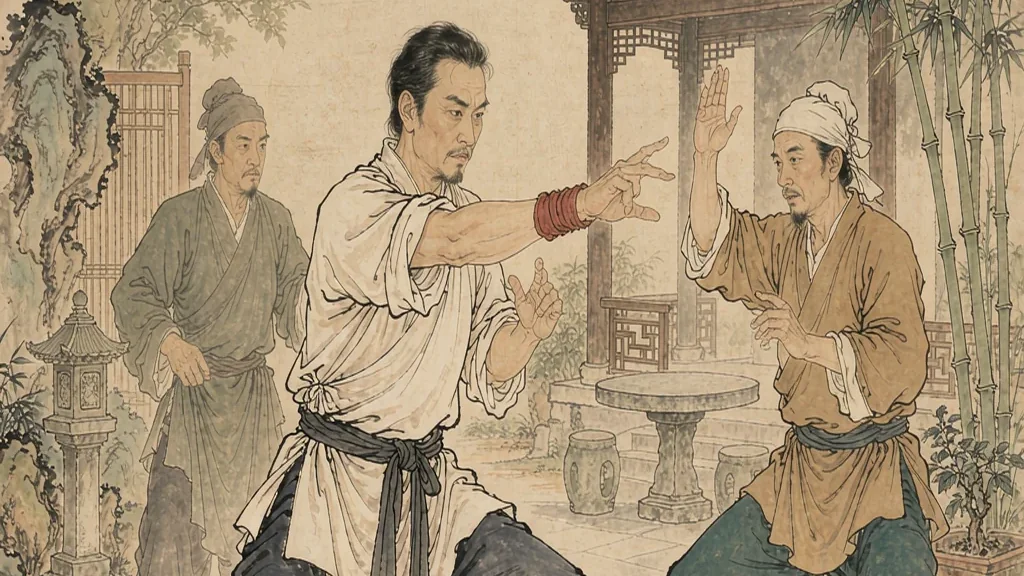
Praying Mantis boxing, known in Chinese as Tanglang Quan, is one of the most distinctive "imitative" styles of Chinese martial art, built on the hooking, trapping, and rapid striking observed in the praying mantis insect. Developed in Shandong province, the style is famous for its twin "mantis hooks" — hands shaped like the insect's raptorial forelegs — which catch, lock, and rip an opponent's limbs. With several branches such as the Seven Stars, Plum Flower, and Six Harmonies schools, mantis boxing combines close-range control with sudden bursts of power. This article covers its legends, hand shapes, techniques, training, and living tradition.
Legends of the Style's Origin
The most beloved story credits the creation of mantis boxing to Wang Lang, a Shandong martial artist who, during a retreat on Mount Kunyu or Laoshan, watched a praying mantis fight and capture a cicada with its hooked forelegs.
Inspired, Wang Lang is said to have modeled hand techniques on the insect's snapping hooks, then blended them with the staff and fist methods he already knew to form a new system. As with many origin tales, this is best read as illustrative tradition.
What is certain is that a coherent mantis style emerged in Shandong and grew into several family branches, each preserving the core idea of the hooking hand.
The Mantis Hook Hand
The signature shape is the "mantis hook": the fingers curve inward and the wrist bends so the hand becomes a rigid, pointed hook rather than an open palm or a fist. Both hands form hooks and work in pairs.
The hook is used to catch and trap an incoming wrist, to lock a joint, or to strike with the bony wrist and forearm. One hand often controls while the other attacks, the "simultaneous block and strike" of the style.
Practitioners drill the hook by repeated circling and snapping, building the flexible yet firm wrist that lets the hand switch from trap to strike in an instant.
Major Branches of Mantis Boxing
The art splits into several schools. The Seven Stars Mantis emphasizes seven key striking points; the Plum Flower Mantis uses stepping patterns like falling petals; the Six Harmonies Mantis stresses coordinated whole-body movement.
Some branches also preserve a "Southern" mantis tradition in Guangdong, related in spirit but developed separately, showing how the insect metaphor spread across regions.
Despite differences, all branches share the hooked hands, the close range, and the principle of using the opponent's force through trapping and leverage.
Close-Range Trapping and Striking
Mantis boxing is fought at close distance, where the hooks can engage the arms and the body can press in. The stylist aims to tie up the opponent's limbs, then strike the opened target.
Techniques include "plucking," "splitting," and "hanging" — names for ways the hook peels an arm aside or pins it, creating the gap for a palm, elbow, or finger jab.
This reliance on sensitivity and leverage makes mantis boxing feel like a blend of striking and grappling, a stand-up control game rather than a kicking contest.
Stance and Footwork
The stance is typically narrow and agile, with the weight ready to shift, so the fighter can bob, weave, and close the line quickly. Low stable postures support the explosive bursts.
Footwork often moves in angled steps that let the body sidestep while the hooks work the arms, avoiding a straight clash and seeking the opponent's side or blind angle.
The waist turns sharply to power both the trap and the strike, so the whole body, not just the arms, drives the insect-like snapping motion.
Training Forms and the Mantis Staff
Students learn set routines that chain hooks, traps, and strikes into flowing sequences; these preserve each branch's signature combinations and are performed with crisp, snapping energy.
The style also has renowned staff methods, where the hooked hands translate into whipping, catching motions of the pole, extending the mantis logic to a long weapon.
Two-person drills let students practice the timing of a real trap: one attacks, the other hooks and counters with controlled force, building the feel for live contact.
The Mantis and Nature Imitation
Mantis boxing belongs to the wider family of "imitative" or "animal" styles, where observing creatures yields martial principles. The insect's patience, then sudden strike, becomes a lesson in timing.
This imitation is not theatrical mimicry but a way to internalize a quality of movement — the mantis teaches economy, the crane teaches balance, the tiger teaches commitment.
For practitioners the insect metaphor keeps training vivid: one is meant to move with the mantis's focused, unhurried readiness rather than wild aggression.
Health, Conditioning, and Modern Spread
The style's constant wrist circling and finger work strengthens the hands and forearms, while its stances build leg power and coordination. Many find the hook drills good for joint mobility.
In the twentieth century mantis boxing spread through diaspora communities and wushu, with demonstrators showcasing its unique hands. Films and popular media further raised its profile.
Today it is taught both as a traditional lineage art and as a performance style, though traditional teachers stress that the hooks exist to control, not merely to display.
Learning Mantis Boxing
A beginner should first master the hook shape and basic trapping drills before rushing into forms, since the hand position is the art's identity and is easy to do loosely.
Paired practice must be gentle at first, with clear signals, because hooking the wrist or finger can injure if forced. A teacher's eye prevents bad habits from setting in.
With patience the student learns the mantis lesson: win not by meeting force head-on but by catching it, turning it, and striking through the opening it leaves.
❓ Frequently Asked Questions
What is mantis kung fu?
It is Tanglang Quan, a Shandong style using hooked "mantis" hands to trap, lock, and strike at close range.
Who created it?
Legend credits Wang Lang, who modeled the hands on a praying mantis; the style later branched into several schools.
What is the mantis hook?
It is a hand curved into a rigid hook, used to catch the opponent's limb, lock a joint, or strike with the wrist.
Is it a striking or grappling art?
Both: it traps with one hand while striking with the other, blending stand-up control with quick attacks.
What are the main branches?
Notable branches include Seven Stars, Plum Flower, and Six Harmonies mantis, plus a Southern tradition in Guangdong.
Is it safe for beginners?
Yes, with a teacher and gentle paired drills; forced hooking of fingers or wrists should always be avoided.