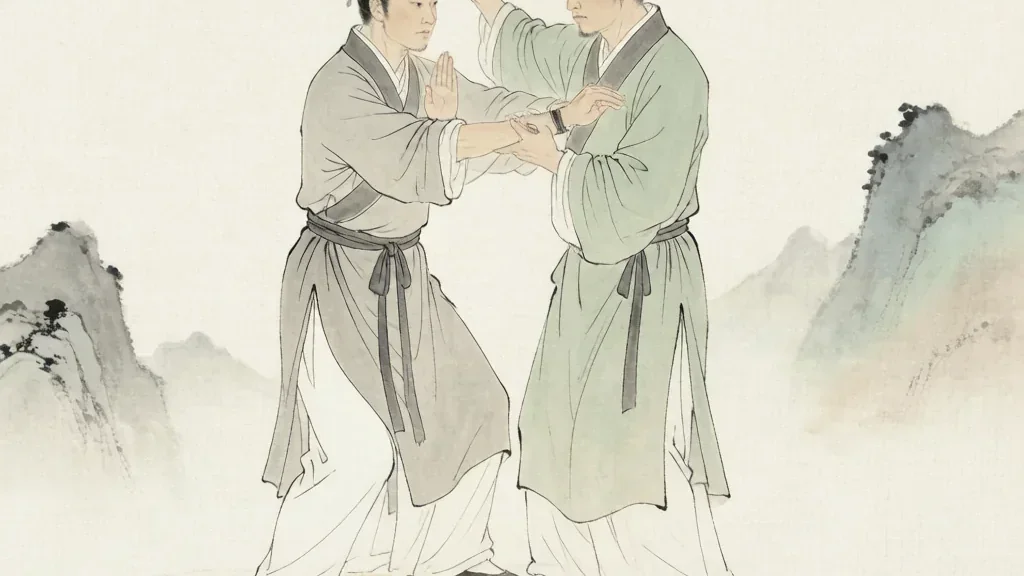
Strikes break bones; locks control bodies. Qinna (擒拿, ), the "seizing and grabbing" art, is the Chinese discipline of joint locks, pressure-point control, and the manipulation of tendons and muscles to immobilize or submit an opponent. Found across nearly every Chinese style, it matters because it reveals the grappling half of kung fu that films often omit. For anyone who thinks Chinese martial arts are only about kicking and flying, Qinna is the reminder that controlling a wrist can be as decisive as any punch.
What Qinna Is and Where It Lives
The characters say it plainly: qin (擒) means to capture or seize, and na (拿) means to hold or lock. Qinna is therefore the art of capturing and controlling. Unlike a pure striking style, it specializes in close contact—gripping the wrist, finger, elbow, shoulder, or neck and applying leverage that the joint cannot resist. It appears embedded in virtually every Chinese system, from the internal arts to the southern fist styles, rather than as a standalone school.
Historically, Qinna developed from the need to subdue without always killing, useful for law enforcement, bodyguards, and monks who took vows against lethal force. The Shaolin tradition is especially associated with its refinement, and many northern and southern styles preserve dedicated locking sets. In the modern era it has also been systematized for police and military use, where controlling a suspect is preferable to striking. Its universality across styles is why serious practitioners study it regardless of their main art.
The Anatomy of a Lock: Tendons, Joints, and Pressure
Qinna works on three main targets: the joints, the muscles and tendons, and the cavities or pressure points (). Joint locks hyperextend or rotate a limb against its natural range—an armbar that straightens the elbow, a wrist lock that twists the hand inward. Tendon-seizing grips the muscle bellies or sinews to cause pain and disable movement. Pressure-point techniques compress nerves or vessels to induce numbness or collapse.
The effectiveness of a lock depends on angles and timing more than strength. A small practitioner who understands the fulcrum can control a larger one, because the joint has a fixed limit and no muscle can override a properly applied lever. This is why Qinna is taught as precision work: the grip must be exact, the body must back the hand with structure, and the application must be immediate. Held too long or applied carelessly, a lock can maim, so responsible training emphasizes control and release.
Dividing, Binding, and the "Seize and Control" Principles
Traditional texts organize Qinna into methods such as "dividing the muscle" () and "separating the bone" (), describing how to isolate and disrupt the body's connections. The broader strategy is "seize and control" (): first capture a limb or neck, then bind it so the opponent cannot generate power, then finish with a lock, takedown, or strike. The capture and the strike are often one motion.
Good Qinna is not static. It flows: a failed wrist lock becomes an elbow lock becomes a throw. Practitioners train "linking locks" that chain several controls so the opponent is never free to recover. This fluidity explains its close relationship with striking styles—many a strike sets up the seize, and many a seize sets up the strike. The art teaches that the moment of contact is not the end of an exchange but the beginning of control.
Qinna in Police, Military, and Self-Defense
Because it emphasizes control over damage, Qinna is a natural fit for modern law enforcement. Police versions strip the art to its safest, most reliable entries—wrist escorts, come-along holds, and takedowns that minimize injury while ensuring compliance. Military and security units likewise adopt simplified Qinna for close-quarters control where firearms are inappropriate or unavailable.
For civilian self-defense, Qinna offers tools against grabs and holds: if someone seizes your wrist or collar, the same principles reverse the situation. Training focuses on reflexive responses to common attacks rather than choreographed duels. The appeal is that it works without relying on size or strength, and it can be applied with graduated force—a firm wrist control rather than a knockout. This scalability makes it one of the most practical components of the Chinese arsenal for everyday protection.
Training Methods and Partner Drills
Learning Qinna demands a partner, because the feel of a live joint cannot be simulated alone. Beginners start with basic wrist and finger locks performed slowly, learning the exact grip and angle. They progress to flowing drills where the attacker offers a limb and the defender applies a sequence of controls, then to resistant sparring where the "attacker" struggles and the defender must maintain control under pressure.
Safety is paramount. Joints are fragile, and a training partner's tap or verbal signal must end the lock instantly. Responsible schools teach escape principles too—how to straighten, relax, and rotate out of a hold—because knowing both sides deepens understanding. Conditioning the hands and forearms (the "iron forearm" toughness) helps practitioners apply and resist grips, but never at the cost of control. In this way Qinna builds both skill and the restraint that marks a mature martial artist.
Qinna and the Broader Chinese Tradition
Qinna sits at the crossroads of Chinese martial arts. It shares principles with the throwing art of Shuai Jiao, complements the striking of Sanda, and appears inside internal styles where joint control is paired with whole-body structure. The "eight energies" sensitivity of Taiji, for instance, has a direct cousin in Qinna's ability to follow and redirect a limb. A well-rounded Chinese martial education is incomplete without some grasp of seizing.
For the cultural learner, Qinna also illustrates a Chinese worldview: the body as a system of connections that can be understood and influenced, not merely struck. It rewards study over brute force and patience over aggression. In an age obsessed with spectacular knockouts, the quiet art of the lock is a lesson in effectiveness through understanding—a fitting emblem of the subtler side of kung fu.
The Methods Of Seizing And Controlling
Qinna organizes its techniques around a small set of physical principles rather than a long list of fixed moves. The best known is the joint reversal, in which a limb is taken past its natural range so the opponent must yield or be injured. Alongside this are seizing the sinew, striking or pressing a nerve point, and methods that disrupt breathing or blood flow through targeted pressure. A skilled practitioner combines these so that a single grip both traps the limb and removes the opponent's ability to resist. Because the effects are immediate and local, Qinna is valued for controlling a stronger attacker without a prolonged struggle. Training emphasizes sensitivity in the hands and an understanding of anatomy, since the same lock must be adapted to whoever is grabbed. This principle-based structure lets a few ideas generate a vast repertoire of controls.
Qinna Within Chinese Martial Arts
Qinna is rarely taught entirely alone; it is usually embedded inside a larger style such as Shaolin, Tai Chi, or one of the northern systems, where it complements striking and throwing. A student may learn a punch from the parent art and later the grab that follows it when the punch is caught, showing how Qinna fits into a complete fighting logic. This integration is why the same lock can appear, with slight variation, across many schools. In modern wushu and sanda, some Qinna is preserved as demonstration or controlled application, while police and security training borrow its principles for restraint. For the learner, recognizing Qinna inside other arts reveals a hidden layer of Chinese martial strategy: the moment an opponent commits, the fight can shift from hitting to holding. That shift is the essence of seizing and controlling.
❓ Frequently Asked Questions
📝 Chinese Vocabulary
擒拿 — : seizing and holding; the art of locks.
分筋 — : "dividing the muscle," a seizing method.
错骨 — : "separating the bone," a locking method.
穴位 — : acupuncture/pressure points.
拿法 — : grabbing methods or hold techniques.
反关节 — : joint reversal, a core Qinna method of controlling a limb against its natural direction
拿筋 — : seizing the sinew, gripping muscle and tendon to disable movement
闭气 — : sealing the breath, a pressure method that disrupts an opponent's breathing
🎉 Fun Facts
- Qinna appears inside almost every Chinese martial style, from Shaolin to the internal arts, rather than as one isolated school.
- The Shaolin monastery is especially credited with refining joint-locking into a sophisticated system.
- Modern Chinese police use simplified Qinna for suspect control, favoring compliance over injury.
- A single wrist grab can be reversed into a lock using the same leverage principles, making Qinna ideal for self-defense against holds.
- Qinna is the component art behind many of the joint locks seen in modern grappling and police control techniques.
- The same character 'na' appears in the word for 'to hold' or 'to capture' in everyday Chinese.