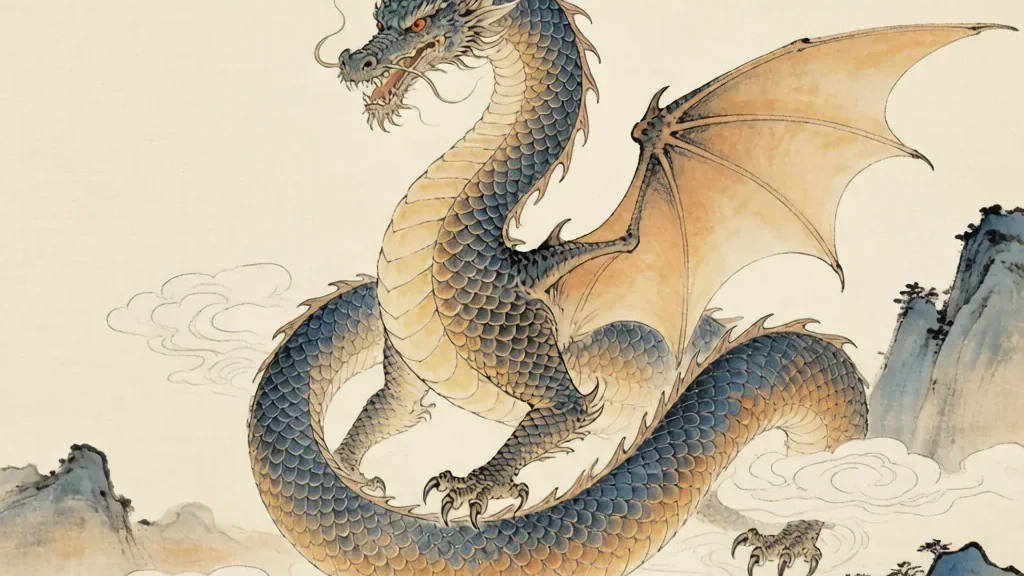
When a Westerner hears the word "dragon," they likely picture a fire-breathing monster — a treasure-hoarding, maiden-eating villain to be slain by a knight in shining armor. But in China, the dragon (龙, lóng) could not be more different. Far from a monster, the Chinese dragon is a divine being, a bringer of rain, a symbol of imperial power, and the most auspicious creature in the entire Chinese mythological pantheon. The Chinese people even refer to themselves as "the descendants of the dragon (龙的传人)." To understand the Chinese dragon is to understand something essential about Chinese culture itself.
The dragon is one of the oldest symbols in Chinese civilization, with archaeological evidence of dragon imagery dating back over 6,000 years to the Neolithic Yangshao culture (仰韶文化). A jade dragon discovered at the Hongshan culture (红山文化) site in Inner Mongolia, dating to approximately 4,000–3,000 BCE, is one of the earliest known dragon artifacts in the world. Unlike the later, more elaborate dragon, this early form is relatively simple — a curled, C-shaped creature with a pig-like snout — but it already embodies the dragon's essential character as a supernatural being mediating between heaven and earth.
The Anatomy of a Divine Creature
The Chinese dragon is not a single animal but a composite of nine different creatures, each contributing a part to create a being greater than the sum of its origins. According to traditional descriptions, the dragon has the horns of a deer (鹿角), the head of a camel (驼头), the eyes of a demon (鬼眼), the neck of a snake (蛇颈), the belly of a clam (蜃腹), the scales of a carp (鱼鳞), the claws of an eagle (鹰爪), the paws of a tiger (虎掌), and the ears of an ox (牛耳). This composite nature reflects the dragon's role as a cosmic synthesis — a creature that unites the characteristics of land, water, and sky.
The number of claws on a dragon's feet carries particular significance. During the Ming and Qing dynasties, only the emperor was permitted to use the five-clawed dragon (五爪龙) as his personal emblem. Princes and high-ranking nobles could use four-clawed dragons, while commoners were forbidden from depicting dragons at all — a restriction enforced by law. This hierarchy of claws was taken so seriously that Korean and Vietnamese dragons, for example, typically have four or three claws, reflecting their tributary status relative to the Chinese emperor.
Chinese dragons are also classified by age and power. The Jiaolong (蛟龙) is a young, hornless water dragon that lives in rivers and lakes. The Qiulong (虬龙) is a horned dragon that has begun to develop its powers. The Yinglong (应龙) is the oldest and most powerful, a fully mature dragon with wings that controls the weather and once helped the legendary Yellow Emperor defeat his enemies. The ultimate aspiration of every dragon is to ascend to heaven, a process that can take thousands of years of cultivation.
Dragon Kings and the Control of Water
In Chinese folk religion, the world's waters are governed by the Four Dragon Kings (四海龙王) — Ao Guang of the East Sea, Ao Qin of the South Sea, Ao Run of the West Sea, and Ao Shun of the North Sea. Each rules an underwater palace filled with sea creatures who serve as their ministers and soldiers. These Dragon Kings control the rain, and when they are angered, they can withhold it — causing drought — or release it in torrents, causing floods.
The Dragon Kings appear in one of China's most beloved novels, "Journey to the West" (西游记), where the Monkey King, Sun Wukong, visits the Eastern Dragon King's palace and demands a weapon. After trying and rejecting several magical arms, he settles on the Ruyi Jingu Bang (如意金箍棒), a massive iron pillar that had been used to measure the depth of the oceans — and which shrinks to the size of a needle at his command. The episode illustrates a recurring theme in Chinese mythology: dragons, for all their power, are not invincible, and they can be challenged, tricked, or even defeated by extraordinary individuals.
The Dragon as Imperial Symbol
For over two thousand years, the dragon has been the primary symbol of the Chinese emperor. The emperor's throne was called the Dragon Throne (龙椅), his face the Dragon Face (龙颜), his robes the Dragon Robes (龙袍), and his body the Dragon Body (龙体). The emperor was understood to be the earthly manifestation of the dragon, a being whose authority derived directly from heaven. The five-clawed dragon motif appeared on imperial architecture, furniture, ceramics, and textiles throughout the Forbidden City — a constant reminder of the emperor's divine status.
This association between dragons and rulership has deep roots. The legendary Yellow Emperor (黄帝), the mythical progenitor of Chinese civilization, was said to have ascended to heaven on the back of a dragon at the end of his reign. The founders of both the Xia and Shang dynasties were described as having dragon ancestry. By the time of the Han Dynasty (206 BCE–220 CE), the dragon was firmly established as the symbol of the emperor, a role it would maintain until the fall of the Qing Dynasty in 1912.
Dragons in Daily Life and Culture
Despite their imperial associations, dragons permeate every level of Chinese culture. The Dragon Boat Festival (端午节), held on the fifth day of the fifth lunar month, features boat races in long, narrow vessels decorated with dragon heads and tails. The festival commemorates the poet Qu Yuan, but its dragon boat races are also a form of water ritual, awakening the dragons from their winter slumber and encouraging them to bring rain for the crops.
The Dragon Dance (舞龙), performed during Chinese New Year and other celebrations, involves a team of dancers manipulating a long, flexible dragon figure on poles, making it writhe and undulate through the streets. The longer the dragon, the more luck it brings — some dragon dance dragons stretch over 70 meters and require more than 50 performers. Firecrackers are set off to wake the dragon and drive away evil spirits, and the dance is believed to bring prosperity for the coming year.
The dragon also appears throughout the Chinese language. A talented person is described as a "dragon among men" (人中之龙). Parents hope their children will "become dragons" (成龙) — that is, achieve great success. A powerful and energetic calligraphy stroke is a "flying dragon and dancing phoenix" (龙飞凤舞). The Year of the Dragon in the Chinese zodiac is the most popular year for having children, as dragon babies are believed to be especially fortunate and destined for greatness.
The Dragon and the Four Directions
In Chinese cosmology the dragon is not alone in the sky. It is one of the four celestial animals, each guarding a direction and a season. The Azure Dragon rules the East and the spring, paired with the White Tiger of the West, the Vermillion Bird of the South, and the Black Tortoise of the North. These four appear on tombs, temples, and maps as a complete compass of protective powers, and the dragon leads the eastern quarter with its association with rising wood and new growth. This system gave the dragon a fixed place in the architecture of the universe, not merely as a free wanderer of the clouds. When a builder aligned a gate or painted a wall, the Azure Dragon was the eastern presence that had to be honored, making the creature a structural part of cosmic order.
The Meaning of the Dragon Pearl
One of the most common dragon images shows the creature chasing or clutching a glowing pearl. The pearl is usually read as the moon, sometimes as the sun, and often as a symbol of wisdom or the perfect truth the dragon guards. In the dragon dance, a performer holds a pearl on a pole to lead the long cloth dragon in its writhing path, so the pearl becomes the focus of the creature's energy and the reason for its motion. Artists liked the motif because it gave the dragon a goal and a partner, turning a formless power into a small drama of pursuit. The pearl also appears in carvings above gates and on imperial robes, where it signals that the dragon's strength serves a higher light rather than mere force.
Dragons in Festivals and Rain Rites
Beyond the famous boat races, dragons appear throughout the Chinese festival calendar as agents of water and renewal. In drought years communities once staged rain-prayer ceremonies with dragon figures, parading them through the streets to summon the creature's mercy. At the Lantern Festival and New Year, dragon-shaped lanterns and cloth dragons wind through towns to wake the sleeping powers of spring. Even the lion dance often shares the stage with dragon imagery, since both are seen as auspicious guardians of the new year. These performances are not only entertainment; they are a way of negotiating with the weather, asking the dragon to give water without wrath. The dragon's presence at every turning of the season shows how deeply the animal is woven into the rhythm of village time.
The Dragon in Modern Identity
The Chinese dragon has outlasted dynasties to become a badge of shared identity. The phrase descendants of the dragon is sung in popular songs and taught to children as a line of cultural belonging that crosses regions and dialects. In international settings the dragon often stands in for China itself, appearing on emblems, team mascots, and festival floats abroad. This use is a deliberate contrast with the West, where the same word means a monster to be slain; Chinese speakers point to the difference as a window into two very different attitudes toward power and nature. The dragon thus works on two levels at once: an ancient rain spirit and a modern symbol of pride. Few mythological animals have kept both their old sacred charge and their new national one so fully intact.
❓ Frequently Asked Questions
📝 Chinese Vocabulary
- 龙 (Lóng) — The Chinese dragon, a divine composite creature and the most important mythological being in Chinese culture.
- 龙的传人 (Lóng De Chuán Rén) — "Descendants of the dragon," a phrase Chinese people use to describe themselves, reflecting the dragon's role as a national symbol.
- 四海龙王 (Sì Hǎi Lóng Wáng) — The Four Dragon Kings, divine rulers of the four seas who control rain and water throughout the world.
- 五爪龙 (Wǔ Zhuǎ Lóng) — The five-clawed dragon, an emblem reserved exclusively for the Chinese emperor during the Ming and Qing dynasties.
- 舞龙 (Wǔ Lóng) — The Dragon Dance, a traditional performance during Chinese New Year and festivals, believed to bring good luck and prosperity.
🎉 Fun Facts
- The Chinese dragon is said to have 117 scales in total — 81 yang (male, positive) scales and 36 yin (female, negative) scales — numbers derived from traditional Chinese numerology.
- During the Qing Dynasty, any commoner caught wearing clothing with a dragon motif could be executed, as the dragon was the exclusive symbol of the emperor.
- The world's longest dragon dance dragon measured 5,556 meters (over 3.4 miles) and required 3,000 performers — a feat recognized by Guinness World Records.
- The dragon is one of the four celestial animals of the directions, ruling the East as the Azure Dragon beside the White Tiger, Vermillion Bird, and Black Tortoise.
- A baby born in a Dragon year is traditionally seen as especially fortunate, and Dragon years tend to bring a small rise in birth rates across China.
- The flaming pearl often shown under the dragon's chin or chased through the air stands for the moon, the sun, or hard-won wisdom in art and dance.