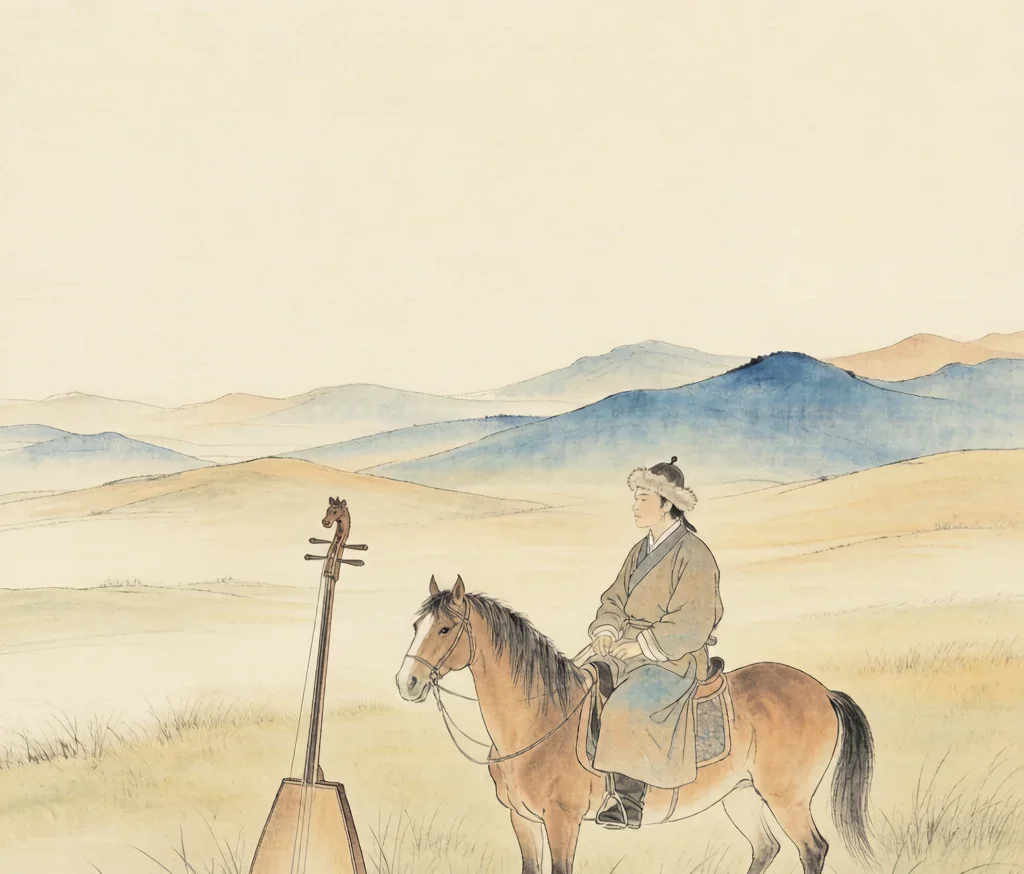
The horsehead fiddle (马头琴, mǎtóu qín), known in Mongolian as 'morin khuur,' is the most iconic musical instrument of the Mongolian people — a two-stringed bowed instrument whose scroll is carved into the shape of a horse's head, and whose soulful, resonant tone evokes the vast grasslands, galloping herds, and nomadic spirit of the Mongolian steppe. The instrument's history stretches back over a millennium, with ancient representations appearing in cave paintings and stone carvings across the Mongolian plateau. According to legend, the first horsehead fiddle was created by a young herdsman named Namjil, whose beloved flying horse was killed by an evil lord. The horse's spirit appeared to Namjil in a dream, instructing him to make an instrument from its body: the neck from its bones, the strings from its tail hair, and the body covered in its hide — with the scroll carved in the horse's likeness so that its spirit would live on in music. This legend, known to every Mongolian child, captures the instrument's profound connection to the horse, which occupies the central place in Mongolian nomadic culture. In 2008, the horsehead fiddle was inscribed on UNESCO's Representative List of the Intangible Cultural Heritage of Humanity, recognizing its significance as a living tradition of the Mongolian people.
Construction and Playing Technique
The traditional horsehead fiddle is constructed from materials that reflect its nomadic origins: the trapezoidal body is carved from a single block of pine or spruce and covered with animal skin — traditionally horse, camel, or sheep hide — stretched taut over the soundboard. The neck and scroll are carved from birch or maple, with the distinctive horse-head carving at the top, each one unique to its maker. The instrument has two strings, traditionally made from the tail hair of horses — 180 hairs for the 'male' string (producing a deeper tone) and 130 hairs for the 'female' string (producing a higher tone). The bow, also strung with horsehair, is held between the two strings rather than over them, a technique unique to the horsehead fiddle and a few other Central Asian bowed instruments. This allows the player to bow either string independently or both simultaneously, creating drones, double-stops, and harmonic effects that are fundamental to the instrument's characteristic sound. The playing technique is distinctive: rather than pressing the strings against a fingerboard (the instrument lacks one entirely), the player stops the strings with the fingertips or fingernails from the side, producing the sliding, microtonal inflections and overtone-rich timbre that evoke the sounds of the natural world — wind across grass, the neighing of horses, the calls of birds. Advanced players use a technique called 'tatlaga' that mimics the gaits of horses — walking, trotting, and galloping — through rhythmic bowing patterns that have been codified into a sophisticated musical vocabulary.
The Morin Khuur in Mongolian Culture
In traditional Mongolian culture, the horsehead fiddle was far more than a musical instrument — it was an essential element of nomadic life, a companion in solitude, and a medium for communicating with the spiritual world. Every Mongolian ger (yurt) of any standing would have a horsehead fiddle hanging on its wall, and the ability to play was considered an essential accomplishment for men. The instrument accompanied all significant life events: it was played during the 'urgel' (long-song) singing at weddings, where the fiddle's sustained drones supported the singer's extended melismatic phrases; it provided the musical foundation for 'bielgee' (Mongolian folk dance), where dancers imitate the movements of daily nomadic life — milking mares, herding sheep, riding horses; and it was played during shamanic rituals, where its deep, resonant tones were believed to facilitate communication with ancestral spirits. The horsehead fiddle's repertoire includes several distinct genres: 'tatlaga' (imitative pieces that evoke animals, landscapes, and natural phenomena), 'urtiin duu' accompaniments (supporting the 'long song' vocal tradition that can sustain single syllables for minutes), and 'bogino duu' (short songs with fixed melodies and regular rhythms). The instrument is also used to accompany the Mongolian epic tradition — recitations of the 'Jangar' (江格尔) and 'Geser' (格萨尔) epics, which can last for days and recount the heroic deeds of legendary warriors. A single horsehead fiddle player can sustain these marathon performances, using the instrument's rich drones and evocative timbres to transport listeners into the epic's mythic landscape.
Regional Traditions: Inner Mongolia and Beyond
The horsehead fiddle tradition spans the Mongolian cultural world, from the steppes of the independent nation of Mongolia (Outer Mongolia) to the grasslands of China's Inner Mongolia Autonomous Region, and among Mongolian communities in Russia's Buryatia and Kalmykia republics. Each region has developed its own distinctive performance style and repertoire. In Inner Mongolia, the 'Chahar' style, centered on the Xilingol League, is characterized by a rich, singing tone and a repertoire of lyrical melodies that reflect the relatively settled pastoral life of the region. The 'Ordos' style, from the Ordos Plateau in southwestern Inner Mongolia, features more rhythmic, dance-influenced music and incorporates elements of Han Chinese musical traditions from the neighboring provinces. The 'Khalkha' style of independent Mongolia emphasizes virtuosic 'tatlaga' pieces and the accompaniment of 'long song' singing. Since the mid-20th century, the horsehead fiddle has undergone significant modernization: the traditional skin-covered body has largely been replaced by a wooden soundboard with f-holes similar to those of a violin, which produces a louder, more stable tone suitable for concert halls and ensemble playing. The instrument has been incorporated into the standard curriculum of music conservatories in both Mongolia and China, and a repertoire of concert works — concertos, sonatas, and chamber music — has been developed by composers seeking to bridge the traditional and classical worlds.
Global Recognition and Contemporary Innovation
In recent decades, the horsehead fiddle has transcended its traditional context to achieve international recognition as one of the world's most distinctive and expressive musical instruments. The 'Morin Khuur Ensemble of Mongolia,' founded in 1992, has toured extensively worldwide, introducing audiences to the instrument's evocative power through programs that range from traditional Mongolian music to arrangements of Western classical works. In Inner Mongolia, the 'Qi Baoligao Wild Horse Morin Khuur Ensemble,' led by the legendary player Qi Baoligao (齐·宝力高, b. 1944) — widely credited with modernizing the instrument and elevating its status — has performed at prestigious venues including the Vienna Musikverein and Carnegie Hall. Contemporary musicians are pushing the instrument's boundaries in new directions: Mongolian rock bands like 'The Hu' have incorporated the horsehead fiddle into heavy metal arrangements, creating a fusion that has attracted a global following; experimental musicians are using electronic processing and looping to create ambient soundscapes from the instrument's overtones; and collaborations with jazz, classical, and world music ensembles continue to expand the instrument's expressive vocabulary. In 2013, China's Inner Mongolia Autonomous Region established a dedicated Morin Khuur Art Academy in Hohhot, ensuring that the next generation of players will receive comprehensive training in both traditional repertoire and contemporary techniques. The horsehead fiddle's journey from the ger to the global concert stage is a testament to the enduring power of an instrument born from the relationship between a people and their horses, a people and their land.