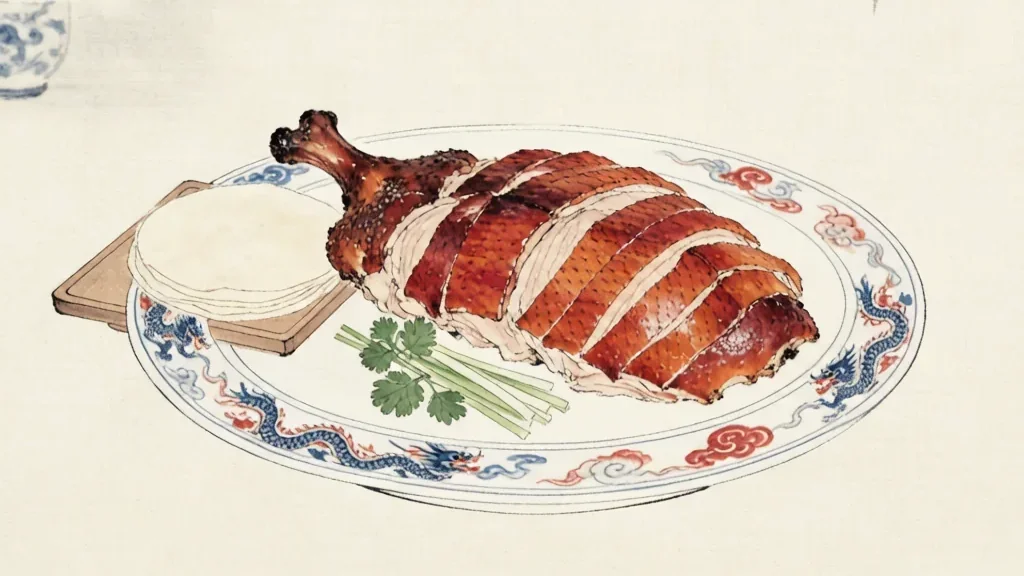
Beijing kaoya, known in English as Peking duck, is the celebrated roast duck of China's former imperial capital, prized for its shatteringly crisp amber skin, tender meat, and the theatrical ritual of slicing it at the table before wrapping the pieces in thin pancakes with scallion and sweet bean sauce. Developed over centuries in the kitchens of Beijing, the dish reached its modern form in the late Qing through specialized roast-duck restaurants that inflated the bird, glazed it with maltose, and roasted it in closed ovens hung over fruitwood. More than a meal, Peking duck is a culinary ambassador — once a dish of emperors, now a global symbol of Chinese gastronomy and a centerpiece of banquet hospitality.
History and Imperial Origins
The pedigree of roast duck in Beijing traces back to the Yuan, Ming, and Qing dynasties, when the capital's chefs refined methods of roasting poultry for the imperial court. Early forms drew on Nanjing's salted-duck traditions brought north when the Ming moved the capital, and on the practice of roasting whole animals inclosed ovens.
By the Qing dynasty, dedicated duck restaurants flourished in Beijing, and the dish became associated with scholar-officials and merchants as well as the palace. The famous Quanjude restaurant, founded in the mid-nineteenth century, helped standardize the modern method and turned Peking duck into a commercial institution.
The Duck Breed
Traditionally the bird used is a large white-feathered Beijing duck (Jing ya), a breed developed for fatty, well-marbled meat and abundant skin — exactly what the crisp-skin technique requires. The quality of the skin, more than the meat, is the measure of a great Peking duck.
Modern birds are often force-fed to enlarge the liver and fat layer, producing the thick skin that renders and crisps so dramatically. The breed's characteristics are so tied to the dish that "Beijing duck" is itself the name of the poultry type worldwide.
Preparation: Inflating and Glazing
The signature skin begins long before roasting. The duck is eviscerated through a small opening, then air is pumped between skin and flesh to separate them — a step that lets the fat render out and the skin crisp uniformly. The bird is scalded, then lacquered repeatedly with a maltose (or honey) syrup that promotes color and crackle.
After glazing, the duck is hung to dry, sometimes overnight in a breeze, so the skin tightens. This drying is essential: moisture is the enemy of crispness, and a properly dried bird emerges from the oven with skin like glass.
Roasting Methods
Two main traditions exist. The "closed-oven" (guan lu) method, associated with Quanjude, hangs ducks on hooks inside a sealed oven fired by fruitwood such as pear or jujube, roasting by radiant heat for even browning. The "open-oven" (jian lu) method, linked to the Bianyifang restaurant, roasts ducks on a rotating spit over a brick hearth.
Fruitwood smoke imparts a subtle aroma prized by connoisseurs. The bird is turned and monitored until the skin is deep amber and blistered. Timing matters: underdone skin is flabby, overdone is bitter. Mastery is judged by the sound and look of the crackling surface.
The Carving Ritual
Serving Peking duck is performance. The chef brings the whole bird to the table and slices it with a thin blade, traditionally aiming for around one hundred thin pieces, prioritizing skin with a sliver of meat. The slicing is done quickly and precisely before the diners, part of the dish's theater.
The order of cutting follows the bird's anatomy, and the best slices — pure crisp skin — are offered first. This ritual elevates the meal from food to spectacle and reflects the Chinese esteem for craft shown in the open.
How It Is Eaten
The classic service wraps slices in a thin wheat pancake (bing) with slivered scallion (spring onion) and a brush of sweet bean sauce (tianmianjiang), sometimes with cucumber. Diners roll their own, balancing rich skin, pungent allium, and sweet-savory sauce in each bite.
Beyond the pancake, the remaining meat may be stir-fried or made into soup, and the bones simmered into a broth — a "three-course" progression that wastes nothing. Some restaurants also serve the skin alone with sugar for dipping, highlighting its crackle.
Cultural Status
Peking duck is a dish of hospitality and occasion, served to guests of honor and at state banquets as a representative of Chinese cuisine. Its imperial associations lend it prestige, and foreign visitors to Beijing are routinely steered to a duck house as a rite of passage.
It also carries regional pride for the city, much as certain dishes define other capitals. The combination of history, technique, and ceremony makes it a cultural artifact as much as a recipe, taught in culinary schools as a benchmark of skill.
Duck Houses and Etiquette
Eating Peking duck carries its own etiquette. Guests are often seated facing the carving station, and the first slices of pure skin may be offered to the most honored diner. Learning to wrap a neat pancake without tearing it is a small social skill, and hosts use the shared ritual to express welcome.
The duck house itself is part of the experience: historic restaurants boast aged ovens, inscribed plaques, and stories of famous patrons, turning a meal into a visit to living heritage. For many Beijingers, returning to a beloved duck house is a way to mark occasions and to claim the city as their own.
Peking Duck Today
Today the dish spans humble neighborhood joints and luxe restaurants, with chains exporting the format to major world cities. While purists defend the fruitwood closed-oven method, innovations include electric ovens and pre-order "one-duck" experiences. The dish remains a touchstone against which Chinese roasting skill is measured.
For travelers, a Beijing duck dinner is both a meal and a cultural performance — a rare case where a food's preparation is as famous as its taste, ensuring its place at the top of China's culinary canon.
❓ Frequently Asked Questions
What is Peking duck?
It is Beijing's famous roast duck, prized for crisp amber skin and served sliced in pancakes with scallion and sweet bean sauce.
Why is the skin so crisp?
The duck is inflated to separate skin from fat, glazed with maltose, dried, and roasted so the skin crisps like glass.
How is Peking duck eaten?
Slices are wrapped in a thin pancake with scallion and sweet bean sauce; meat and bones are later made into other dishes.
What wood is used for roasting?
Traditionally fruitwood such as pear or jujube, which lends a subtle smoky aroma.
Where did Peking duck come from?
It developed in Beijing over the Yuan, Ming, and Qing dynasties, refined in imperial and restaurant kitchens.
Is the whole duck used?
Yes: skin is served first, meat is stir-fried or wrapped, and bones are simmered into soup.