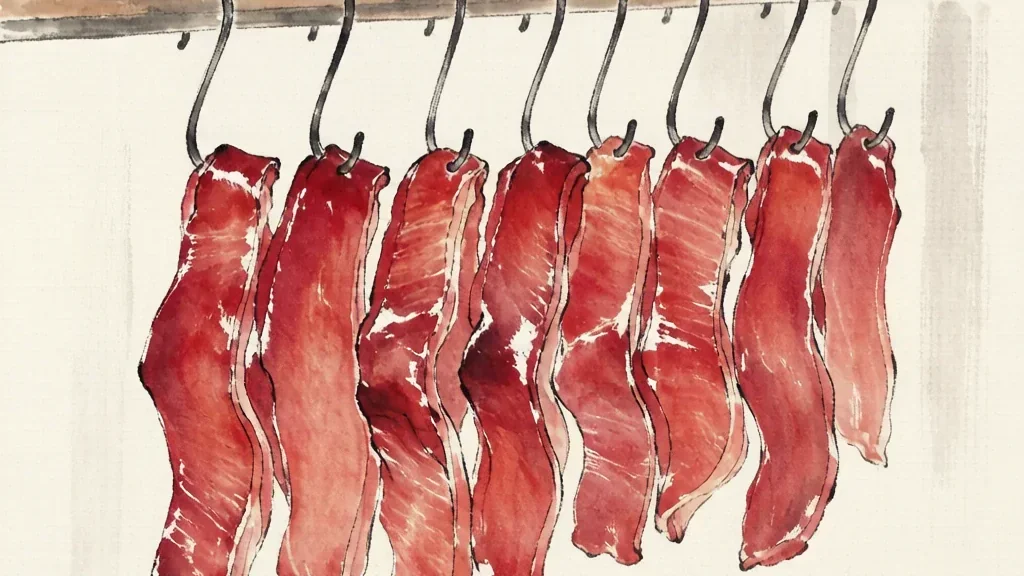
Char siu, often written charsiu in Cantonese romanization and usually rendered "barbecue pork" in English, is the glossy, reddish, sweet-savory roasted pork that is one of the most recognizable icons of Cantonese cuisine. Strips of pork — traditionally the shoulder or a fatty collar cut — are marinated in a sauce of honey, hoisin, soy, fermented red bean curd, and rice wine, then roasted on hooks in a rotisserie oven so the glaze caramelizes into a lacquered, faintly charred crust. Eaten sliced over rice, stuffed into buns, folded into noodles, or simply as a deli meat from the barbecue shop, charsiu is both an everyday comfort and a festive centerpiece. Its name means "fork-roasted," referring to the long forks once used to hold the meat over fire.
Name and Meaning
The Cantonese term cha siu (叉烧) combines cha, "fork," and siu, "roast" — literally meat roasted on a fork or skewer. This points to the old method of impaling long strips of pork on forks or hooks and turning them before an open flame or inside a rotisserie. In Mandarin the same characters are read cha shao, and English menus variously spell it char siu, charsiu, or cha shao.
The name underscores that charsiu is defined less by the cut of pork than by the cooking technique and the signature marinade. Any pork prepared this way, regardless of exact muscle, earns the label, which is why the dish reads as a method as much as a specific recipe.
Historical Roots
Roasting pork over fire is an ancient practice across China, but the sweet, glazed Cantonese charsiu took shape in the kitchens of Guangdong and among the Cantonese diaspora in Hong Kong and Southeast Asia. Barbecue shops (siu laap) specializing in roasted meats became neighborhood institutions, displaying glistening pork in the window alongside roasted duck and goose.
The use of fermented red bean curd and honey in the marinade reflects the Cantonese preference for balanced, slightly sweet flavors and the ingenuity of preserving and perfuming pork. As Cantonese immigrants carried their foodways abroad in the nineteenth and twentieth centuries, charsiu became a global shorthand for Chinese barbecue.
The Marinade and Color
The characteristic red hue comes from a few possible sources. Traditionally, a small amount of fermented red bean curd (nan ru) tinted the meat; modern shops often use red food coloring or red yeast rice for a more vivid lacquer. The marinade itself is built on hoisin sauce, light and dark soy, honey or maltose, rice wine, five-spice powder, and garlic.
Fat is essential to good charsiu. The marinade penetrates and the roasting renders the fat while the sugars caramelize on the surface, producing the sticky, slightly burnt "burnt honey" edges that connoisseurs seek out. A final brush of honey or maltose syrup right before serving heightens the shine.
Cuts of Pork Used
The classic choice is pork shoulder or butt, which balances fat and lean for a juicy result. A prized variant called "flower proclaims" or faan fa cha siu uses a streaky cut with beautiful marbling. The very best, most tender version is made from pork tenderloin tips or the neck, sold at a premium.
Some shops offer "honey-roasted" charsiu with extra syrup, while leaner versions cater to health-conscious customers, though purists maintain that some fat is non-negotiable for authentic flavor and mouthfeel. The strip form allows even cooking and easy slicing.
How It Is Cooked
In a traditional siu laap kitchen, long strips of marinated pork are hung on hooks inside a cylindrical rotisserie oven, sometimes fired by gas or wood, and turned slowly so heat circulates evenly. The rotating motion lets the glaze baste the meat as it drips and re-coats. Home cooks approximate this with a broiler or oven, brushing the syrup on in layers.
The meat is roasted until the internal temperature is safe and the exterior is burnished, then rested and sliced on the bias into bite-sized pieces. Because it is roasted on the bias and served in pieces rather than carved like a joint, charsiu reads as a versatile ingredient as well as a dish.
Ways to Eat Charsiu
Charsiu is extraordinarily versatile. Sliced over plain rice with a little jus it becomes charsiu fan, a lunch counter staple. Tucked into a steamed bun it is charsiu bao, a dim sum favorite. Added to wonton noodle soup or stir-fried noodles, it lends sweet-savory depth. It also appears in fried rice and as a filling for pastries.
As a cold cut, it is bought by the catty from the barbecue shop and eaten at room temperature with rice or noodles at home, or simply enjoyed as a snack. During festivals it may be part of a larger roasted-meat platter shared by a family.
Place in Cantonese Barbecue Culture
Charsiu belongs to the siu laap family of Cantonese roasted meats, alongside siu ngap (roast duck), siu ngaap (roast goose), and crispy roast pork (siu yuk). A proper siu laap shop displays the hanging meats in its window, a visual promise of the day's roast, and sells by weight.
For many Cantonese families, buying charsiu from the local shop on the way home is a routine that blurs the line between restaurant and home cooking. The dish embodies the Cantonese culinary values of balanced sweetness, careful roasting, and respect for the ingredient's natural texture.
Charsiu Around the World
Through Cantonese migration, charsiu traveled to Hong Kong, Malaysia, Singapore, Thailand, Vietnam, and the Chinatowns of the West. In each place it was absorbed into local cooking: in Malaysia and Singapore it tops wilted greens or fills rice rolls; in Hawaii it appears in plate lunches and manapua buns.
In Western cities, charsiu is a common sight in Chinese barbecue restaurants and a familiar filling in bakeries. Its sweet, smoky profile has made it a gateway dish for newcomers to Cantonese food, and it frequently appears on averages of "most iconic Chinese dishes" lists.
Making Charsiu at Home
Home preparation is approachable with a pork shoulder and a good marinade. The pork is soaked overnight in the soy-hoisin-honey mixture, then roasted on a rack so the fat can render, with repeated brushing of syrup in the final minutes to build the glaze.
A touch of red yeast rice powder or a drop of red coloring replicates the classic look, while a broiler finish mimics the char of the rotisserie. Leftovers keep well and improve fried rice or noodle dishes, making a single roast useful across several meals.
❓ Frequently Asked Questions
What kind of meat is charsiu?
It is pork, usually shoulder or a fatty collar cut, marinated sweet and roasted until glazed and slightly charred.
Why is charsiu red?
The color comes from fermented red bean curd or red yeast rice in the marinade, and sometimes a little coloring.
Is charsiu spicy?
No, it is sweet and savory rather than spicy, with aromatic notes from five-spice and garlic.
How do you eat charsiu?
Sliced over rice, in steamed buns, in noodles or fried rice, or as a cold cut bought from a barbecue shop.
Can I make charsiu at home?
Yes, by marinating pork shoulder overnight and roasting it with repeated syrup brushing to build the glaze.
What does charsiu mean?
The Cantonese words mean "fork-roasted," referring to the old method of roasting strips of pork on forks.