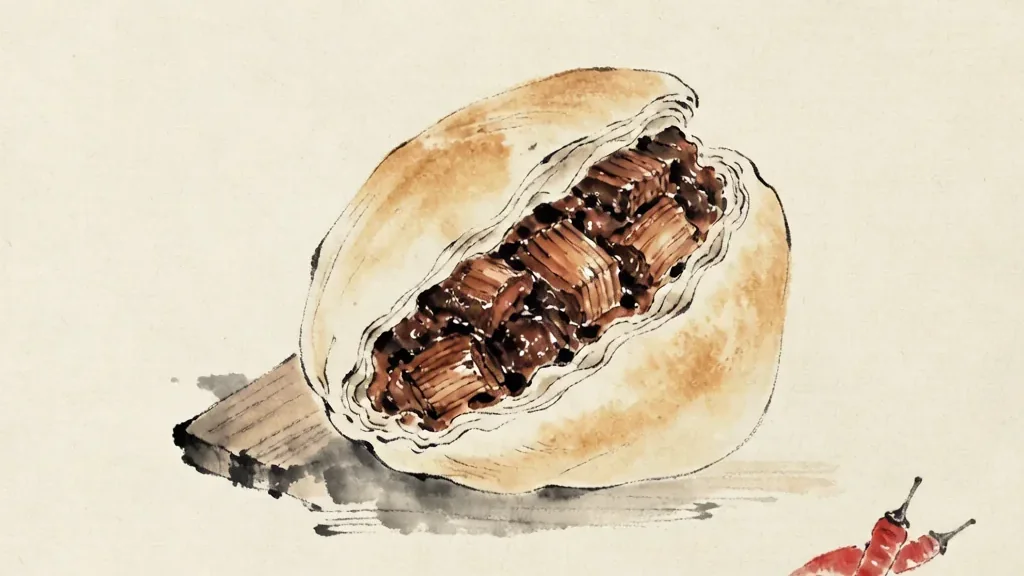
If China has a hamburger, it is ròu jiā mó (肉夹馍) — a slow-braised, fragrantly spiced meat stuffed into a crisp, hollowed wheat bun, eaten hot and messy in the hand. The name literally means "meat sandwiched in mo," and despite the word order it is essentially a filled bun rather than bread around a patty. Born in Shaanxi province around the ancient capital of Xi'an, roujiamo is the street food of the Silk Road heartland, where Muslim Hui cooks perfected the braise and the bake. It is hearty, portable, and layered with history, connecting a modern snack to the caravans and capitals of imperial China. To bite into one is to taste the crossroads of Central Asia and the Han heartland.
What Is Roujiamo?
Roujiamo consists of two parts: the "mo," a flat round wheat bun baked in a clay oven until the outside is crisp and the inside is tender, and the filling, traditionally pork or beef braised for hours with soy, ginger, star anise, and other spices, then chopped and mixed with a little of its own broth and sometimes cilantro and chili. The bun is slit, the meat is packed in, and the result is eaten immediately. The contrast of crackly bread and juicy, savory meat is the whole appeal.
There are two main styles by meat. The Xi'an (Guanzhong) style uses pork, braised in a master stock until fork-tender, then minced with fat and broth so it stays moist. The northwestern (especially Hui Muslim) style uses beef or lamb, halal, often with cumin and a different bun. Both deliver a handheld, protein-rich meal that has fed travelers and workers for centuries, and both are served from stalls that smell of toasted grain and spiced meat.
Origins in Shaanxi and the Silk Road
Roujiamo hails from Shaanxi province, whose capital Xi'an (formerly Chang'an) was the eastern terminus of the Silk Road and a succession of imperial capitals. The bun form descends from ancient "mo" breads of the Guanzhong plain, while the braised-meat filling reflects both Han stewing traditions and the Muslim (Hui) influence that entered via Central Asia. Some historians link an early version to the "lamb stuffed cake" of the Zhou or Han eras, making roujiamo one of China's oldest fast foods.
The dish's geography explains its character. Shaanxi sits where northern wheat culture meets northwestern nomadic and Islamic foodways; the result is a wheat bun carrying a spice-laden braise. As trade and pilgrimage moved through Xi'an, the snack spread along routes and into cities, becoming especially identified with the city's Muslim Quarter. Today roujiamo is a point of regional pride and a must-eat for any visitor to Xi'an.
The Bun: Mo
The "mo" is not a soft burger bun but a flat, dense wheat bread, traditionally baked against the wall of a cylindrical clay oven (like a tandoor) so the exterior crisps while the inside stays chewy. Good mo has a toasted, slightly blistered crust and a hollow, breadcrumb-soft interior that soaks up meat juices. The bun is usually made from a simple leavened dough, sometimes with a little oil, and is baked fresh throughout the day.
Texture is everything. If the mo is too soft, it turns to paste with the juices; if too hard, it fights the meat. The ideal is a shell that shatters at the edges but yields in the middle. Vendors often bake a stack and slit them to order, warming them again on the griddle before filling. The bun's neutrality is deliberate — it exists to carry and contrast the rich, spiced meat.
The Braised Meat
The meat is the soul. Pork or beef is simmered for hours in a master braise of soy sauce, ginger, garlic, star anise, cinnamon, cloves, fennel, and often a local Shaanxi touch like grass jelly (cǎo guǒ) or bay leaf. The long, slow cooking renders the connective tissue into gelatin, making the meat lush and easy to chop. Crucially, the cooked meat is minced together with a spoonful of the reduced broth and some of the fat, so the filling stays glossy and moist rather than dry.
The chop matters: roujiamo meat is cut with a heavy cleaver into a coarse mince, not ground, preserving texture. Cilantro and sometimes green chili are mixed in for freshness and heat, especially in Xi'an. The skill of a shop is judged by the depth of its braise and the balance of meat to fat to broth. A great roujiamo tastes of time — the hours the meat spent surrendering to the spices.
How to Eat Roujiamo
Roujiamo is eaten by hand, hot, leaning over slightly because the juices can drip. Take it soon after it is made, while the mo is still crisp and the meat steaming. It is a full meal in one item, though Xi'an locals often pair it with a bowl of huí mían (biangbiang noodles) or a cold noodle side, or wash it down with a sour plum drink. The portion is satisfying without being huge.
There is no ceremony, only appetite. Order at a stall, watch the meat chopped and the bun filled, and eat standing or at a low stool. Because it is portable and self-contained, roujiamo is the original Chinese grab-and-go lunch, predating any modern fast food by centuries. For visitors, it is the single best edible introduction to Shaanxi's rustic, spice-forward cooking.
Roujiamo in Chinese Food Culture
Roujiamo has been called "the Chinese hamburger" in English, a useful but flattening label — it is better understood as a native filled-bun tradition with roots deeper than the modern burger. Its fame has spread nationally through chains and internationally via Chinese restaurants, yet the best versions remain stubbornly local to Xi'an and the northwest, where the braise and the bake are taken seriously.
For the broader story of Chinese cuisine, roujiamo illustrates how regional staples encode history: a wheat bun from the plain, a braise from the Silk Road, a halal variation from the Hui. It is comfort food, street food, and heritage in one handful. Eating one in the shadow of Xi'an's old city wall is to taste a living connection to the caravans and capitals that shaped central China.
The Xi'an Muslim Quarter Experience
No visit to Xi'an is complete without joining the crowds of the Muslim Quarter, where roujiamo stalls line the lanes and the air smells of toasted grain and spiced meat. Here the snack is eaten standing or on a low stool, often paired with a bowl of cold noodle or a sour plum drink, and the pace is lively and social. Vendors slit a freshly baked mo, pack it with chopped braise, and hand it over hot, the juices already threatening to drip. Rival shops guard their master stocks and debate quietly over whose spice blend is truest, a local rivalry that regulars follow like sport. Eating roujiamo in this setting is to taste Shaanxi's crossroads identity directly: Han wheat, Silk Road spice, and Hui halal craft on a single warm bun.
Roujiamo Goes National and Global
Once a regional street food, roujiamo now travels easily. Chinese fast-casual chains sell a standardized version in malls across the country, and frozen, par-baked mo with braised filling let home cooks assemble one in minutes. Abroad, it appears on menus of northwestern Chinese restaurants and as a familiar comfort for diaspora communities, often described simply as the Chinese hamburger. The dish has even inspired fusion takes, cheese-stuffed or breakfast-style, though purists prefer the classic pork or lamb. Its portability and self-contained format made it a natural fast food long before the term existed, and its spread shows how a local Xi'an snack can become a national symbol of rustic, spice-forward Chinese cooking.
❓ Frequently Asked Questions
📝 Chinese Vocabulary
肉夹馍 — : meat in a mo bun.
馍 — : a flat wheat bun, the bread of roujiamo.
卤 — : to braise / master stock.
陕西 — : the province of origin.
西安 — : Xi'an, the city most associated with roujiamo.
回民 — : Hui Muslim, the community known for the northwestern halal style.
腊汁肉 — : The slow-braised meat used in Xi'an roujiamo.
凉皮 — : Cold noodle skin, a common Shaanxi side dish paired with roujiamo.
🎉 Fun Facts
- The word order "meat sandwiched in mo" says the meat first, reflecting how the filling is the star.
- Roujiamo's braise and bun reflect the Silk Road meeting of Han wheat culture and Central Asian Muslim cooking.
- The bun (mo) is baked against the wall of a clay oven so the outside crisps while the inside stays tender.
- Some historians trace an early ancestor of roujiamo to the Zhou or Han dynasties, making it one of China's oldest fast foods.
- In Xi'an's Muslim Quarter, rival roujiamo stalls have competed for decades, and locals fiercely debate which family's braise is the most authentic.
- The dish is so iconic that Shaanxi promoters have pushed for it to represent the province's food heritage in tourism campaigns alongside the Terracotta Army.