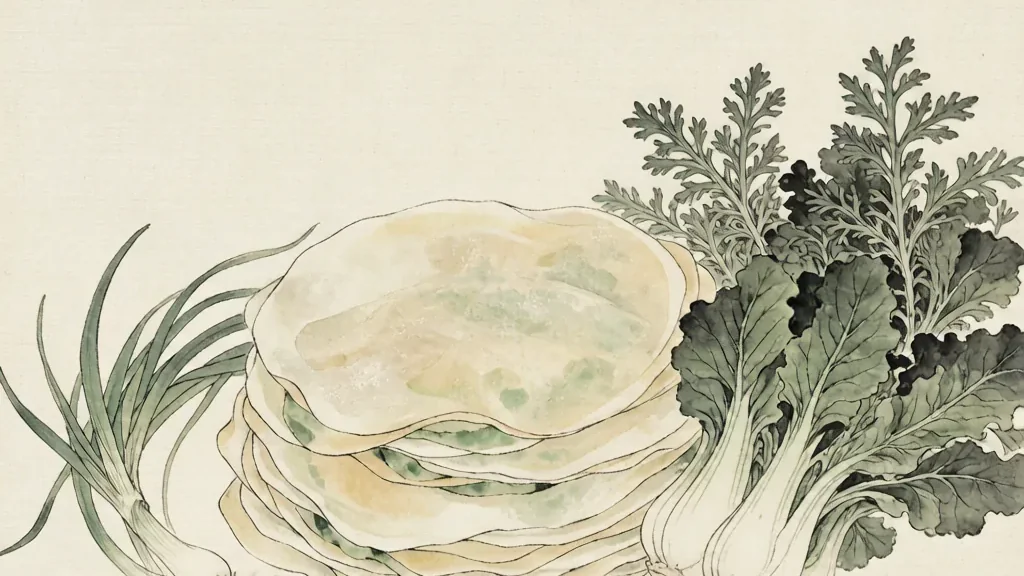
Chunbing (春饼, chūnbǐng), the "spring pancake," is a thin, unleavened wheat pancake eaten rolled around fresh spring vegetables and savory fillings to mark the arrival of spring, especially the solar term Lichun ( Beginning of Spring). Soft, pliable, and neutral in flavor, the pancake is a wrapper rather than a dish in itself: diners spread it with sweet bean sauce, tuck in blanched sprouts, scallion, shredded meat, and egg, then roll and eat. A northern Chinese tradition with roots in imperial spring ceremonies, chunbing turns the turning of the season into a hands-on, hopeful meal—the edible announcement that winter is ending and green things are returning.
The Lichun Festival
The custom centers on Lichun (立春), the first of the twenty-four solar terms, usually around February 4, signaling spring's start. In imperial China, the court held a 迎春 (welcoming-spring) ceremony in which officials ate spring pancakes and "bit the spring" (咬春, yǎochūn) by consuming fresh scallions and shoots, symbolically tasting the new season. Commoners adopted the habit, and eating chunbing at Lichun became a widespread northern tradition.
The act is symbolic as much as culinary: to eat the pancake is to participate in spring's arrival, to align oneself with the agricultural calendar. The phrase "bite the spring" captures the idea of taking in the season's vitality through its earliest greens—a small ritual of renewal.
Making the Thin Pancake
Chunbing are made from a simple dough of wheat flour and water, rolled paper-thin and cooked on a dry griddle (no oil, or a film) so they stay soft and flexible rather than crisp. A clever technique pairs two discs of dough with a dab of oil between them, rolls and cooks them as one, then peels them apart into two translucent skins—efficient and evenly thin. The finished pancake is pale, sheer, and strong enough to hold fillings without tearing.
Thinness is the craft. Too thick and the roll is doughy; too thin and it breaks. Home cooks prize the ability to stretch the skin large and even, and the best are nearly translucent. The neutral pancake is a deliberate blank, built to showcase what it wraps.
Fillings and "Biting the Spring"
The classic fillings are the first tender vegetables of the year: blanched mung-bean sprouts, shredded carrot, spinach, Chinese chives, and scallion whites, plus cooked meats such as pork, chicken, or the festival's 酱肉 (soy-braised meat). A spread of sweet bean sauce (tiánmiàn jiàng) or hoisin ties it together, and a thin egg crepe often lines the inside. The eater assembles and rolls.
The emphasis on fresh greens is the heart of "biting the spring." In a pre-modern world of stored winter vegetables, the first sprouts were a genuine novelty and a nutritional lift. The pancake thus bundled celebration and nutrition: a taste of the season's renewal.
Northern Tradition and the Imperial Legacy
Chunbing is fundamentally a northern food, tied to the wheat-growing north and its solar-term observances, distinct from the rice-based south. Historical records describe it in the Yuan and Ming periods, and Qing court life embraced the Lichun pancake as part of seasonal ritual. The tradition reflects how Chinese food is woven into the calendar, with specific dishes for specific days.
Its imperial association gave the humble pancake a refined aura, but it remained a people's food too. The same skill of rolling thin skins appears in everyday northern cooking (for roujiamo or jianbing-adjacent wraps), showing chunbing as a festive peak of a common technique.
Chunbing vs. Other Wraps
Chunbing is often confused with similar wraps. The 春卷 (chunjuan, spring roll) is a filled, deep-fried crisp roll, not a soft pancake. The 烤鸭饼 (peking duck pancake) is nearly identical in technique and is used for Beijing duck. Jianbing is a grilled crepe, different again. What unites them is the northern love of the thin wheat skin as a vehicle—chunbing is the seasonal, vegetable-forward member of this family.
Understanding the distinction matters for the eater: chunbing is soft and hand-rolled around raw-ish greens, a fresh contrast to the fried crunch of a spring roll. Both celebrate spring, but by different textures and temperatures.
Modern Observance
Today some northern families still make chunbing at Lichun, while restaurants and markets sell the skins ready-made for convenience. The ritual has faded in cities busy with modern life, but it persists as a nostalgic, healthful custom and a teaching moment about the solar terms. Social media has even revived interest, with home cooks posting their thinnest skins.
As a symbol, chunbing carries the optimism of beginnings. To roll a pancake full of the year's first greens is to wish oneself a fresh, growing year—a quiet hope folded into dough, eaten by hand at winter's edge.
Beyond Lichun
Though tied to spring, the thin pancake technique supports year-round eating: it wraps leftover braised meat, stir-fried vegetables, or duck, functioning as a versatile northern bread. In this sense chunbing is both a festival and an everyday skill, the special occasion and the daily wrap sharing one method.
That duality is fitting for a food of thresholds. Born to mark a single day, it proved useful enough to stay, reminding eaters that the rituals we keep are often just daily habits made meaningful by the calendar.
Making Chunbing at Home
The home version is approachable. Mix flour and warm water into a soft dough, rest it, then pinch off balls and roll each thin, brushing with oil and stacking in pairs before cooking on a dry skillet until flecked with spots. Peel the pair apart while warm. Fillings can be prepped ahead: blanch sprouts, shred carrots, slice scallion, and cook a little meat. At the table everyone assembles their own roll, which is half the fun.
Storing the skins is easy; they keep in the fridge and reheat wrapped in a damp cloth, so a batch can serve several meals. The technique transfers to duck pancakes and other wraps, making chunbing a gateway skill for northern Chinese bread-making and a pleasant way to mark the season with family.
❓ Frequently Asked Questions
What is chunbing?
A thin, soft unleavened wheat pancake rolled around spring vegetables and meat, eaten at Lichun.
When is it eaten?
At Lichun, the Beginning of Spring solar term, as part of welcoming the new season.
What goes inside?
Blanched sprouts, scallion, shredded carrot, meat, egg, and sweet bean sauce.
Is it the same as a spring roll?
No; chunbing is a soft hand-rolled pancake, while chunjuan is a filled, deep-fried crisp roll.
What does "bite the spring" mean?
Eating the year's first fresh greens inside the pancake to symbolically taste spring's arrival.
How is the pancake made thin?
By rolling two oiled dough discs together, cooking, then peeling them into two sheer skins.