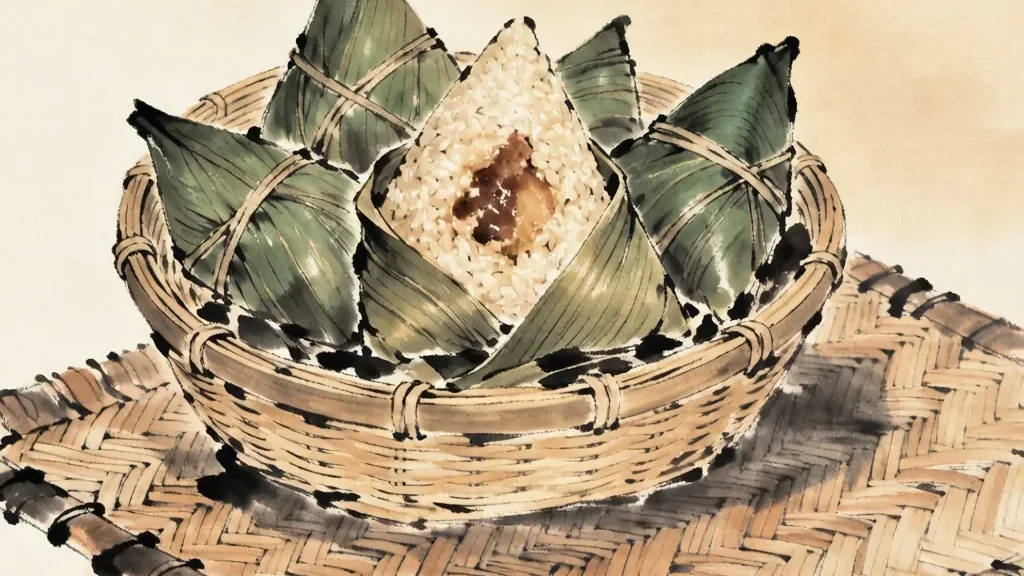
The scent reaches you before the sight — a vegetal, almost tea-like aroma that drifts through alleyways and apartment corridors each year when the fifth lunar month arrives. It's the smell of bamboo leaves steaming, releasing their essence into parcels of sticky rice that have been tied with kitchen string into neat tetrahedral pyramids. These are zongzi, the food that carries within its humble leaves one of China's most poignant legends, a story of loyalty, poetry, and a love so profound that an entire nation still throws rice into the river to honor it.
The Poet and the River
To understand zongzi, you must first meet Qu Yuan (340–278 BCE), the aristocrat-poet whose death gave birth to this 2,300-year-old tradition. Qu Yuan served as a minister in the ancient state of Chu during the Warring States period, a time of chaos and shifting alliances. He was brilliant, passionate, and utterly devoted to his kingdom. He proposed reforms to combat corruption and strengthen Chu against the rising power of Qin, but his honesty made him enemies in the court.
False accusations led to his exile. Wandering the countryside, Qu Yuan poured his despair into poetry — verses so beautiful and anguished that they would become cornerstones of Chinese literature. His most famous work, "Li Sao" (Encountering Sorrow), runs to nearly 2,500 characters and reads as a fever dream of cosmic journeys and political heartbreak. When Qu Yuan learned that the Qin state had conquered Chu's capital, he could bear no more. On the fifth day of the fifth lunar month, he clasped a heavy stone to his chest and walked into the Miluo River.
When the local people heard what had happened, they raced to the river in their boats, beating drums to scare away fish and evil spirits from the poet's body. They threw packets of rice wrapped in leaves into the water, hoping the fish would eat the rice instead of Qu Yuan. These desperate, loving gestures became the twin traditions of the Dragon Boat Festival: the racing of dragon boats, and the making of zongzi.
The Art of the Wrap
Making zongzi is not a task for the impatient. The process begins the night before, when glutinous rice is soaked until each grain swells with water, becoming pearly and tender. Bamboo leaves — or in some regions, reed leaves or lotus leaves — must be soaked and boiled to make them pliable and to release their fragrance. The filling ingredients are prepared: pork belly marinated in soy sauce and five-spice powder, salted duck egg yolks, chestnuts, dried shrimp, mushrooms, mung beans.
The wrapping itself is a geometry puzzle that Chinese grandmothers solve with muscle memory. Two or three leaves are overlapped to form a cone, which is filled with rice and the chosen fillings, then folded and tied with string into a tetrahedron shape. The technique is unforgiving — too loose, and water will seep in during cooking, turning your zongzi into a soggy mess. Too tight, and the rice has no room to expand, resulting in a dense, unyielding brick. The perfect zongzi has a taut, glossy surface, the rice grains having fused together under pressure into a cohesive but tender mass.
Once wrapped, the zongzi are simmered for hours — sometimes four, sometimes six — during which time the bamboo leaf infuses every grain of rice with its distinctive fragrance. When you finally unwrap one, the leaf peels away to reveal a glistening pyramid of amber-colored rice, the color coming from soy sauce that was mixed into the soaking water. The aroma that rises is complex: bamboo, pork fat, the earthy sweetness of chestnut, the briny tang of egg yolk.
The Great Flavor Divide: North vs. South
Zongzi reveals one of China's most delicious culinary fault lines. Northern zongzi are predominantly sweet — white rice with jujubes, red bean paste, or osmanthus-scented sugar, often dipped in honey. Southern zongzi are emphatically savory: rice seasoned with soy sauce, filled with fatty pork belly that melts during cooking, salted egg yolk, chestnut, mung beans, and shiitake mushrooms.
Between these poles lie infinite variations. Jiaxing, in Zhejiang, is famous for zongzi stuffed with pork belly so tender it collapses at the touch of chopsticks. Sichuan versions arrive laced with chili oil. Hainan wraps zongzi in banana leaves for tropical fragrance. The Hakka people make alkaline zongzi (碱水粽), where the rice is treated with alkaline water, turning translucent golden-yellow with a springy, jelly-like texture — eaten cold with sugar.
Zongzi Across Borders
The tradition has traveled far beyond China. Japan's chimaki are slender, cylindrical dumplings eaten during Children's Day. Vietnam's bánh chưng are square rice cakes essential for Lunar New Year. In Malaysia and Singapore, Nyonya zongzi represent a beautiful Peranakan fusion — rice tinted blue with butterfly pea flower, filled with candied winter melon and coriander powder.
These variations reveal something essential: zongzi are vessels of memory that adapt to their environment. Every Chinese diaspora community has brought its zongzi tradition with it, modifying recipes while preserving the essential ritual of wrapping, tying, boiling, and sharing.
More Than a Meal
In an age of fast food, zongzi stand as monuments to slowness. You cannot rush a zongzi — the rice must soak, the leaves must be prepared, the wrapping requires patience, the cooking takes hours. Zongzi-making is traditionally a family activity, multiple generations around a table piled with leaves and bowls of filling. Grandmothers teach granddaughters the precise angle of the leaf fold. The process is a form of time travel, connecting modern families to the villagers who stood on the banks of the Miluo River two millennia ago, throwing rice to protect the body of a beloved poet.
Zongzi and the Turning of Summer
The Dragon Boat Festival falls on the fifth day of the fifth lunar month, a point in the old calendar when summer heat, humidity, and disease arrived together. People called the month the 'poison month' and treated zongzi as part of a larger set of protections: the same season that brought the rice parcels also brought mugwort at the door, realgar wine, and five-colored threads for children. Eating zongzi was therefore more than a meal; it was a way to mark a dangerous turn of the year with a comforting, portable food. The leaf-wrapped rice traveled well, fed travelers, and needed no plate, which suited a holiday of riverbanks and crowds. Seen this way, the dumpling belongs to an ancient rhythm of watching the seasons and using food, scent, and ritual together to carry a household safely through the heat.
Sweet and Savory, Side by Side
Within China the zongzi divides clearly along a north-south line, and the split reveals how local taste shapes a single idea. Northern parcels favor sweetness: plain glutinous rice with red dates, red bean paste, or osmanthus sugar, sometimes finished with a dip of honey. Southern parcels turn savory, the rice seasoned with soy and packed with pork belly that melts as it cooks, plus salted egg yolk, chestnut, mushroom, or mung bean. Between the poles sit countless local spins, Sichuan's chili oil version, Hainan's banana-leaf wrap, the Hakka's alkaline, jelly-textured cake eaten cold with sugar. A first-time eater is often surprised that the same green triangle can be dessert in one province and a meaty main in another. This range is the charm of zongzi: one form, many fillings, each tied to the pantry and memory of a place.
From Home Kitchen to Factory Line
Zongzi have moved from purely homemade food to a major commercial product without losing their holiday meaning. In the past, wrapping was a family affair, with grandmothers teaching the tricky leaf fold days before the festival. Today large makers produce millions of parcels each season, vacuum-sealed and frozen so they can be shipped across the country and abroad. Supermarkets devote whole aisles to gift boxes of zongzi in spring, much as mooncakes appear before the Mid-Autumn Festival. Yet the handmade version still matters: many families keep the tradition alive, and some restaurants market 'grandma-style' wrapping as a mark of quality. The factory has made the dumpling available year-round and across oceans, but the seasonal making at home remains the moment when the food's story, of a poet, a river, and a nation's grief, gets passed to the next generation.
❓ Frequently Asked Questions
📝 Chinese Vocabulary
- 粽子 (zòngzi) — Glutinous rice dumplings wrapped in bamboo leaves
- 屈原 (Qū Yuán) — The Warring States poet whose death inspired the Dragon Boat Festival
- 端午节 (Duānwǔ Jié) — Dragon Boat Festival, celebrated on the 5th day of the 5th lunar month
- 离骚 (Lí Sāo) — "Encountering Sorrow," Qu Yuan's most famous poem
- 碱水粽 (jiǎn shuǐ zòng) — Alkaline zongzi, a Hakka specialty with a golden, translucent appearance
🎉 Fun Facts
- The world's largest zongzi, made in Guangxi province in 2018, weighed over 3,000 pounds and required a team of 30 people to wrap it — it used more than 1,000 pounds of glutinous rice.
- In some parts of China, there's a tradition of "zongzi divination" — the shape and texture of the first zongzi you unwrap on Dragon Boat Festival day is said to predict your fortune for the coming year.
- Archaeologists have found evidence of leaf-wrapped rice offerings in China dating back over 7,000 years, suggesting that the zongzi tradition may be even older than the Qu Yuan legend.
- In several regions, a few zongzi are hung by doorways or given as charms during the fifth lunar month, thought to keep misfortune away.
- Northern eaters often dip sweet zongzi in sugar or honey, while southerners dress savory ones with soy sauce or chili oil.
- The triangular parcel is sometimes said to echo the mountains Qu Yuan wandered, or simply to make a hot bundle easy to hold.