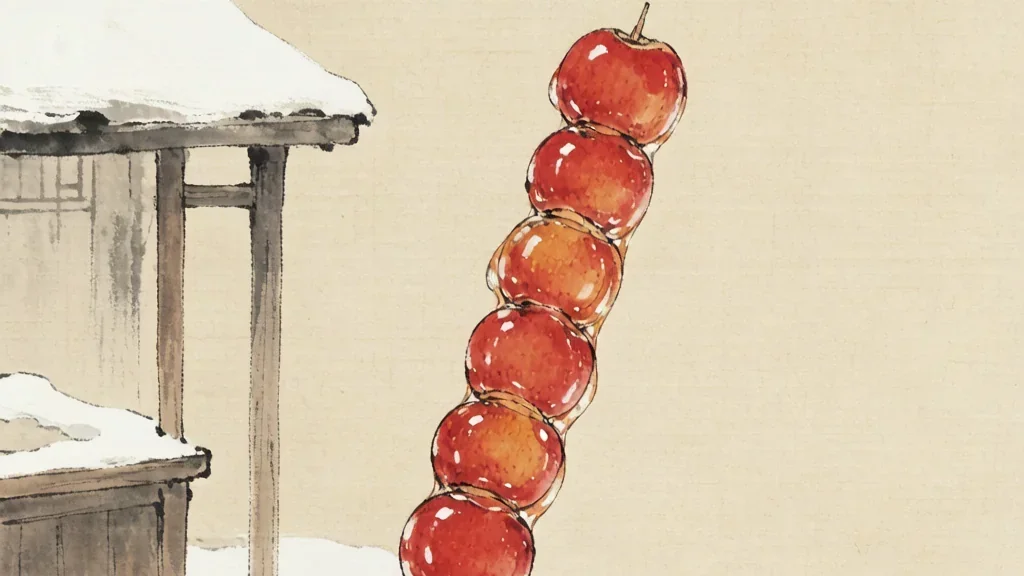
Tanghulu is the iconic northern Chinese street snack of glossy red hawthorn berries skewered on a bamboo stick and coated in a hard, glassy shell of caramelized sugar. Crisp at first bite, then sweet-tart from the fruit within, it is a winter sight along the hutongs and night markets of Beijing and across the northeast, where vendors carry tall bundles of the glistening red spears. Though hawthorn is the classic filling, modern tanghulu may enrobe grapes, strawberries, cherry tomatoes, or mandarin segments. Beloved for its simple contrast of brittle sugar and sour fruit, tanghulu is both a child's treat and a nostalgic emblem of old Beijing, its making a small performance of sugar work practiced by street hawkers for centuries.
What Tanghulu Is
The word tanghulu combines tang, "sugar," and hulu, "bottle gourd" — the latter referring to the shape of the skewered fruit cluster, which early versions sometimes arranged to evoke a gourd. The result is a candied fruit on a stick, the Chinese cousin of a lollipop built around whole fruit rather than a flavored disc.
Classic tanghulu uses 5 to 8 haws threaded onto a straight stick, dipped in hot sugar syrup that sets into a thin, crackling coat. The appeal is textural: the snap of sugar giving way to the soft, sour pulp. It is eaten by biting or nibbling down the stick, fruit by fruit.
Historical Background
Tanghulu's origins are often placed in the Song dynasty, with popular legends crediting it to a court physician who cured an imperial family member's ailment with sugared hawthorn, or to northern commoners who candied the abundant wild haws to preserve them. Whatever the exact start, candied haws became a staple winter street food in Beijing and Hebei.
Old Beijing descriptions from the Qing dynasty onward mention tanghulu sellers crying their wares in the cold months, and the snack appears in memoirs and fiction as a fixture of the city's soundscape. Its survival as a street tradition makes it a living link to pre-modern urban food culture.
The Hawthorn Berry
The traditional fruit, shan zha (hawthorn), is small, bright red, and intensely tart, with a dense flesh and a few seeds. It is valued in Chinese foodways not only for flavor but for a reputed ability to aid digestion, which is why hawthorn products — teas, jellies, and candies — follow rich meals. The sourness is exactly what makes it suit sugar coating.
Hawthorn's astringency means a bare berry is too sharp for many; the sugar shell balances it. This sweet-sour partnership is the essence of tanghulu and explains why the fruit, rather than a sweeter one, remained standard for so long.
How Tanghulu Is Made
The technique is a brief, precise sugar cook. Sugar and a little water (sometimes with a drop of vinegar or corn syrup to prevent crystallization) are boiled to the "hard crack" stage, then the strung haws are quickly dipped and turned so a thin film forms. Exposed to cold air, the syrup sets almost instantly into a brittle, translucent shell.
Timing and temperature matter: too low and the coat is sticky; too high and it browns or tastes burnt. Street vendors master the window by eye and weather, since winter cold helps the shell set. The best tanghulu shatters cleanly rather than clinging to the teeth.
Variations and Fillings
While hawthorn is canonical, vendors now coat many fruits. Grapes, strawberries, pineapple chunks, mandarin oranges, and even cherry tomatoes appear, often mixed on one stick for color. A "filled" style injects the haw with red-bean paste or replaces the sour center with something sweeter for children.
In some regions a dusting of crushed peanuts or sesame is added, or the sugar is tinted. Despite novelty, purists hold that true tanghulu is hawthorn alone, its red-on-red elegance the point. The variations mainly broaden appeal without changing the candy logic.
Regional Presence
Tanghulu is above all a northern and northeastern snack, tied to the cold climates where haws grow and where a hard sugar shell sets readily. Beijing's Wangfujing and Qianmen areas are famous for tanghulu sellers, and the snack is common in Tianjin, Harbin, and across Hebei and the northeast.
In the south it is less native, though tourist areas and night markets now sell it. The dish's identity remains bound to the winter streets of the north, where the sight of a vendor's tall straw target studded with red skewers is a seasonal signal.
Cultural Symbolism
Beyond snack status, tanghulu is a token of old Beijing nostalgia, invoked in films, songs, and memoirs as a sensory memory of childhood and courtyard life. Its bright red color aligns with Chinese associations of red with luck and festivity, making it a fitting treat around the lunar new year.
For the diaspora and for domestic tourists, buying tanghulu is a way to "consume" tradition performatively. The snack thus carries more than sugar: it is a small, edible heritage object, a bite of the city's past available on any winter evening.
Tanghulu in Folklore and Song
Beyond the street, tanghulu appears in old Beijing folk songs and children's rhymes that mimic the vendor's call, preserving the snack in oral culture. Memoirs of republican-era Beijing recall the sound of the seller's bamboo clapper and the sight of his straw target studded with red spears as a defining sensory memory of winter.
The snack also features in period films and television as a visual shorthand for a bygone street life, its bright red skewers evoking nostalgia for a slower city. In this way tanghulu functions as a small cultural artifact, carrying the texture of the past into the present through taste and image.
Modern Street Culture
Today tanghulu thrives at night markets, temple fairs, and ice festivals, often photographed as much as eaten. Social media has amplified its visual appeal — the glossy red spears read well in pictures — and vendors sometimes build artistic displays.
Packaged or machine-made versions exist, but the hand-dipped street original remains prized for freshness and the theatrical dip. The snack's endurance shows how a minimal technique, well matched to its fruit and climate, can outlast trends and remain a genuine folk food.
❓ Frequently Asked Questions
What is tanghulu?
It is a northern Chinese street snack of hawthorn berries on a stick coated in a hard, glassy shell of caramelized sugar.
Is tanghulu very sweet?
The sugar coat is sweet, but the hawthorn inside is tart, so the overall taste is a sweet-sour balance.
What fruit is used in tanghulu?
Traditionally hawthorn; modern versions also use grapes, strawberries, mandarin, pineapple, or cherry tomatoes.
Where is tanghulu from?
It is a northern Chinese specialty, especially associated with Beijing and the northeast, sold in winter.
How is the sugar shell made?
Sugar syrup is boiled to hard-crack stage and the skewered fruit is quickly dipped so it sets brittle in the cold.
Why is tanghulu culturally important?
It is a nostalgic emblem of old Beijing and a festive red treat, evoking childhood and courtyard-life memory.