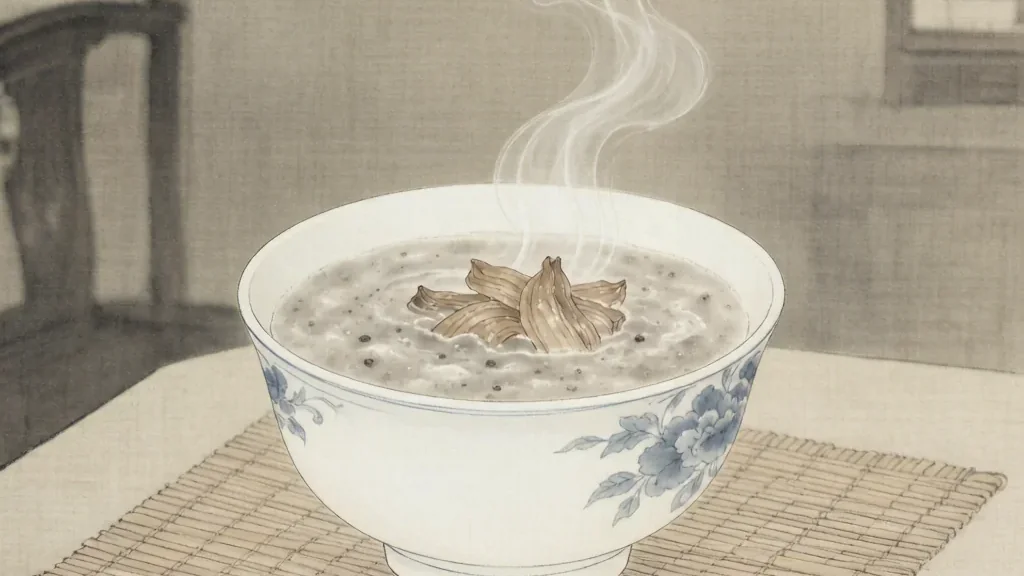
Douzhi (豆汁, dòuzhī) is Beijing's most notoriously acquired taste: a thin, grayish-green fermented drink made from the watery byproduct of mung-bean starch production, left to sour naturally until it develops a pungent, tangy, almost cheese-like aroma that first-timers often find startling. Served hot in a bowl, usually with a ring of fried dough (jiaoquan) or a crispy pastry for dipping, it is the city's oldest working-class breakfast and, alongside luzhu and chaogan, one of the three "challenge" foods that locals use to prove their Beijing credentials. Loved loyally by natives and baffling to nearly everyone else, douzhi is less a beverage than a badge of belonging to the old capital.
By-Product of Mung-Bean Starch
Douzhi begins with mung beans (lǜdòu) processed into starch for cellophane noodles (fěnsī) and sheets. The cloudy soaking and grinding water left behind is not discarded but fermented—left to sit and sour over time, during which lactobacteria transform it into a lightly alcoholic, sharply acidic liquid. What is waste to starch-makers becomes a treasured drink to Beijingers, a classic example of thrift turning discard into delicacy.
The fermentation is uncontrolled and traditional, relying on ambient microbes rather than a pure culture. This is why douzhi's flavor is inconsistent batch to batch and why attempts to industrialize it have struggled to reproduce the alley version. The grayish, faintly effervescent result is unlike any other Chinese drink.
Acentury-Old Beijing Breakfast
The drink's history in Beijing reaches back to the Qing dynasty, when it was the cheap sustenance of laborers and the poor in the city's southern and eastern districts. By the Republican era it was a fixture of dawn markets, sold from insulated buckets and eaten standing at a stall with a fried snack. Emperors reportedly drank a refined version, but the people's douzhi remained resolutely humble.
Its working-class roots explain both its prestige and its stigma. To enjoy douzhi was, for generations, simply what Beijing's poor did to start the day; to enjoy it still, amid abundance, is a conscious claim of authenticity. The drink is memory more than refreshment.
The Smell and the Taste
Douzhi's reputation rests on its aroma, which veterans describe as richly fermented and newcomers often compare to ripe cheese, spoiled grain, or a barn. The taste itself is sour, savory, and mildly funky rather than offensive—many say the smell is far worse than the flavor. Sipped hot, it is thin and warming, more broth-like than juice, with a clean sour finish that some find addictive.
The gap between odor and taste is the crux of the douzhi experience. Those who push past the first whiff often discover a bracing, palate-cleansing sourness. Veterans advise holding the nose on the first bowl and trusting the second; devotion usually follows.
How It Is Served
Traditionally douzhi is heated but not boiled (boiling spoils the ferment), then poured into a bowl and eaten with a 焦圈 (jiaoquan), a small crunchy fried ring, or a 咸菜 (salt pickle) and a 烧饼 (shaobing). The crispy, neutral snack offsets the sour liquid and gives the meal texture. A skilled drinker dips the jiaoquan and sips alternately, finishing the bowl while it is still hot.
The pairing is functional: starch and salt tame the acidity and make a light breakfast filling. Shops that serve douzhi almost always sell these companions, and the set is the authentic way to encounter the drink rather than alone.
Cultural Status as a "Challenge" Food
Douzhi sits atop Beijing's hierarchy of challenge foods. With luzhu and chaogan it forms a trio that locals deploy to test outsiders: lasting a bowl of each is, jokingly, the citizenship test of the capital. The drink's difficulty is precisely its value—easy pleasures need no loyalty, but a hard one forged through the nose binds the drinker to place.
This role has grown as old Beijing shrinks. Douzhi has become a deliberate act of cultural preservation, drunk by younger natives to feel connected to a vanishing alley world. Its survival is less about nutrition than about identity performed one soured sip at a time.
Modern Survival
Today douzhi is harder to find than before, concentrated in a few old shops and temple fairs, though bottled and canned versions exist for the nostalgic. The famous 锦馨 (Jinxin) and 尹三 (Yin San) stalls still draw queues of regulars and curious tourists. Hygiene modernization has cleaned up preparation without, devotees hope, sanitizing away the soul.
AsBeijing changes, douzhi stands as edible resistance to uniformity. It will likely never be beloved by all, and that is fine with its fans, who guard its difficulty as a virtue. A city that kept its sour morning drink is a city that remembers who it was—and douzhi is that memory, poured hot.
Nutrition and Fermentation
As a fermented drink, douzhi contains lactobacillus and is low in calories, which partly explains its historical role as a light, digestible breakfast. The fermentation also makes some nutrients more available and gives the sour tang. It is not alcoholic despite the ferment, and contains no dairy. Traditional preparation is natural, though modern bottling standardizes safety.
The sourness can aid appetite in hot weather, and Beijingers value it as a morning starter that wakes the palate. Like other fermented foods, it divides opinion by gut familiarity; those raised on it crave the tang, while newcomers need several tries. Its health profile, modest and traditional, is a minor reason for its endurance compared with identity.
Where to Try It
In Beijing, douzhi is found at old-name snack shops and seasonal temple fairs rather than trendy malls. Famous stalls draw both loyal elders and brave tourists curious about the legend. Order it with jiaoquan and a pickle, eat it hot, and accept that the smell is the point. A first bowl is a rite of passage more than a refreshment.
Outside the capital, the drink is scarce, which adds to its local mystique; canned versions let the curious taste it abroad but lack the fresh stall's character. To understand old Beijing, many say, you must at least attempt a bowl of douzhi—the city's sour, humble, defiant morning greeting.
❓ Frequently Asked Questions
What is douzhi?
A hot, fermented drink made from the sour byproduct of mung-bean starch making, traditional in Beijing.
Why does it smell so strong?
Natural lacto-fermentation produces a pungent, cheese-like aroma that veterans love and newcomers find intense.
What does it taste like?
Sour, savory, and mildly funky; many say the flavor is gentler than the smell suggests.
How is it eaten?
Hot in a bowl, with a crispy jiaoquan ring or pickle and shaobing for dipping.
Is it safe?
Yes; it is a traditional fermented food, and reputable shops prepare it hygienically.
Why is it a Beijing thing?
It grew from the capital's working-class alleys and is now a marker of old-Beijing identity.