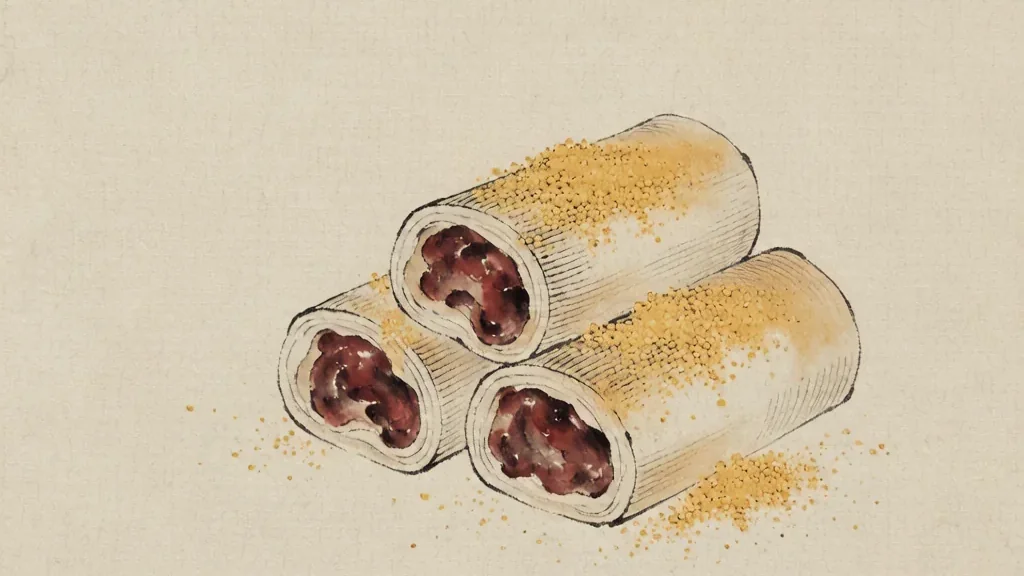
Among the gentle, sweet snacks of old Beijing, few have a name as playful as lǘ dǎ gǔn (驴打滚), the "rolling donkey." It is a soft roll of glutinous rice flour coated in toasted soybean flour, with a red bean paste center, and its name comes from the way the finished roll is tumbled in golden soy powder — evoking a donkey rolling in dust. Chewy, mildly sweet, and faintly nutty from the soy, it is a staple of Beijing's traditional pastry (gāodiǎn) shops and a beloved treat at temple fairs. Lvdagun is a small masterpiece of northern Chinese snack craft, showing how a handful of humble ingredients — rice, beans, soy — can become something with texture, story, and a smile built in.
What Is Lüdagun?
Lüdagun is made by steaming a sheet of glutinous rice flour (nuòmǐ) dough, spreading it with sweet red bean paste (dòushā), rolling it into a log, and then coating the outside with roasted soybean flour (dòufěn). Sliced into rounds, each piece shows a pale rice spiral around a dark bean center, dusted in tan soy powder. The texture is chewy and soft, the flavor gently sweet with a toasty, almost peanut-like note from the soy flour. It is served at room temperature or lightly chilled.
Unlike fried pastries, lvdagun is steamed and rolled, making it comparatively light. The soybean flour is not just decoration; it adds a dry, nutty coating that keeps the sticky rice from clinging to everything and contributes much of the flavor. The combination of chewy rice, smooth bean, and toasty soy is the dish's signature trio, and it explains why it endures as a comfort sweet rather than a festival-only showpiece.
The Name and the Donkey
The name "lü dagun" literally means "donkey rolls," and the story is charmingly literal. After the red-bean-filled rice roll is formed, it is rolled in roasted soybean flour, sending up a little cloud of golden powder that resembles a donkey kicking up dust as it rolls on the ground. The image stuck, and the snack has carried the name ever since. It is a rare case where a Chinese dessert is named for a farmyard animal rather than an ingredient or occasion.
Some folk explanations add that the donkey was a common working animal in old Beijing, and the dusty rolling motion was familiar to anyone who watched beasts of burden rest in the lanes. Whether or not the etymology is precise, the name captures the humor and earthiness of northern folk food culture, where a snack can be both delicious and a small joke. The playful name also makes it memorable to children, ensuring its place in the city's sweet repertoire.
Origins in Old Beijing
Lüdagun is a traditional snack of the Manchu and Han cultures of the northeast that became naturalized in Beijing, especially popular during the Qing dynasty. It belongs to the broader family of "lǘ dǎ gǔn" and similar steamed rice rolls found across northern China, often sold at temple fairs (miào huì) and by itinerant vendors. Its ingredients — glutinous rice, red bean, soybean — are staples of the northern pantry, which made it accessible to ordinary households.
Over time it became a fixture of Beijing's "gāodiǎn" (traditional pastry) shops and a souvenir for visitors to the capital. Today it is sold in the city's historic districts and at cultural festivals, often alongside other old snacks like aiwowo and tanghulu. Its survival is a quiet testament to the continuity of northern snack culture, even as Western-style desserts flood the market.
How Lüdagun Is Made
The method is straightforward but demands timing. Glutinous rice flour is mixed with water and steamed into a pliable sheet, which is then cooled slightly so it can be handled. A layer of smooth red bean paste is spread over the surface, and the sheet is rolled tightly from one edge into a log. The log is then rolled in a tray of toasted soybean flour until fully coated, and cut into slices.
The key skills are steaming the rice to the right tenderness — too dry and it cracks, too wet and it sticks — and toasting the soy flour to a deep golden color without burning, which develops the nutty aroma. Home cooks can replicate it with a steamer and a non-stick surface, though achieving the silky bean paste takes practice. Because it keeps well at cool room temperature, lvdagun is also a practical make-ahead treat.
Lüdagun in Beijing Snack Culture
In Beijing's taxonomy of traditional snacks (collectively called "Běijīng xiǎochī"), lvdagun sits among the sweet, steamed, rice-based treats rather than the savory breakfast items. It is the kind of thing eaten as an afternoon bite, a festival purchase, or a gift box component. Its mild sweetness makes it approachable even to those wary of strongly flavored Chinese sweets, and its chewiness is satisfying without being heavy.
The snack also travels well in the sense of representing Beijing elsewhere: tourists buy it as a taste of the old capital, and it appears in museum shops and heritage markets. Alongside aiwowo and tanghulu, lvdagun forms part of the "old Beijing sweet trio" that vendors once cried through the hutongs. To eat one is to take a small bite of the city's folk memory, complete with its donkey joke.
Lüdagun Among Northern Rice Snacks
Lüdagun belongs to a wider northern family of steamed, roll-shaped rice sweets that turn humble glutinous rice into soft, giftable treats. Close cousins include aiwowo, a steamed ball of rice coated in dry rice flour and filled with sweet paste, and various rolled gao cakes pressed with nuts and fruit. What sets lvdagun apart is its bath of toasted soybean flour, which gives a nutty coat no other rice sweet quite matches. Across Hebei, Beijing, and the northeast, these snacks appear at temple fairs and festivals as a gentle, not-too-sweet counterpoint to fried street food. Together they form a recognizable category of northern folk confectionery, humble in ingredient but rich in memory, and lvdagun is among the most charming ambassadors of the group.
Serving and Storing Lüdagun
Unlike fried pastries, lvdagun is best at cool room temperature or lightly chilled, which firms the rice and keeps the soy coating dry. It travels well, which is why it became a natural festival gift and a component of mixed sweet boxes rather than a strictly make-and-eat snack. Because it contains no egg or dairy, it keeps longer than many desserts, though it should be eaten within a day or two for the best texture. At home, leftover pieces can be loosely covered and refreshed briefly at room temperature before serving. Vendors often slice the log to order so each round shows its pale spiral and dark center, a small visual promise of the chewy, mildly sweet bite inside.
Modern Twists on a Folk Sweet
Old Beijing snacks have found new life in the city's cafes and heritage shops, and lvdagun is no exception. Some modern makers swap the classic red bean for sesame, mashed date, taro, or even matcha paste, while keeping the toasted soy coat that defines the original. Boutique shops sell neatly boxed sets aimed at young buyers and tourists, and a few dessert cafes plate lvdagun with a drizzle of honey or a scoop of ice cream. Yet the traditional version still dominates at temple fairs and old-style pastry counters, where the playful donkey name and the dusty soy roll remain part of the charm. The result is a folk sweet that feels both nostalgic and current, bridging grandmother's kitchen and the gift shop shelf.
❓ Frequently Asked Questions
📝 Chinese Vocabulary
驴打滚 — : rolling donkey (soybean-coated rice roll).
糯米 — : glutinous rice flour.
豆沙 — : red bean paste.
豆面 — : roasted soybean flour.
小吃 — : snack / small eats.
老北京 — : Old Beijing, the city most associated with lvdagun.
庙会 — : Temple fair, a traditional venue for selling lvdagun.
艾窝窝 — : Aiwowo, a related old Beijing steamed rice sweet.
🎉 Fun Facts
- The name comes from the golden soy flour puffing up like dust as the roll is tumbled — a donkey rolling on the ground.
- Lüdagun is part of the traditional Beijing "xiaochi" (snacks) family sold at temple fairs for centuries.
- The toasted soybean flour both flavors the roll and keeps the sticky rice from clinging to fingers.
- It is one of the few Chinese sweets named after an animal rather than an ingredient or festival.
- Although it looks delicate, lvdagun keeps surprisingly well at cool room temperature, which is why it became a practical gift and festival box item rather than a make-and-eat-only sweet.
- Some Beijing families still make lvdagun at home for the Spring Festival, treating the rolling-in-soy step as a small family ritual that children love to help with.