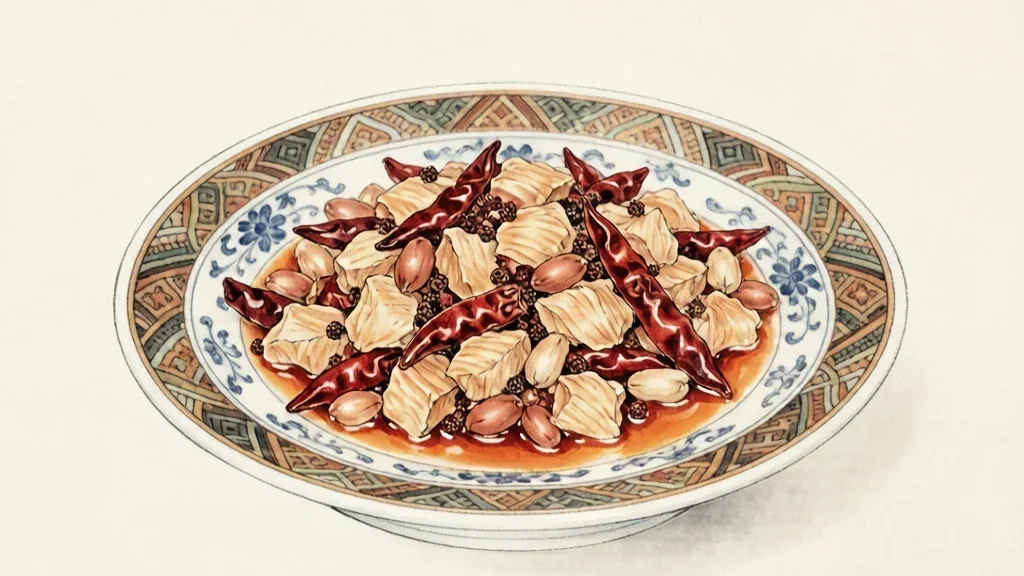
Gong Bao ji ding (宫保鸡丁, Gōngbǎo jīdīng) is the pinyin spelling of the dish widely known in English as Kung Pao chicken—diced chicken stir-fried with roasted peanuts, dried chili, and Sichuan peppercorn in a sweet-sour, faintly numbing sauce. The name commemorates Ding Baozhen (丁宝桢), a Qing official of the nineteenth century whose honorary title "Gong Bao" (Palace Guardian) became attached to the recipe associated with his household. As a model of Sichuan's "lazhi" (fragrant-chili) flavor, it teaches the central lesson of the cuisine: that heat, numbness, sweetness, and sourness can be tuned into a single harmonious bite. It is at once home cooking, restaurant standard, and global ambassador.
Etymology of the Name
The characters 宫保 are an official title, not a cooking term; "ji ding" (鸡丁) means diced chicken. The full name therefore reads "Palace Guardian's diced chicken," a honorific rather than a description of method.
The title derives from Ding Baozhen's grant of "Tai zi shao bao" (太子少保), a court rank commonly shortened in speech to "Gong Bao." Dishes linked to his table took the name, and it stuck even as the man was forgotten by most diners.
This naming pattern—attaching an official's title to a recipe—reflects how Qing food culture mingled bureaucracy and the kitchen.
The Historical Figure: Ding Baozhen
Ding Baozhen (1820–1886) was a scholar-official from Guizhou who served as governor of Shandong and later viceroy of Sichuan. He was known as an able administrator and a patron of public works, and anecdotes credit him with a personal taste for chicken with chili and peanuts.
Whether he invented the dish or merely enjoyed a version of it, the association is fixed in the name and in local Sichuan lore. Food historians treat the precise origin as legendary rather than documented.
What matters culturally is that the dish carries a person's name and rank into every kitchen that makes it—a small biography in a bowl.
Ancestry and Influence
The Gong Bao flavor sits within Sichuan's "lazhi" (糊辣, toasted-chili) family, which builds aroma by frying dried chili in oil without burning it. Some scholars suggest the dish absorbed techniques from Guizhou and Shandong during Ding's career, blending them in the Sichuan wok.
Regardless of lineage, by the late Qing it was recognized as a Sichuan preparation and later codified among the cuisine's classic compound flavors. Its portability helped it spread along trade and migration routes.
The dish thus exemplifies how regional Chinese cooking borrows and synthesizes across provincial lines.
Ingredients in Detail
The protein is boneless chicken thigh, diced small and often "velveted" with egg white and starch so it stays silky under fierce heat. Peanuts are roasted separately to keep them crisp and added at the end.
Aromatics are deliberately few—scallion whites, sometimes ginger—so the chili and pepper lead. The sauce marries soy, vinegar, sugar, and a little stock, thickened just enough to glaze.
Sichuan peppercorn (huā jiāo, 花椒) is the signature addition, lending a citrusy numbness (má) distinct from chili's burn.
The "Lizhi Kou" Flavor
Cooks describe the target balance as "lizhi kou" (荔枝口, "lychee profile"): sweet first on the tongue, then sour, with chili fragrance behind and a tingle on the lips. The name evokes the lychee's sweet-then-acid bite, not its flavor.
Achieving it demands restraint. The vinegar must be added off the strongest heat so its brightness survives; the sugar must round without dominating; the chili must perfume, not scorch.
This precise tuning is why Gong Bao is taught as a benchmark of a cook's control over Sichuan seasoning.
The Peanuts
Roasted peanuts are not garnish but structural: their crunch against tender chicken and the snap of chili defines the bite. They also carry a faint bitterness that keeps the sweet-sour sauce from floating.
Southwestern Chinese cooking uses peanuts freely, and their inclusion marks the dish's regional roots. Allergen versions substitute cashews or omit nuts, but the classic insists on peanuts.
The nuts must be added last and kept whole, so each mouthful contains meat, chili, and a satisfying crack.
Technique: The Fast Stir-Fry
Gong Bao is a "bao" (爆) dish—extremely hot, extremely fast. The wok is heated until smoking, the chicken seared in seconds, then chili and peppercorn bloomed in the oil to release aroma before the pre-mixed sauce hits.
The sauce reduces almost instantly to a gloss, peanuts and scallion go in, and the dish is plated at once. Total cooking is a couple of minutes; lingering steams the chicken and dulls fragrance.
The method rewards preparation: because there is no time to chop mid-cook, everything is measured and ready before the fire starts.
Status in Sichuan Cuisine
Gong Bao ji ding is listed among the representative dishes that define Sichuan cooking for outsiders, alongside mapo tofu and twice-cooked pork. It is taught early to culinary students as a lesson in balanced "lazhi" seasoning.
At home it is weeknight fare; in restaurants it is a safe, beloved order. Its moderate heat makes it a bridge dish for those new to the cuisine's numbing extremes.
The dish's clarity—few ingredients, perfect balance—makes it a touchstone against which other stir-fries are measured.
Home Cooking vs Restaurant
Home versions often use less oil and sugar than restaurant or takeout ones, leaning on vinegar and aromatics. The chicken may be breast rather than thigh, though thigh is preferred for moisture.
Restaurant versions aim for theatrical gloss and consistent heat, sometimes toning down the Sichuan pepper for broad appeal. Tourist-oriented shops may offer a sweeter "Western" style alongside the authentic one.
Both belong to the same dish; the differences trace the journey from Sichuan kitchen to global table.
Global Journey
Carried by emigrants, Gong Bao became a pillar of "Chinese restaurant" menus worldwide, usually sweeter, saucier, and milder than the original. That adaptation introduced millions to Chinese food and, often, to Sichuan pepper.
The dish's fame also fed curiosity back home and abroad about "real" Sichuan cooking, helping fuel the global rise of regional Chinese cuisine in the late twentieth century.
Today one can eat a scrupulously traditional Gong Bao in Chengdu and a candy-sweet Kung Pao in a Midwestern food court—same name, two cuisines, one long story.
❓ Frequently Asked Questions
Why is it called Gong Bao?
It commemorates Ding Baozhen, a Qing official whose honorary title "Gong Bao" (Palace Guardian) was attached to the dish linked to his household.
How is it different from Kung Pao chicken?
It is the same dish; "Gong Bao" is the pinyin spelling and "Kung Pao" the older postal romanization found on English menus.
What is "lizhi kou"?
The "lychee profile"—the intended sweet-then-sour balance with chili fragrance and a numbing tingle from Sichuan pepper.
Is the numbness required?
In the authentic Sichuan version, yes—Sichuan peppercorn is essential to the character, though milder export versions reduce it.
Why peanuts?
They provide the crucial crunch and a slight bitterness that balances the sweet-sour glaze; they are traditional and structural.
What chicken is used?
Boneless thigh, diced small and often velveted with egg white and starch to stay tender under high heat.