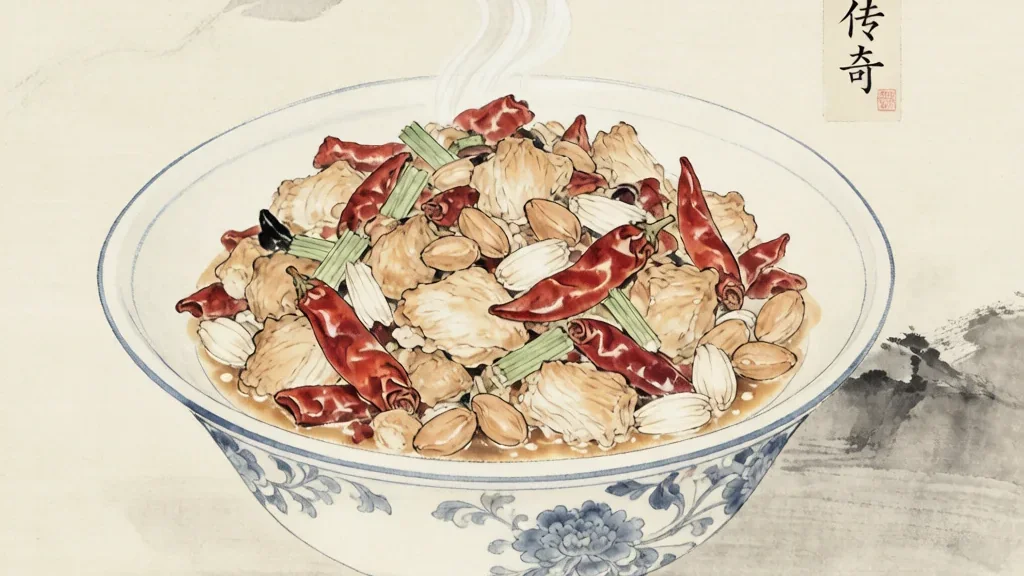
Kung Pao chicken—Gong Bao ji ding (宫保鸡丁, Gōngbǎo jīdīng) in Mandarin—is one of the most recognizable Chinese dishes in the world, a stir-fry of diced chicken, roasted peanuts, and dried chili peppers in a glossy sweet-sour, gently numbing sauce. The name honors Ding Baozhen, a Qing-dynasty official whose honorary title "Gong Bao" (Palace Guardian) became attached to the dish he supposedly favored. Equal parts homestyle comfort food and global ambassador, Kung Pao chicken shows how a provincial Sichuan stir-fry crossed oceans, adapted to local palates, and returned home as a familiar "Chinese restaurant" icon while remaining rooted in the aromatics of its native cuisine.
Name and Romanization
"Kung Pao" is the older postal-style romanization of 宫保 (Gōngbǎo), an official title meaning roughly "Palace Guardian." The full Chinese name, 宫保鸡丁, means "Palace Guardian's diced chicken." English menus long used "Kung Pao," and the spelling stuck even as pinyin became standard.
The "ji ding" (鸡丁) simply means diced chicken, referring to the small uniform cubes that cook quickly and evenly in a hot wok. The dish is sometimes listed as "Gong Bao chicken" on modern menus using pinyin.
Either spelling points to the same stir-fry of chicken, peanuts, and chili—a dish whose name is itself a small piece of Qing bureaucratic history.
The Official Behind the Name
Ding Baozhen (丁宝桢, 1820–1886) was a Qing official from Guizhou who served as governor of Shandong and later viceroy of Sichuan. He was granted the honorary title "Tai zi shao bao" (太子少保), commonly shortened to "Gong Bao," and dishes associated with his household took the name.
Stories credit Ding with a fondness for a stir-fry of chicken and peanuts, and with encouraging the combination of chili and the numbing Sichuan pepper. As with many origin tales, the details are legendary rather than documented, but the link to his title is firm in the dish's name.
What is certain is that by the late Qing the dish was known in Sichuan and beyond as a "Gong Bao" preparation, a name that traveled with the cuisine.
Core Ingredients
The trinity at the heart of the dish is diced chicken thigh (more flavorful and forgiving than breast), roasted peanuts, and dried red chili. To these Sichuan peppercorn adds the characteristic tingling numbness (má) that distinguishes the authentic version.
Aromatics are minimal—usually scallion whites, sometimes garlic and ginger—so the chicken, chili, and pepper stay center stage. The peanuts are added near the end so they stay crunchy.
Good versions use bone-in flavor logic translated to boneless cubes: the meat is velveted with a little egg white and starch so it stays tender under high heat.
The Flavor Profile
Authentic Kung Pao balances several sensations at once: mild heat from dried chili, the citrusy tingle of Sichuan pepper, a sweet-sour lift from sugar and vinegar, and a savory base from soy and chicken. Cooks call the target a "lazhi" (fragrant chili) and "lizhi kou" (lychee-profile) sweetness—sweet first, then sour.
Crucially, the dish is aromatic rather than brutally hot. The chilies are often fried briefly in oil to release fragrance without burning, and many are left whole to perfuse rather than scorch the palate.
This balance is why the dish travels so well: it has personality without demanding a tolerance for extreme spice.
Cooking Technique
Kung Pao is a "bao" (quick stir-fry) dish. The wok is heated smoking-hot, the chicken seared fast to keep it tender, then the chilies and peppercorns are tossed in to bloom their aroma before the sauce hits.
The sauce—a pre-mixed combination of stock, soy, vinegar, sugar, and starch—is poured in and reduces in seconds to a glossy coat. Peanuts and scallion go in last, and the dish is plated immediately while hot and fragrant.
Speed and heat are everything; lingering steams the chicken and dulls the chili perfume, so the whole stir-fry takes only a couple of minutes.
The Peanuts Question
Peanuts are non-negotiable in the classic recipe, providing the crunch that plays against the tender chicken and the snap of chili. They also reflect the dish's southwestern roots, where peanuts are a common garnish.
Some regional or allergenic adaptations swap in cashews or omit nuts entirely, but purists hold that the roasted peanut is essential to the texture and the rustic character.
The nuts also carry a subtle bitterness that rounds the sweet-sour sauce, a quiet contribution easy to miss but missed when absent.
From Sichuan to the World
Chinese immigrants carried the dish abroad in the nineteenth and twentieth centuries, where it entered the "Chinese restaurant" canon alongside chop suey and fortune cookies. Abroad it often arrived sweeter, saucier, and milder than at home.
American Kung Pao routinely leans sweet and glossy, sometimes with bell peppers and a heavier hand on the cornstarch, a version many Chinese-Americans now recognize as distinct from the Sichuan original.
Yet the global fame also fed interest back home, and today chefs in Chengdu and beyond serve both the traditional tingling version and a "Western-style" sweet one for tourists.
Variations and Relatives
The Gong Bao formula extends to other proteins: shrimp, fish, or tofu can stand in for chicken, each keeping the chili-peanut frame. Vegetarian versions use pressed tofu or mushrooms.
Close cousins include yuxiang (fish-fragrant) dishes and other "lazhi" stir-fries that share the fragrant-chili logic. The Kung Pao idea—quick, aromatic, nutty—proved endlessly adaptable.
Regional Chinese kitchens also tweak the heat and sourness, so a Chengdu bowl differs from a Beijing one, and both differ from a Californian one.
Cultural Status Today
In China, Kung Pao chicken is a standard of home cooking and restaurant menus alike, taught to beginning cooks as a model of balanced seasoning. It is also listed among the dishes representing Sichuan cuisine to outsiders.
Internationally it is a gateway Chinese dish—familiar, safe, and satisfying—often the first "real" Chinese stir-fry a newcomer tries. Its name alone signals "Chinese food" in many languages.
That dual identity, local staple and global emblem, is precisely what makes it a useful lens on how cuisines travel.
Nutrition Notes
Chicken thigh provides protein and the peanuts add healthy fats and a little fiber, making the dish more substantial than many vegetable stir-fries. The main cautions are added sugar, oil, and sodium in the sauce.
Home cooking controls these easily: use less sugar and oil, lean on vinegar and aromatics for punch, and keep the peanuts for satiety. A lighter version keeps the flavor while trimming the calorie load.
Eaten with rice and a green vegetable, Kung Pao makes a balanced meal rather than a guilty takeout indulgence.
❓ Frequently Asked Questions
What does "Kung Pao" mean?
It is an older romanization of 宫保 (Gōngbǎo), an honorary Qing official title held by Ding Baozhen, after whom the dish is named.
Is Kung Pao chicken very spicy?
Authentically it is aromatic with mild heat and a numbing tingle from Sichuan pepper; restaurant versions abroad are often sweeter and milder.
Why are there peanuts in it?
Roasted peanuts add the essential crunch and a slight bitterness that balances the sweet-sour sauce; they are traditional and expected.
What cut of chicken is used?
Boneless chicken thigh, diced small and often velveted with egg white and starch so it stays tender under high heat.
Can it be made vegetarian?
Yes, tofu or mushrooms can replace the chicken while keeping the chili-peanut frame, though it then loses the "ji ding" name.
How is it different from Gong Bao chicken?
They are the same dish; "Kung Pao" is the older spelling and "Gong Bao" the pinyin form found on modern menus.